E-Paper



Congress' media struggle: Party has tough job countering Modi's advantage
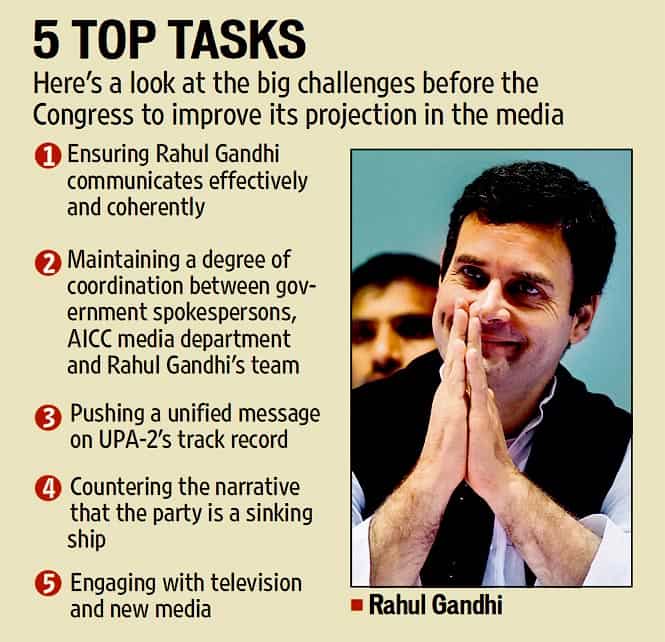
Congress vice-president Rahul Gandhi’s debut television interview last week, and the reactions it triggered, have brought the focus back on the party’s difficult relationship with the media.


Congress vice-president Rahul Gandhi’s debut television interview last week, and the reactions it triggered, have brought the focus back on the party’s difficult relationship with the media.
At various points in the past few years, the party and the government have alternated between patronising the media, and dismissing it as irrelevant. But even as it seeks to expand its media footprint, the Congress knows it is on the defensive in the battle of public perceptions.
What has gone wrong? A Congress minister, who wished to remain anonymous, told HT that the souring of the relationship coincided with a difficult run in governance. "2010-11 was a turning point. The scams dominated the headlines. And while we did make mistakes, the media was unrelenting in creating a mood of negativity and pessimism."
Another party source alleged that India Inc’s backing for Narendra Modi also influenced the coverage. "The corporate ownership of the media and their backing for Modi is well known by now. Also, journalists belong to urban middle classes which were unhappy with the government and in awe of Modi and AAP. "This is refuted by BJP supporters who allege that given its long stint in power, and vast networks in Delhi as the ‘establishment party’, the Congress in fact has more sympathisers in the media.
When the media turned critical, a strong school of thought in the ruling party felt that since their core vote-base was in rural India, among low income groups and marginalised communities, the media discourse did not matter.
But with Modi monopolising media space through a large part of 2012, the party was forced to revise its view. It had done exceedingly well in the cities in 2009 and the mood in urban India could not be ignored anymore. The links between the urban and the rural were more intimate than earlier thought. A farmer in Bihar had access to the same news channels as a city resident and a youth in a small town spent time in a cyber-cafe and was a recipient of new media content.
Last May, the UPA launched a media blitzkrieg to sell its achievements through the Bharat Nirman ad campaign. While comparisons with NDA’s failed India Shining campaign were inevitable, the government’s media managers felt this would help ‘balance the negative mood’. It would also neutralise the media through an infusion of funds, at a time when big television and print outlets were reeling from a financial crisis.
The party also created a new media cell to take on the BJP’s social media warriors. New spokespersons were appointed and trained. And the assembly results on December 8 made even the inaccessible, closed top leadership realise the need to engage with the media, culminating in Gandhi’s interview.
But many media observers feel it is a case of ‘too little, too late’.
The problems are compounded by the lack of coordination between the party and the government on messaging, as well as within the party between the authorised media cell and Rahul Gandhi’s core team of advisors. Privately, Congress leaders admit that the problem is internal.
"We first did not understand the power of the medium. And now we have a really hard job — to defend a record none of us can be too proud of."