
Sign in

Global coal leeway may shrink as nation’s development progresses

According to the Paris deal, rapidly developing nations such as India may need to start ditching coal power after a review in 2025.

Updated on: Dec 21, 2015, 24:52:57 IST
Hindustan Times | By , New Delhi
Share
Share via
  • facebook
  • twitter
  • linkedin
  • whatsapp
Copy link
  • copy link

The Paris Climate agreement does not provide a ‘clear’ framework to protect the world from the dangers of climate change, thereby hiding more than it reveals.
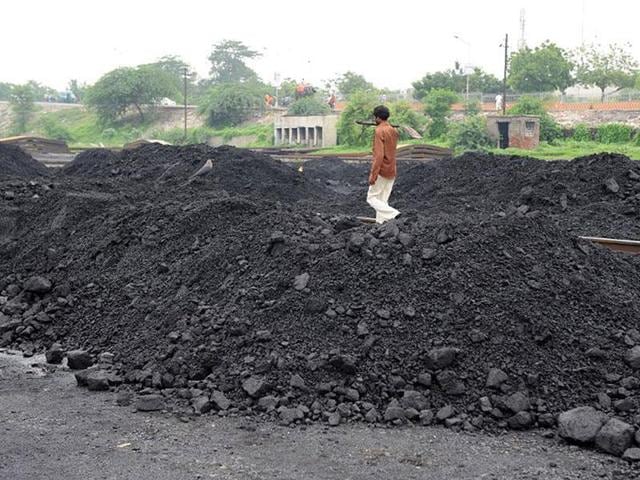
The Paris agreement indicates that countries which depend heavily on coal to fuel their development, such as India, will have to reduce their consumption by a lot more than what was previously anticipated. (HT File Photo)

The first and probably the last climate deal of this century indicates that coal-dependent countries like India will have to reduce its consumption much before than what was earlier anticipated. The obligation has fallen on all nations, not just the rich, and the most vulnerable nations are expected to get a climate largesse from an expanding band of voluntary contributors – the developed and emerging economies.

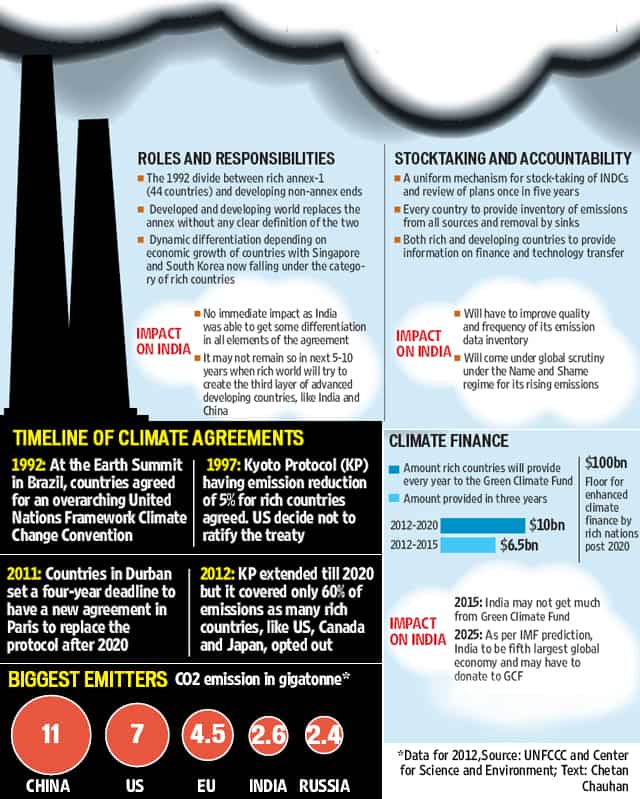
As environment minister Prakash Javadekar said several times, the differentiation in the roles and responsibilities of the two worlds – developed and developing – was there in all elements, but in a very diluted form. In fact, the firewall between rich and emerging economies like India has diminished to such an extent that it may vanish when the “dynamic” agreement is reviewed through a new methodology over the next 10 years.

The International Monetary Fund estimates that India would figure in the world’s top five economies and become its third-largest carbon emitter by 2025, when the next level of enhanced climate action plans – called INDCs – comes into force.
Article image

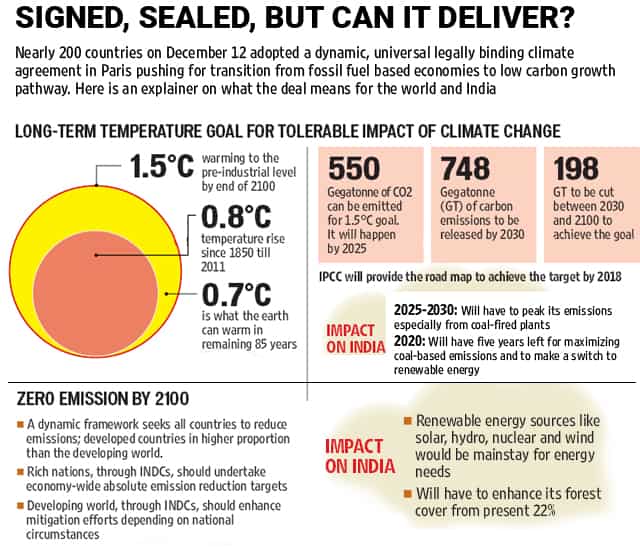
Most experts say that by then, India will have to announce an estimated deadline for plateau-ing its carbon emissions – which means no more use of coal, the country’s primary energy source. This could happen over the next decade, once the country’s basket of clean technologies become bigger and more stable, an environment ministry official said on the condition of anonymity.

While terms like ‘legally binding’ and ‘universal nature’ in the agreement sound pleasant, in reality many crucial parts of the deal are not binding due to the specific wordage. For instance, in the emission reduction section, the use of the world “should” instead of “shall” makes the pledge voluntary. Also, the $100-billion climate finance floor does not find mention in the agreement. It was a conference decision, which means subject to review.
Article image

The cheer over Paris delivering an “ambitious” agreement has been short-lived, with most independent organisations now saying that it will lead to a temperature rise of 3 degrees Celsius instead of limiting it to 1.5 degrees by the turn of the century.

According to Sunita Narain of the Centre for Science and Environment, the biggest winners at the Paris meet were developed countries, especially the United States, because their historical responsibility to fight climate change had been erased. “India got the right words in the agreement, but failed to operationalise equity and get its fair share of carbon space,” she added.

However, there are others who hold that India earned more life for its coal usage at the event.

  • Chetan Chauhan
    ABOUT THE AUTHOR
    Chetan Chauhan

    Chetan Chauhan is the National Affairs Editor looking into all aspects of news and features from across India. A Chevening scholar with over three decades of experience in reporting and news management, Chetan has extensively covered all important aspects of the social sector, political economy, environment and climate change nationally and internationally. He did a journalism course at the Reuters Institute of Journalism in Oxford and Digital Media training at Nanyang Technological University in Singapore. He started as a reporter with The Statesman in 1996 and joined the Hindustan Times in 2000 in the metro bureau covering environment, crime and Delhi politics. He covered hot local news, from the Jessica Lal murder case to the rebellion of Delhi Congress MLAs against then Chief Minister Sheila Dikshit, to the replacement of toxic vehicle fuel with cleaner compressed natural gas (CNG) in the national capital. Some of his stories on air pollution became part of the Supreme Court’s landmark MC Mehta versus Government of India case in the National Capital Region (NCR), forcing the government to take corrective measures. As part of the national political bureau since 2004, he covered important central sectors such as environment, education, social justice, labour, rural development, water resources, renewable energy, agriculture, broadcasting and the Planning Commission for more than a decade producing several exclusive and investigative breaking stories. His specialisation is the environment, having covered at least a dozen United Nations global conferences on climate change, biodiversity and wildlife including climate summits in Paris, Copenhagen and Bali. He also covered India’s two five-year plans ---11th and 12th and reported on drafting and execution of right based laws such as Right to Education, Right to Information and rural job guarantee law, MG-NREGA, now being introduced in new format as VG-RAM-G Act. He has in-depth knowledge of social sector issues. He was one of the first to report on tigers vanishing from Sariska and Panna wildlife reserves in 2004 and 2008, respectively, leading to the setting up of the National Tiger Conservation Authority (NTCA) and the introduction of stringent penal provisions for poaching. He has written extensively on the rising human-animal conflict in India and the degradation of India’s biodiversity hotspots because of mining and other activities. Since 2004, Chetan has covered Parliament comprehensively and participated in training on the nuanced coverage of Parliament proceedings. He has travelled extensively across India to cover national and provincial elections since 1998, especially in the Hindi heartland states, considered India’s road to power. He writes a regular column for Hindustan Times, Ecostani, on important national politics, economy, Himalayan ecology and environmental issues. His other responsibilities include providing inputs for edits and edit page articles for the publication, apart from managing news flow from across India.Read More

Check India news real-time updates, latest news on Hindustan Times and more across India.