
 E-Paper



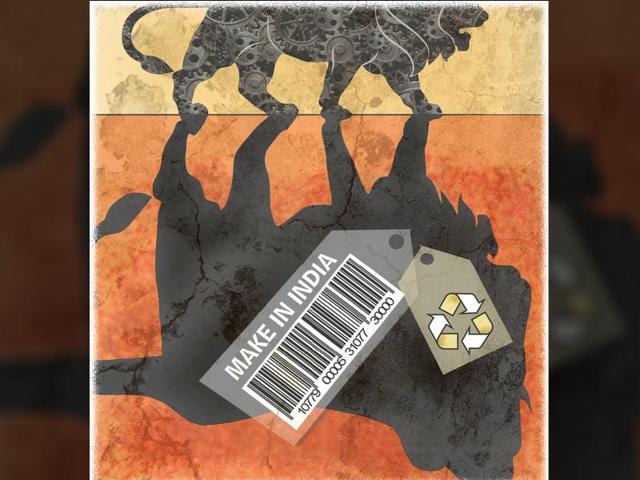
In Modi's 'Make in India' push, key lies in Jharkhand
Except for a few rickety trucks bouncing up and down the rutted roads, it is hard to tell that buried under the russet ground of this west Jharkhand region is some of the world’s largest, untouched deposits of high-grade coal and bauxite.


Except for a few rickety trucks bouncing up and down the rutted roads, it is hard to tell that buried under the russet ground of this west Jharkhand region is some of the world’s largest, untouched deposits of high-grade coal and bauxite.
Small clusters of village huts intersperse vast stretches of hilly forests and harvested fields, where tribal men and women bundle stacks of hay. One-street towns bustle with roadside stalls selling shiny aluminum utensils, farm tools and household knick-knacks.
Nearby, two huge chimneys rise from an unfinished power plant that saw its fuel supply nixed by a legal wrangle over coal, even though there is so much of it here — untapped — that it can help erase India’s power deficit for at least the next two decades.
A new and relatively small state, Jharkhand’s stature in national politics maybe modest but with its enormous amount of natural resources the region remains key in determining whether the country can build an industrial economy to absorb 100 million jobseekers over the next decade and avert a demographic disaster.
Achieving industrial success, though, is more complicated than merely enabling policy in a country where states often work to foil federal plans unless it’s the same party ruling in both.
So, winning in Jharkhand is seen as crucial for Prime Minister Narendra Modi’s grand industrial plans. His party already rules in mineral-rich Chhattisgarh and Madhya Pradesh.
“Emphasis on the Make in India programme is to a great extent focused on manufacturing revival and growth,” Harsh Pati Singhania, the director of JK Organisation, one of India’s biggest business conglomerates, told Hindustan Times.
“It (Jharkhand) has the capability to harness competitive growth in industries like steel, aluminum, cement, etc. that are essential for building infrastructure and also the growing need of urbanisation.”
Since winning power, Modi’s government has signed off on faster environmental approvals for industrial projects and taken steps towards ending state control of coal mining, seeking to boost manufacturing’s share in the economy to 25% from around 15% now.
But to build an industrial economy and compete with aspiring manufacturing nations such as Thailand and Indonesia, the government will also need abundant supplies of raw material. Currently coal and iron ore supplies remain erratic, forcing many power and steel plants to import.
Some 40% of India’s mineral deposits are in Jharkhand, including more than 72 billion tonnes of coal and 3.7 billion tonnes of iron ore. Along with resources-rich neighbouring Odisha and Chhattisgarh, it makes up what must be the heart of India’s industrial future.
In Chandwa, where symbols of modernity such as satellite TV and mobile phones have only recently touched hardscrabble tribal life, the debate is already about jobs and the heavy price of development the region must pay once its nine coal blocks are mined.
Sitting in front of a tea shop, NGO worker Rajesh Pandey tries to articulate the dilemma. “I think people want development but in a way that doesn’t destroy their way of life,” he said. A group of locals nodded in agreement.
Although insurgency-plagued, a prime reason for Jharkhand’s failure to harness its mining potential has been its history of electing unstable coalitions to power.
Worse, illegal quarrying, often patronised by politicians for personal gain or to fund their campaigns, has spawned widespread corruption.
“But Jharkhand still has a lot left, a lot can be retrieved,” said a senior state civil servant on condition of anonymity because he feared retribution.
“This state remains vital to the success of our industrial dreams.”
(Additional reporting by B. Vijay Murty and Vishal Sharma)


