E-Paper



J-K floods: These doctors are turning out to be Angels of Mercy
With hospitals and clinics still submerged in flood-hit Srinagar, local doctors and nurses are setting up makeshift relief camps, tending to the sick and homeless.


The three-storey building still under construction in Srinagar’s Rawalpora Housing Colony has no doors or windows yet, but is full of grateful locals. They were all in need of medical aid and are now being treated here, at a makeshift relief camp set up by neighbourhood doctors and volunteers. The camp is one of the hundreds that have taken shape in the Valley, as the region reeled from its worst floods in 50 years.

With hospitals and clinics six feet or more under floodwaters, doctors and nurses have set up makeshift clinics with basic equipment and whatever stocks of medicines they could buy or salvage.
“We are about 100 doctors living in this neighbourhood. We cannot reach our respective hospitals neither can we sit idle while thousands need treatment, so we decided to get together,” says Dr Jameel Ahmad Mir, an orthopedic specialist posted at a government hospital in Tangmarg, 40 km from Srinagar.
The group has also volunteered to staff seven government hospitals in the area that have not been flooded, but have become nonfunctional because most of the staff live in flood-hit areas and have been evacuated.
“The Bone and Joint Hospital , for example, is lying abandoned. We plan to restart it over the weekend. We’re not thinking about seeking permissions right now, all we are thinking about is helping people,” says Dr Mir. He and his colleagues have pooled their stock of essential medicines.
“We can provide consultations and treat minor ailments, which is what people need at the moment. Those who need superspeciality care will be moved to functional private hospitals,” says Dr Sajjad Fazli, an ophthalmologist who runs a private clinic.
A two-minute walk away is the Mohammad Iqbal convention centre and wedding hall, now home to about 3,000 evacuees. There is a medical helpdesk at the door. All new arrivals get a health check.
“This is my first forced leave as I am the kind of person who works even on national holidays and most weekly offs,” says Dr Saleem Najar, head of the nephrology department at Sher-i-Kashmir Institute of Medical Sciences (SKIMS), the biggest of the three government-run medical colleges in the state. “There was no way I could have said no to volunteering for this medical camp.” On average, Dr Najar sees 10 people an hour at the camp.
“The majority have very high blood pressure, which is natural considering the trauma they are undergoing. Medicines to control high blood pressure top the list,”says Kausar Jabeen, a nurse at SKIMS who is also volunteering here.
A separate room has been turned into a makeshift maternity ward. “Many of the pregnant women are in shock,” says Jabeen.
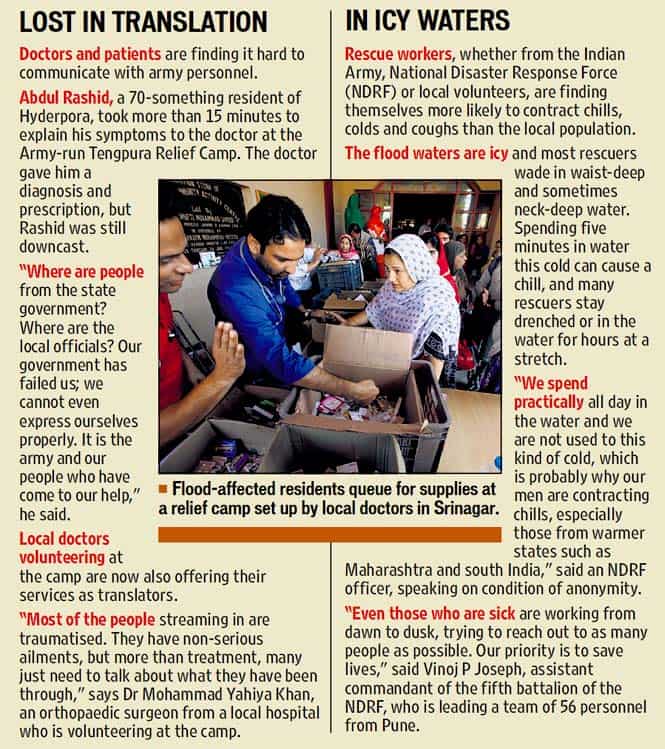
Local doctors are also volunteering at medical relief camps set up by the Indian Army. “My conscience tells me to not think of moving to safety but to help others in this hour of need,” says Dr Mohammad Yahiya Khan, an orthopedic specialist at Bone and Joint Hospital, who is volunteering at the Army-run Tengpura Relief Camp.