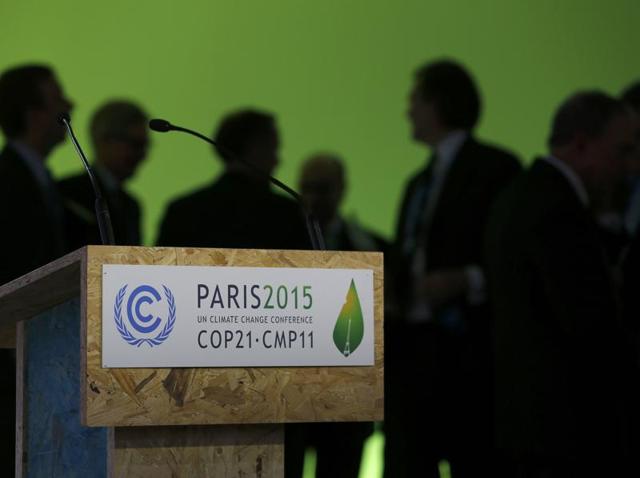
New climate agreement in Paris may end 1997 Kyoto Protocol
Countries could reach a new climate agreement in Paris next week to slow down global warming but there’s an adverse payoff for India as the 1997 Kyoto Protocol from which it had benefitted a lot is expected to be tossed aside.

The first commitment period till 2012 of the protocol, the only existing climate treaty, has ushered clean technologies into India through the Clean Development Mechanism (CDM) that provided for substantive funding by rich countries through carbon trading.
The second commitment period was fixed three years ago but is yet to take off.
In its report to the United Nations climate framework, the CDM executive board, which is the funding mechanism under the protocol, said it had cut down its programmes by a third and laid off 15 workers due to the continuing “disastrous state” of the carbon market.
Developing countries like India and China have been pushing for a new lease of life for the treaty which only required developed nations to take on legally-binding emissions targets.
The two countries received around 80% of the CDM projects because of their capability to reduce emissions from new schemes. Among the beneficiaries were the Delhi Metro Rail Corporation, Okhla waste-to-energy plant and afforestation activities in states like Haryana and Himachal Pradesh.
The call for ratification does not appear to have had an impact as an Indian negotiator said “we will walk from Paris with a coffin for Kyoto”.
Sources say the chances of the second commitment period of the protocol seeing the light of day appear bleak as less than half of the 144 countries involved have officially agreed to participate
In 2012, the European Union, which was the biggest buyer of carbon credits – one credit is equal to a tonne of emission saved – decided to prioritise CDM projects to the least developed countries and small island nations because of a geographical imbalance in distribution of the projects, as China and India were getting the most.
But the EU decision has mostly remained unimplemented as the proposed beneficiaries have not applied for new projects because of the declining carbon market.
Environment secretary Ashok Lavasa had another analogy to offer. “In global warming some streams dry up,” he said, while referring to the discussion on the Kyoto Protocol.
The price of a carbon credit in European exchanges is less than 10 euros, making the CDM projects financially unviable.
Many civil society groups have said relying on carbon markets is unproductive and instead direct finance should be considered, an option being examined for the Paris agreement.
ABOUT THE AUTHORChetan ChauhanChetan Chauhan is the National Affairs Editor looking into all aspects of news and features from across India. A Chevening scholar with over three decades of experience in reporting and news management, Chetan has extensively covered all important aspects of the social sector, political economy, environment and climate change nationally and internationally. He did a journalism course at the Reuters Institute of Journalism in Oxford and Digital Media training at Nanyang Technological University in Singapore. He started as a reporter with The Statesman in 1996 and joined the Hindustan Times in 2000 in the metro bureau covering environment, crime and Delhi politics. He covered hot local news, from the Jessica Lal murder case to the rebellion of Delhi Congress MLAs against then Chief Minister Sheila Dikshit, to the replacement of toxic vehicle fuel with cleaner compressed natural gas (CNG) in the national capital. Some of his stories on air pollution became part of the Supreme Court’s landmark MC Mehta versus Government of India case in the National Capital Region (NCR), forcing the government to take corrective measures. As part of the national political bureau since 2004, he covered important central sectors such as environment, education, social justice, labour, rural development, water resources, renewable energy, agriculture, broadcasting and the Planning Commission for more than a decade producing several exclusive and investigative breaking stories. His specialisation is the environment, having covered at least a dozen United Nations global conferences on climate change, biodiversity and wildlife including climate summits in Paris, Copenhagen and Bali. He also covered India’s two five-year plans ---11th and 12th and reported on drafting and execution of right based laws such as Right to Education, Right to Information and rural job guarantee law, MG-NREGA, now being introduced in new format as VG-RAM-G Act. He has in-depth knowledge of social sector issues. He was one of the first to report on tigers vanishing from Sariska and Panna wildlife reserves in 2004 and 2008, respectively, leading to the setting up of the National Tiger Conservation Authority (NTCA) and the introduction of stringent penal provisions for poaching. He has written extensively on the rising human-animal conflict in India and the degradation of India’s biodiversity hotspots because of mining and other activities. Since 2004, Chetan has covered Parliament comprehensively and participated in training on the nuanced coverage of Parliament proceedings. He has travelled extensively across India to cover national and provincial elections since 1998, especially in the Hindi heartland states, considered India’s road to power. He writes a regular column for Hindustan Times, Ecostani, on important national politics, economy, Himalayan ecology and environmental issues. His other responsibilities include providing inputs for edits and edit page articles for the publication, apart from managing news flow from across India.Read More

E-Paper