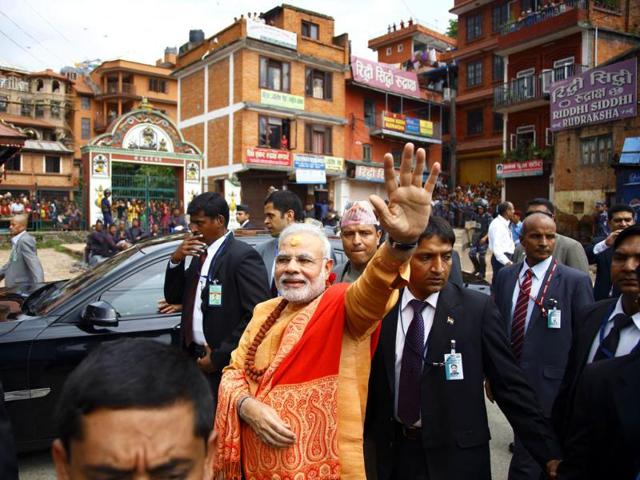
PM Narendra Modi wants health insurance for all
Prime Minister Narendra Modi has called a meeting on health reforms this week in which the format of the health insurance for all, setting up medical colleges in each district and a three-year BSc course in community health are likely to be discussed.

Improving public health facilities had been high on PM Modi’s agenda and health minister Harsh Vardhan has been working on series of reforms that entails to provide affordable health to all. The government has announced the setting up of All India Institute of Medical Sciences in different states and improving health infrastructure.
But government sources said the meeting of all dealing with health, including department of pharmaceuticals, have been called with an idea to take the agenda ahead.
The Prime Minister’s Office has asked Planning Commission secretary Sindhushree Kullar to make a presentation on the reforms that can unclog the health sector.
One of the major issues to be discussed at the meeting would be health insurance for all. Sources said the government was looking at a proposal of nominal premium for health insurance that would cover treatment for widespread ailments like diabetes, cardiac and cancer. “The aim is to provide a basic minimum health insurance cover to all. The rate of the premium for the middle class could be dependent on one’s income. But for the poor it would be very nominal,” a government official said.
Another issue likely be flagged is the growing shortage of health personnel in rural India. There are just 0.64 doctors and 1.44 nurses for 1,000 Indians. The ratio halves for rural India with a large number of health personnel working in urban areas. Although the number of health personnel has increased the demand for medical treatment has also risen with improvement income in recent years, says a government paper for the 12th five year plan.
To meet the growing demand, the government wants to set up a medical college in each district with the help of state governments in coordination with the upgraded district hospitals.
Modi is also keen to initiate three year BSc course in community health which failed to take-off during the previous UPA regime because of resistance by the Medical Council of India claiming that it would create a workforce of “half-baked” doctors.
The government has, however, brushed aside such concerns saying the pass-outs would work as community health workers and not doctors. The officials expect a go ahead to many of these reforms at the meeting.
ABOUT THE AUTHORChetan ChauhanChetan Chauhan is the National Affairs Editor looking into all aspects of news and features from across India. A Chevening scholar with over three decades of experience in reporting and news management, Chetan has extensively covered all important aspects of the social sector, political economy, environment and climate change nationally and internationally. He did a journalism course at the Reuters Institute of Journalism in Oxford and Digital Media training at Nanyang Technological University in Singapore. He started as a reporter with The Statesman in 1996 and joined the Hindustan Times in 2000 in the metro bureau covering environment, crime and Delhi politics. He covered hot local news, from the Jessica Lal murder case to the rebellion of Delhi Congress MLAs against then Chief Minister Sheila Dikshit, to the replacement of toxic vehicle fuel with cleaner compressed natural gas (CNG) in the national capital. Some of his stories on air pollution became part of the Supreme Court’s landmark MC Mehta versus Government of India case in the National Capital Region (NCR), forcing the government to take corrective measures. As part of the national political bureau since 2004, he covered important central sectors such as environment, education, social justice, labour, rural development, water resources, renewable energy, agriculture, broadcasting and the Planning Commission for more than a decade producing several exclusive and investigative breaking stories. His specialisation is the environment, having covered at least a dozen United Nations global conferences on climate change, biodiversity and wildlife including climate summits in Paris, Copenhagen and Bali. He also covered India’s two five-year plans ---11th and 12th and reported on drafting and execution of right based laws such as Right to Education, Right to Information and rural job guarantee law, MG-NREGA, now being introduced in new format as VG-RAM-G Act. He has in-depth knowledge of social sector issues. He was one of the first to report on tigers vanishing from Sariska and Panna wildlife reserves in 2004 and 2008, respectively, leading to the setting up of the National Tiger Conservation Authority (NTCA) and the introduction of stringent penal provisions for poaching. He has written extensively on the rising human-animal conflict in India and the degradation of India’s biodiversity hotspots because of mining and other activities. Since 2004, Chetan has covered Parliament comprehensively and participated in training on the nuanced coverage of Parliament proceedings. He has travelled extensively across India to cover national and provincial elections since 1998, especially in the Hindi heartland states, considered India’s road to power. He writes a regular column for Hindustan Times, Ecostani, on important national politics, economy, Himalayan ecology and environmental issues. His other responsibilities include providing inputs for edits and edit page articles for the publication, apart from managing news flow from across India.Read More

E-Paper