
 E-Paper



Rivers take revenge on builder greed in hill states
Rivers have exacted their revenge. Choked by rampant construction and bullied to change their course in the name of development, angry rivers of Uttarakhand and Himachal Pradesh left behind massive devastation in the last few rain-swept days. Chetan Chauhan reports.


Rivers have exacted their revenge. Choked by rampant construction and bullied to change their course in the name of development, angry rivers of Uttarakhand and Himachal Pradesh left behind massive devastation in the last few rain-swept days.
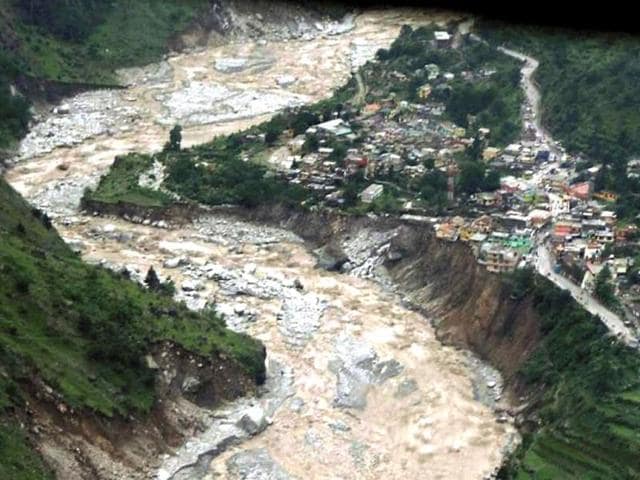
Satellite imagery shows that in both Kedarnath and Rudraprayag in Uttarakhand, where over 60,000 pilgrims are said to be stranded, hundreds of buildings have come up next to rivers in the last decade or so. Till early 1980s, there were just a few hutments at the base of Kedarnath.
"The natural flow of water in Kedarnath was blocked by huge construction in recent years," said an Indian Space Research Organisation (ISRO) official on Wednesday, requesting anonymity. ISRO monitors hydrological flow of major river basins in India.
Water flooded Kedarnath town after the breaking of the Kedar Dome, a glacial river 6 km upstream from the shrine.
The Uttarakhand government wasn't unaware of the impending disaster. The disaster management department had warned of greater devastation after buildings were washed away by Uttarkashi flash floods in August 2012. Two months later, a cloudburst claimed 69 lives in Rudraprayag.
"Large-scale construction of dams and absence of environmental regulations has led to the floods," said Sunita Narian, director general of Delhi based advocacy group Centre for Science and Environment (CSE).
"There is no local planning and local authorities are not in control. The houses built on river banks are falling like a pack of cards. The floods are completely man-made, avoidable and criminal," she added.
Around 70 hydel projects are proposed on the two main tributaries of the Ganga - Alaknanda and Mandakini - that meet at Rudraprayag, the epicenter of the devastation. Two 20km tunnels are being built to divert these rivers for hydel projects and constant blasting of the river banks has affected the local ecology. The green cover on the hills that checks and absorbs the flow of water has been eroded in the name of hydel energy.
"These projects have been allowed without cumulative environment impact assessment on the region. With these projects come hotels, residential and commercial buildings, and roads. This piecemeal approach has contributed to the devastation," said Himashu Thakkar of South Asian Network on Dams, Rivers and People.
A CSE analysis showed that vehicle population in the state almost tripled between 2005-06 and 2012-13. Cars, jeeps and taxis, the most preferred means of transport for tourists landing in the state, increased the most. "Most of these places have much more tourist inflow than the area's carrying capacity," said Bharat Jhunjhunwala, an environmental activist and a resident of Rudraprayag.
The story is no different in Himachal's Kinnaur district where chief minister Virbhadra Singh was stranded for almost 48 hours because of landslides. ISRO satellite images show how Sangla valley, a key tourist attraction, had changed in the last few years.
"What used to be an open green area (in Sangla) till a few years ago is now a concrete jungle," the ISRO official said. To top it, the 1,000 MW Karchham hydel project has been commissioned by making the Sutlej disappear for over 100 metres.
Vinod Tare, senior faculty at IIT Kanpur and an expert on the Himalayan ecosystem, says when trees are removed, rocks blasted and unscientific anthropogenic pressure is exerted, nature plays havoc.
Studies by the Pune-based Indian Institute of Tropical Meteorology has shown that the fury of flash floods over the north-west Himalayan region in the last 20 years has increased and a probable reason is global warming.


