
 E-Paper



With towering debt and tiny profit, it's tough living as a farmer
The death of Gajendra Singh Kalyanwat, the Rajasthan resident who hung himself in the heart of Delhi, puts focus on the hundreds of farmers across India continue who have killed themselves owing to increasing farm debt.


Farmer distress in India has got a name: Gajendra Singh Kalyanwat.
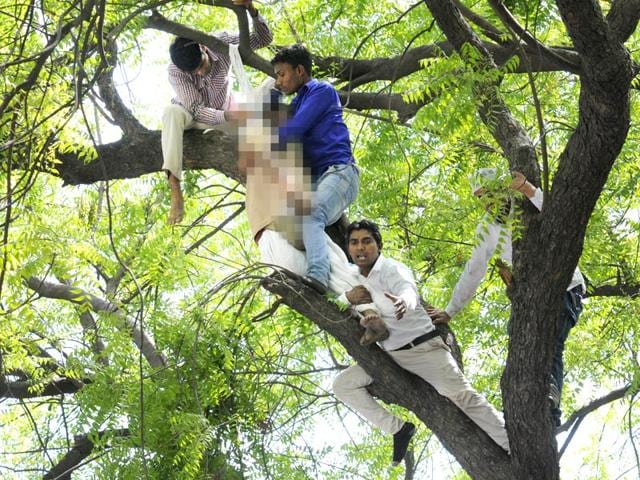
The farmer from Rajasthan hanged himself in the heart of Delhi at an Aam Aadmi Party rally at the Jantar Mantar on Wednesday even as hundreds of farmers across India continue to kill themselves owing to increasing farm debt.
On Thursday, politics played out in Parliament with the opposition accusing the NDA government of triggering the agrarian crises while the ruling party shot back blaming the Congress governments of the past for putting farmers in distress.
Home Minister Rajnath Singh put forth the government perspective on farm sector crises in the Lok Sabha and admitted that farmers cannot sustain themselves just on basis of farm income.
Earlier, Leader of Opposition in the lower house Mallikarjuna Kharge blamed the NDA government for Gajendra Singh's death.
Government data shows that profit from agriculture for small and marginal farmers who constitute about 85% of the agrarian class in India has gone down because of increase in input costs. As a result, credit burden has been increasing the most on them.
The government informed Parliament recently that outstanding farm loan in a period of three years has increased from Rs 5,83,000 crore in 2012 to Rs 8,11,290 crore in 2014, a 40% increase over a period of three years.
And in these three years around 35,000 farmers took their lives and the reason given for that by commerce minister Nirmala Sitharaman was "distress of farmers due to debt burden".
A Lancet Study in 2014 had said that suicide rate among farmers in India was the highest in the world.
"Even if the Indian state is unable to enact land reforms due to the power of local elites, interventions to stabilise the price of cash crops and relieve indebted farmers may be effective at reducing suicide rates," the study said.
Cambridge University and University College, London last year found that suicide rates were highest among the most debt-ridden farmers who are clinging on to small holdings.
Experts blame agriculture policy paralysis for causing distress to farmers, about 85% of whom have small and marginal holdings of less than five hectares. The irrigation network has not increased much in the last 20 years, the farm insurance policy fails to protect farmers from natural calamities and farm produce has become a victim of market players.
The magnitude of farmer suicides can be gauged from an Intelligence Bureau report submitted to the government in December 2014 which reported farmer suicides from across India particularly from Maharashtra, Telangana, Karnataka, Punjab, Gujarat, Uttar Pradesh and Tamil Nadu.
Outstanding loans, rising debt, low crop yield, poor procurement of rate of crops, successive crop failure because of erratic monsoon and decline in ground water level were identified as main causes of suicide by the bureau.
In Maharashtra alone, the number of farmers taking their lives has increased from 975 in January-July 2014 to 1,373 between August 2014 to February 2015.
Madhya Pradesh has also reported number of farmer suicides after unseasonal rainfall damaged crops in March-April this year.
The past one year has been particularly bad for Indian farmers as poor monsoon in 2014 resulted in low productivity in summer crop and the winter crop on 93,000 hectares was damaged because of unseasonal rains.
Agriculture growth for 2014-15 is pegged at just one percent, the lowest in the last five years, and weak July-September monsoon can spell doom for farmers if quick public intervention does not happen.


