
 E-Paper



A cricket team to envy: The Sporting Life by Rudraneil Sengupta


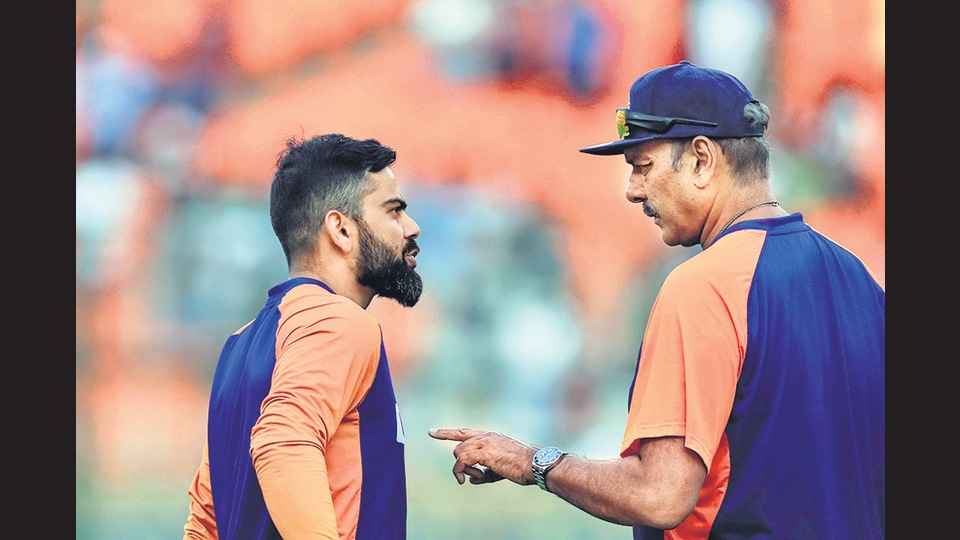
Not since the Sourav Ganguly-John Wright era has there been a combination as winning as Kohli-Shastri. They’ve built a team culture that’s pure gold, and it shows on the scoreboards.
The on-field personalities of captain Virat Kohli (brazen, belligerent) and head coach Ravi Shastri (clipped clichés, an air of snootiness) may not be particularly endearing. Add to that Indian cricket’s general aversion to engage with the media and an almost childish defensiveness about journalistic criticism, and you have a group whose inner workings remain largely opaque.
Except, of course, when it comes to the scores. Those are there for all to see — a team that’s at the height of its powers, nearly invincible across formats, scripting an infectiously raucous feel-good history. More’s the pity, then, that as journalists we aren’t allowed the access that would let us document this wonderful moment in Indian cricket.
Kohli and Shastri are doing something very special. A few matches can be won on the back of inspired individual performances, or be the natural outcome of being a single-sport nation with incredible influence and financial might. But the sustained excellence that this Indian team has made a habit of can only come from building a team culture that’s solid gold. A team culture that rewards excellence but is patient with failure; one where players feel both safe and inspired; where there is mutual trust and respect, the freedom to make mistakes and a structure that helps iron out flaws.
There was a glimpse of this at work when, early on in India’s historic Australia tour in December, young opener Prithvi Shaw was dropped from the squad after a string of poor performances. In team sports, it’s not uncommon for a player who performs poorly to find himself ignored and isolated. But there was Shaw, spending long hours at the India nets, supervised by both Shastri and batting coach Vikram Rathour. A 21-year-old making his first tentative steps in international cricket was being nurtured, made to feel like he was still part of something big and special.
Shaw went on to have a stunning run-spree in domestic cricket, where he amassed 827 at an average of 165.4, to lead Mumbai to the Vijay Hazare trophy last week.
As another example, look at Rishabh Pant. Before his spectacular rise as India’s match-winner-in-chief during the Australia tour, Pant was unsure if he would find a place in any of the India teams. He had spent most of 2019 without finding his scoring touch. His wicketkeeping skills were clearly not of international standard. He had been dropped from the T20 and ODI legs of the tour. In Tests, he was the back-up keeper.
Yet, when the opportunity came his way, he was a revelation with the bat. With each match, his keeping improved. Taking nothing away from his remarkable inner strength, this version of Pant would likely not have emerged if it wasn’t for a system at work behind the scenes to build his confidence, develop his skills and allow him the freedom to be both flawed and fearless.
Shastri briefly spoke about the atmosphere within the team after their demolition of England in the Test series earlier this month, revealing how there was a conscious decision to step back from the usual high-tension environment of competitive sport as a response to the unique challenges of being constantly in bio-bubbles.
“You had to be patient, more than anything else,” Shastri said. “We started with two losses in the one-dayers in Australia. Normally, you can go straight to the point and address it with the individual and tell him, ‘Pull up your socks’. But I had made up my mind, very early on with my team management, to show empathy. Because for six months a lot of the guys had not got out of their flats… that’s not easy.”
Without a truly unique team environment, it is simply not possible to see the kind of performances we have seen from debutants over the last few months. In the ongoing T20 leg of the England series, we are seeing the resurrection of yet another player of great talent who was, not too long ago, seemingly lost — Ishan Kishan.
We have seen something like this before — a team constantly scripting history and unearthing great talent. And it remains the gold standard in team-building in Indian cricket: the Sourav Ganguly-John Wright era.


