
 E-Paper



A radio museum in Bengaluru where every exhibit still works

 Prefer HTon Google


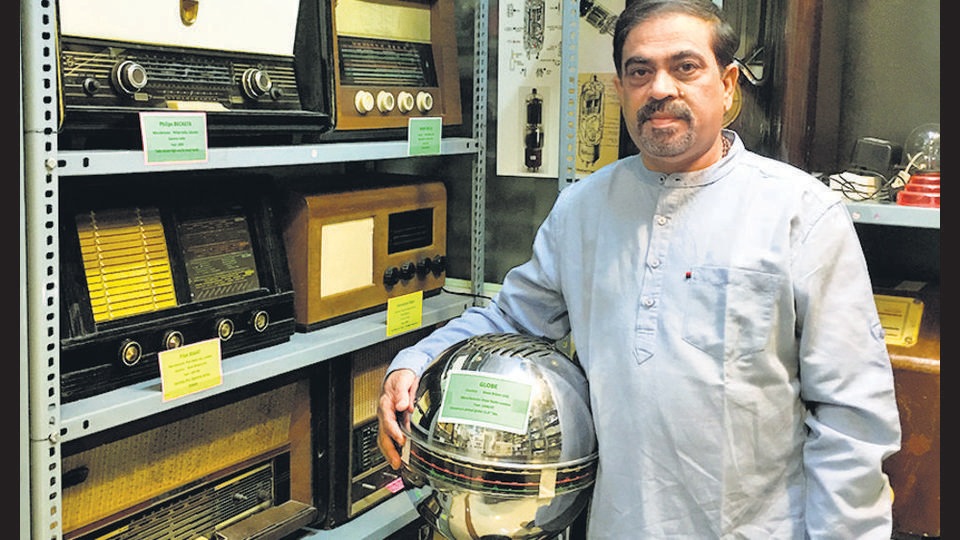
Uday Kalburgi, an electronics and telecom engineer, has spent his life caring for, collecting and restoring old radios. Now he’s got 111 of the gleaming gems on display on the ground floor of his family home.
Uday Kalburgi has about 150 dependents that his wife and two children have made their peace with. These rather needy things are short-wave radios that he has collected over decades and is constantly restoring and repairing. Of the 150, 111 are now on display in a museum he recently inaugurated on the ground floor of the family’s four-storey home in Bengaluru.
Born in Bellary, Karnataka, in 1963, Kalburgi became fascinated with radios at the age of nine. If he walked past a repair shop, he would stop and stare, riveted, as handymen fixed transmitters and otherwise tinkered.
He began collecting radio sets at 15. By then it was the late 1980s and, though he didn’t know it, these would be the final years before radio made way for TV.
“There was a time when the radio was such a focal point of family gatherings,” says Kalburgi, now 57 and an electronics and telecommunications engineering consultant. “Around these sets, stories were woven, musicians from far away sang to us, and good and bad tidings from around the world tiptoed into the home.”
The world has long since moved on — to gadgets that grow ever smaller, capable of performing an alarmingly long list of tasks. But where today’s devices are discarded and replaced annually, a radio set was a fixture, a matter of pride. And for Kalburgi, the allure has held.
What makes his collection particularly interesting is that every item in it still works. “Most radios at my museum are restored. As they have aged, it has taken time, patience and skill to revive each one,” he says. “Those who repair such sets can’t usually restore them. They do not know the nitty-gritty of spare parts. I apply what I have learned in my years and now I look forward to sharing that know-how.”
In all, 70 people have visited his museum since its launch on February 13, to coincide with World Radio Day. There, proudly displayed on shelves, are the items he has collected from markets and stores across the country. One radio, his largest, is a Philips BX998A from 1955 that weighs 27 kg. The smallest is a Philips 2802 from 1928 that didn’t even have a band switch. “Big or small, they are equally precious to me,” Kalburgi says.
He now hopes that his museum will inspire some interest, if not love, in a new generation. “Radios can be used as amplifiers. So you can connect your set to an Alexa or a Bluetooth receiver and use it as a speaker,” he says. Meanwhile, he’s working on getting his wife to agree to let his museum “gradually” expand.
(Access to the radio museum is free, but the Kalburgis would appreciate a call before you visit. You can reach Uday Kalburgi on 9108553014)


