
 E-Paper



A trove of Indo-Portuguese artefacts, Goa’s Museum of Christian Art gets a makeover


This unique style blends two cultures such that Mary is sometimes depicted in a sari, standing on a lotus; local flora and fauna pop up in statuary; Nagas are incorporated in distinctly Christian works.
The Museum of Christian Art (MoCA) sits within the 17th-century Convent of Santa Monica in the heart of Old Goa, the scenic precinct of churches, monuments and ancient monastic ruins. A church is attached to the three-storey stone structure. The museum is housed in its nave.
Over the past three years, the museum has been painstakingly renovated in a project executed jointly by MoCA and the Calouste Gulbenkian Foundation, a philanthropic organisation based in Portugal, with the conservation of the over-200 artefacts carried out by INTACH (the Indian National Trust for Art and Cultural Heritage), New Delhi.
The revamped museum is now spread across the ground floor, a mezzanine and a reconstructed first floor, the original having collapsed in the 19th century.
“In the new museum layout, the art objects from the collection have been showcased in specially designed display cases with appropriate lighting. The collection has been grouped according to their materials and arranged in chronological order to assist the interpretation of the evolution of the Indo-Portuguese art history,” says museum curator Natasha Fernandes.
When the Portuguese arrived in India, they brought European masterpieces with them, and used those masterpieces as models when commissioning new works by India’s own highly skilled artists. As a result, from the 16th to mid-20th century, a range of artefacts was created in Portuguese colonies here that bear the stamp of both cultures.
Sometimes, a Portuguese icon will have features that look distinctly Indian; local embroidery shows up on garments worn by representations of Jesus and Mary; local flora and fauna turn up in statuary; and, in a seamless marriage of cultures, symbols of significance to the Hindu faith such as the lotus and Naga are seen in distinctly Christian artefacts.
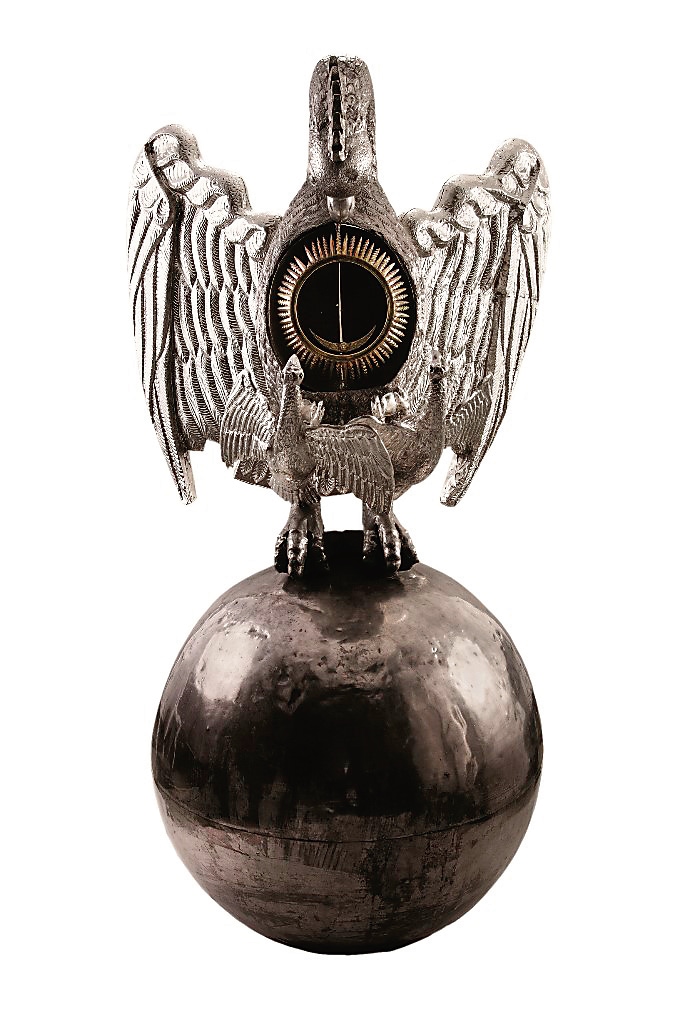
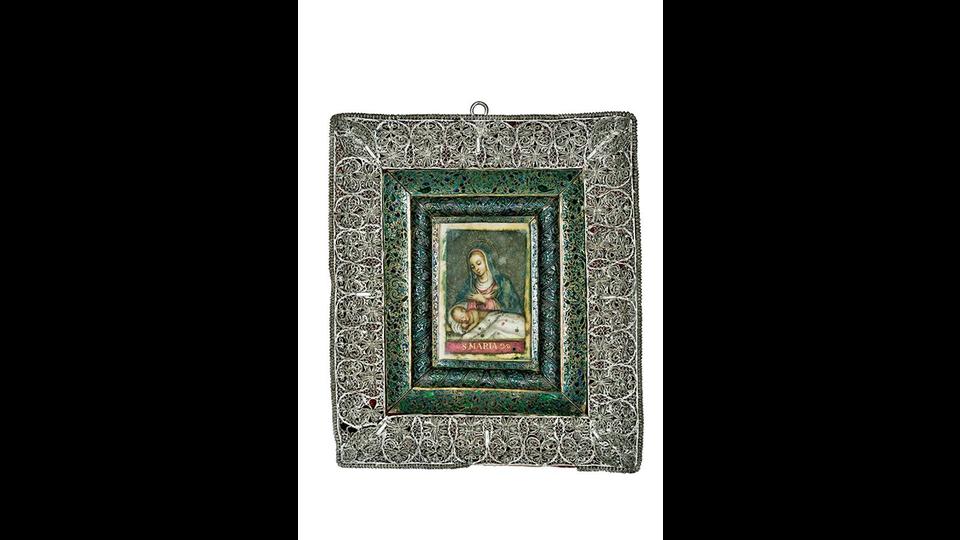
At the museum, the most intricate examples of Indo-Portuguese art include an 18th-century image of Infant Jesus as Saviour of the World featuring Nagas and a red velvet gown covered in zardozi embroidery; a 20th-century ivory representation of Mary as Nirmala Matha, rising from a lotus and dressed in a sari; a 17th-century painting of the Virgin and Child framed in paisleys and silver filigree; and a 17th-century silver-on-wood tabernacle monstrance.
The tabernacle monstrance (a tabernacle is a sacred object used to hold the consecrated wafer called the host) is nearly 5 ft high. The spherical base is made of wood covered in silver, and the monstrance (used to present the sacred host for the adoration of the faithful) takes the form of a splendid pelican. In its breast is an opening surrounded by a golden sunburst designed to show off the consecrated host. Two offspring cling to the bird, waiting to be fed. “All these features as well as the metalwork technique employed by the silversmiths, especially on the feathers, make this piece unique,” Fernandes says.
Elsewhere, an intricate 17th-century ivory representation of Jesus as the Good Shepherd depicts a young boy in sheepskin with gambolling sheep at his feet, and one leaping over his left shoulder. The pedestal is made to resemble a terraced hillock. Jutting out from the upper level is a face representing the fount of life, from whose mouth the water of life gushes into a basin, from which birds of paradise drink. On the lower level is a figure of a holy penitent performing penance in a cave. Lush green foliage symbolic of the Tree of Life would have been part of the original, but is now lost.
The delicate painting of Virgin and Child shows Mary with her arms folded at her breast gazing down at the sleeping Jesus. The painting is notable also for its multiple frames — one bearing stylised leaf motifs, another with floral and animal motifs, yet another with scrolling Mughal-style paisleys and the final outermost frame worked in fine silver filigree.
These and other artefacts at the renovated museum can be viewed online at museumofchristianart.com.


