
 E-Paper



An Irish spell: Sanjoy Narayan on the stunning music of House of Guinness

 Prefer HTon Google


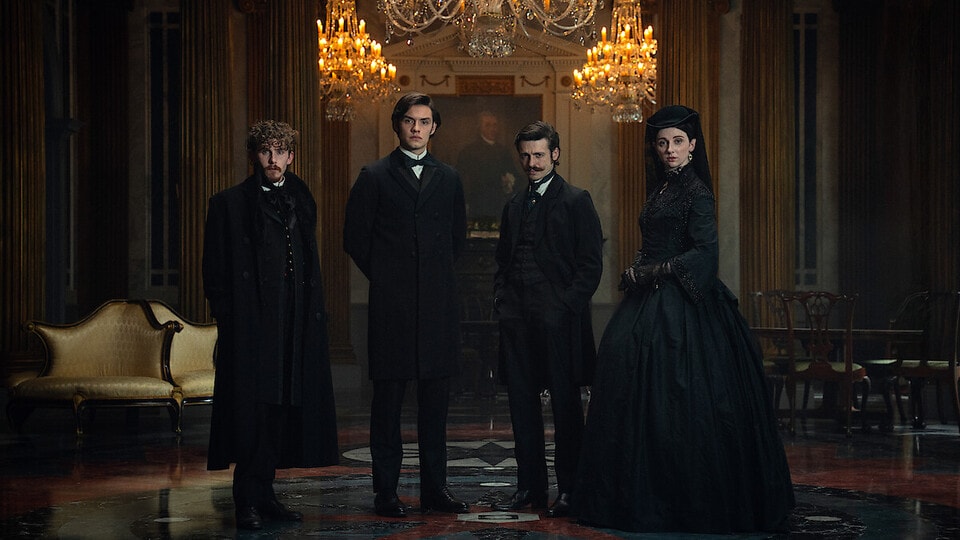
In committing to an Irish identity, and merging past with present, the music does a better job of capturing the country’s rebellious spirit than the show itself
The Netflix period drama House of Guinness arrived in September, billed as a hybrid of Succession and Peaky Blinders. It chronicles the power struggle within Ireland’s most famous brewing dynasty, in the wake of the death of the head of the family, Benjamin Guinness, in 1868. The eight-part series has proven divisive: while American and British critics have largely embraced it as “irresistible” entertainment, Irish reviewers have been scathing, criticising everything from its treatment of colonialism to its depictions of Fenians as “feral leprechauns”, in the words of one critic.
Amid this split, one element stands out: the audacious, anachronistic soundtrack that marries contemporary Irish punk and rap with traditional folk music.
Creator Steven Knight, who pioneered this approach in Peaky Blinders (2013-22), with the use of Nick Cave and Arctic Monkeys against a 1920s backdrop, doubles down on the formula here. But where Peaky Blinders deployed British rock, House of Guinness commits to an entirely Irish musical identity.
Music supervisor Amelia Hartley ensured that every artist featured was either Irish, had lived in Ireland, or had collaborated with Irish musicians. The result is a deep-dive into a sonic landscape that, some might argue, captures the nation’s rebellious spirit more authentically than the show itself.
The opening episode sets the tone, deploying Fontaines DC’s Starburster, that convulsive, art-punk eruption that soared on international charts after its release last year. It is followed by Get Your Brits Out, a provocative, Irish-language rallying cry by the West Belfast hip-hop trio, Kneecap. This band reappears over and over, through the series. Their inclusion is particularly significant, given that they are known for performing in balaclavas and championing Irish language rights through confrontational rap. Kneecap emerged from the same cultural moment as Fontaines DC: a new generation reclaiming Irish identity on fresh terms.
Fontaines DC, currently one of Ireland’s most celebrated exports, bookend the series. Their 2022 Irish-language track In ár gCroíthe go deo (In Our Hearts Forever) appears in Episode 2, while the 2024 track Death Kink features in Episode 6. Starburster returns in the finale, reinforcing the band’s positioning as the sonic signature of a particular vision of Ireland: restless, poetic and uncompromising.
The genius of the soundtrack lies in its juxtaposition of the contemporary and the traditional. Lankum, the Dublin quartet who have revolutionised Irish folk with their dark, drone-inflected interpretations, contribute Katie Cruel (2019) and The Granite Gaze (2017). Their approach of taking centuries-old songs and rendering them with almost gothic intensity bridges the chronological gap between the show’s 1860s setting and its 2020s sensibility.
The Mary Wallopers, brothers who have become cult figures for their raucous takes on traditional Irish ballads, appear with Rich Man and the Poor Man (2023) and As I Roved Out (2019). Their raw, bar-room energy provides unadorned authenticity. Similarly, Lisa O’Neill’s ethereal Goodnight World and Old Note (both from 2023) offer moments of haunting introspection, her refrains echoes of Ireland’s rich storytelling tradition.
The series also reaches back to touchstones of musical identity. Ruby Murray’s Phil the Fluter’s Ball, a 1950s chart-topper, nods to mid-century Irish popular music. Beer, Beer, Beer by The Clancy Brothers provides meta-commentary in the finale: the folk group that introduced Irish music to American audiences in the 1960s singing about the product that made the Guinness family fortune.
Deeper cuts showcase contemporary diversity: The Murder Capital’s brooding post-punk (For Everything; 2019), Gurriers’ ferocious noise-rock (Nausea; 2024), the experimental Gilla Band’s Lawman (2020), and the genre-defying Robocobra Quartet’s take on a traditional closer, The Parting Glass (2025).
The approach called to mind other period productions that wielded contemporary music boldly. Sofia Coppola’s Marie Antoinette (2006) used New Order and The Strokes to capture adolescent ennui in Versailles. Baz Luhrmann’s The Great Gatsby (2013) deployed Jay-Z and Lana Del Rey. A Knight’s Tale (2001) famously opens with Queen’s We Will Rock You at a medieval joust.
When it works — as in the title track House of Guinness too, which its composer Ilan Eshkeri calls a “crazy mash-up” of folk tunes with modern twists — this approach creates emotional immediacy, allowing contemporary audiences to “feel” rather than merely “see” history.
Still, the counter-argument persists. Some viewers find the juxtapositions jarring. There have been complaints about sound-mixing in which music sometimes overwhelms the dialogue. My sole grouse at the moment relates to overexposure: Starburster has become 2025’s go-to track across productions. It features in this show as well as in the series MobLand, in the trailer for the Tom Hardy film Havoc and in the Netflix series Black Rabbit, and that isn’t even a complete list. This is now costing it some of its edginess.
None of this, to my mind, weakens the case for the show in question. Whether or not House of Guinness succeeds as drama, its soundtrack stands as a legitimate achievement: a curated introduction to contemporary Irish music for the uninitiated, and for those already familiar with the scene, a chance to hear favourite artists in unexpected contexts.
In that sense, it does seem to achieve what the show itself struggles to accomplish: an authentic representation of Irish identity in all its complexity, contradiction and creative vitality.
(Write in with feedback to sanjoy.narayan@gmail.com. The views expressed are personal)


