
 E-Paper



Boarding delayed? Scroll, swipe, play at MAP art spaces at Bengaluru airport

 Prefer HTon Google


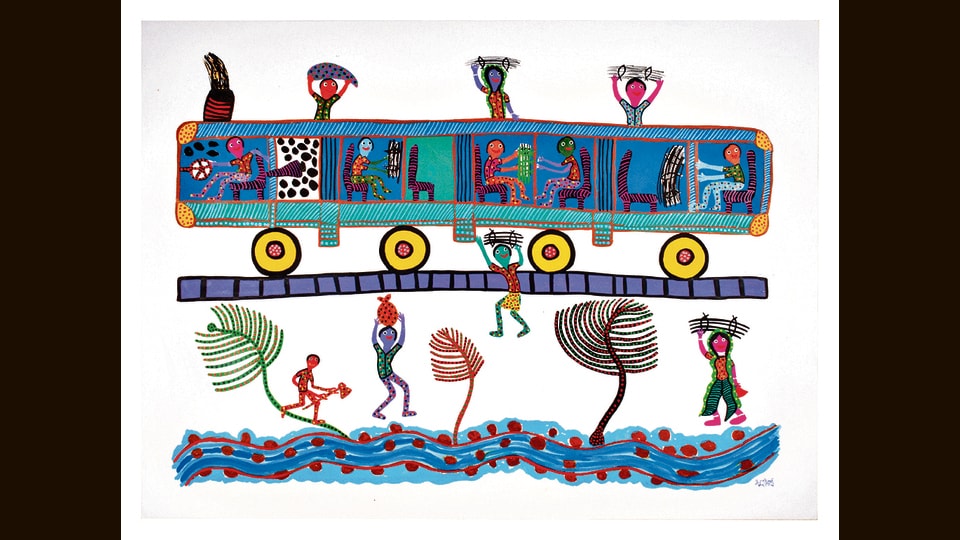
Visitors can piece together puzzles, create art, or explore 10,000 years of heritage on interactive screens, at the Museum of Art & Photography’s new spaces.
There’s a surprise in store for fliers at Terminal 2 of Bengaluru’s Kempegowda International Airport, and it’s a surprise that invites their participation.
Two large enclaves, one each at the domestic and international departures terminals, set up by the Museum of Art & Photography (MAP), offer intriguing ways to while away the time as one waits for one’s flight.
Waiting here are paintings, photographs and sculpture by the likes of Jamini Roy, Jangarh Singh Shyam, Jyoti Bhatt, Suresh Punjabi and LN Tallur — giants whose works encompass Modernist, folk, abstract and contemporary styles.
There is a games corner where visitors may piece together Indian art-inspired jigsaw puzzles, or colour in classical line drawings.
In an unusual highlight, each venue also features large interactive screens that allow visitors to navigate their way through MAP’s massive collection of Indian art, going back 10,000 years.
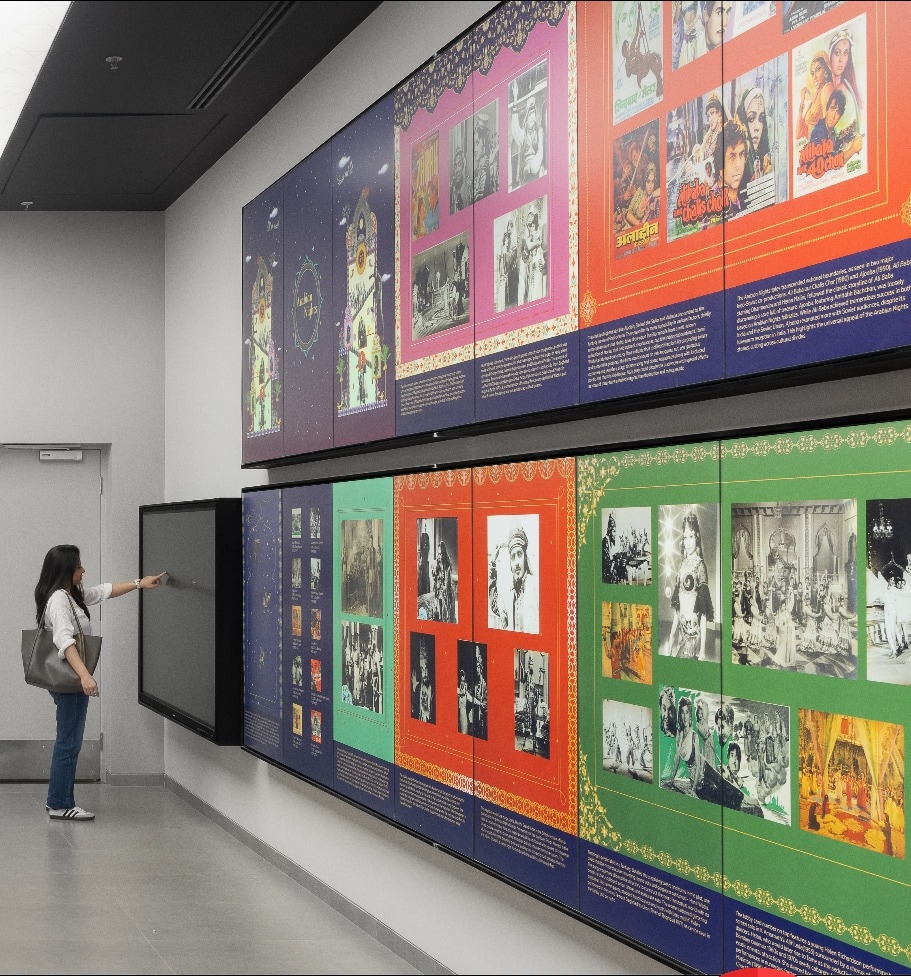
Flip, digitally, through the Kanchana Chitra Ramayana, an exquisite 18th-century illustrated manuscript. Watch shadow puppets come alive. Pick a tribal art form and explore it. Or simply run a pattern search — draw a shape, any shape, on the screen, and it will throw up all the artworks where similar shapes show up in the MAP collection.
“The idea is to invite people to enjoy art on their terms. Children are welcome too,” says Arnika Ahldag, director of exhibitions and curation at MAP. “In the art world, some exhibits tend to be playful, some end up being educational and some are personal — each viewer might look at it and feel something different. We are hoping these exhibits will let people do all these things in one accessible space.”
Flight plan
Part of the larger space, at the international terminal, will consist of temporary exhibitions too. The first of these, on until January, features the work of Bhuri Bai, the renowned Bhil artist from Madhya Pradesh. Colourful dots and dashes, typical of the Bhil tradition, adorn her work. But there’s nothing typical about her art.
A former sweeper, Bhuri Bai, now in her 60s, is known for being the first female practitioner of the sacred folk mural art form, and the first to create the art on paper and on canvas. The exhibition serves as a timeline of her oeuvre, starting with works she created in her 20s, and proceeding through to a 2018 autobiographical series commissioned by MAP.
Where Bhil art typically depicts nature, myth and village life, her art works feature all these and incorporates elements of the modern day (buses, tractors, new landscapes), and intangible elements of Bhil culture such as tattoo designs. On display at the airport is also a painting with a rare self-portrait hidden within it.
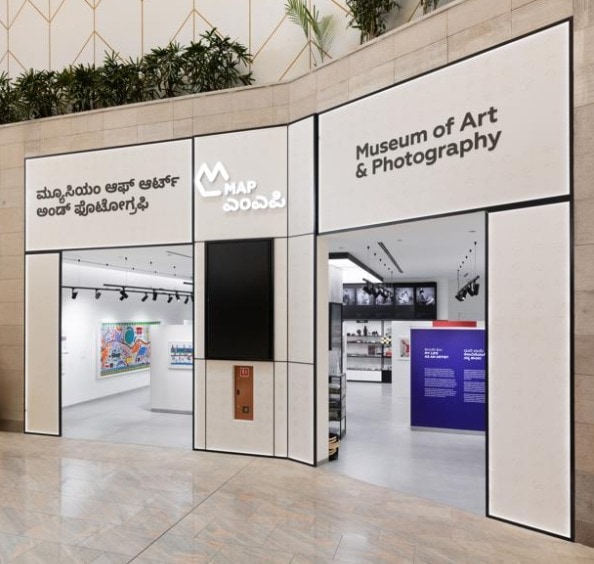
“Bhuri Bai is an artist important to MAP,” says Ahldag, curator of this exhibit. It is her art that covers the boundary wall of the MAP building in the centre of Bengaluru.
“The airport initiative is our way of taking the museum out of the museum,” adds Harish Vasudevan, acting director of MAP, “and democratising the way in which it is experienced.”
Close encounters
Walk into the MAP premises in the city, meanwhile, and a very different perspective awaits.
A new exhibition, on until end-October, serves as a meditation on the mind of one of India’s foremost abstractionists: Ram Kumar.
The artist (September 23, 1924 to April 14, 2018), who died aged 93, would have been 100 this year. To mark the end of his centenary year, MAP pays tribute through a show titled Shape of a Thought.
Kumar, born in Shimla, lived in Delhi and grew to love Varanasi, a pilgrim town that inspired much of his art. In addition to paintings by the artist set in Varanasi, the show features intimate letters he wrote to his friend, Abhishek Poddar, a prominent collector, patron of the arts, and founder of MAP.
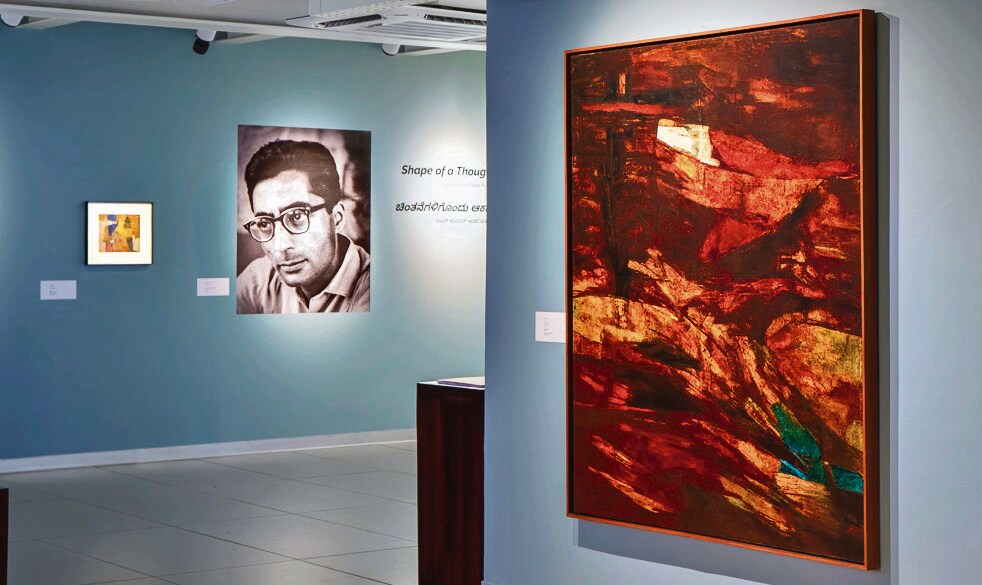
The letters contain musings on people, life, time, our world, and of course, art.
A writing desk invites viewers to contemplate these themes as Kumar did, and write letters too, to a loved one, or to themselves.
Written cues around the exhibition hall, meanwhile, prompt viewers to take a second look at each painting, to see what’s lurking within the shades on canvas.
“I was never hesitant to ask, ‘Can you please explain what you’ve painted over here?’” Poddar says. While Kumar often insisted that he take from each painting what he could, he would often also explain. In the case of one large, brown canvas, “I saw it very differently after Ram said to me, ‘Do you see this person here?’ Now I cannot not see that person.”
Ram Kumar was a man moved by people and cities, and the struggles of the human condition. He was always looking to engage with the world directly, Poddar says. “We met when I was a teenager. I didn’t know enough and would just talk about art, yet we maintained a lifelong friendship and correspondence. He was a mentor to me,” Poddar adds, “and a rare gift to the art world.”


