
 E-Paper



Has India fulfilled its tryst with destiny? A data-driven review
Political freedom was a beginning. How much progress have we made since then, on key parameters like social equity, gender parity, education, economic growth?


“Long years ago, we made a tryst with destiny, and now the time comes when we shall redeem our pledge, not wholly or in full measure, but very substantially. At the stroke of the midnight hour, when the world sleeps, India will awake to life and freedom”.
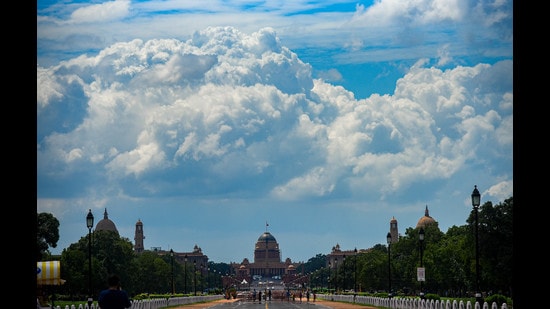
Spoken by Jawaharlal Nehru in India’s Constituent Assembly towards midnight on 14 August 1947. these words are the best expression of independent India’s first celebration of freedom.
Political freedom, however, did not address all of India’s problems. Bhim Rao Ambedkar’s warning in his last speech to the Constituent Assembly on November 25, 1949, articulated the challenges ahead.
“On the 26th of January 1950, we are going to enter into a life of contradictions. In politics we will have equality and in social and economic life we will have inequality. In politics we will be recognising the principle of one man one vote and one vote one value. In our social and economic life, we shall, by reason of our social and economic structure, continue to deny the principle of one man one value. How long shall we continue to live this life of contradictions? How long shall we continue to deny equality in our social and economic life.”
15 August is India’s 75th Independence Day. How far is India from realising its tryst with destiny? Here are six points which can help us answer this larger question.
Universal franchise has achieved political equality across social groups
Elections preceded formal independence in India, as the British allowed for elections with limited franchise from 1920 onwards. The fact that voting rights were limited to the propertied classes meant a natural disadvantage for the socially deprived castes thanks to their poverty. The Poona Pact of 1932, which was a political compromise between Mahatma Gandhi and Ambedkar and created reservation in legislatures for what would later become Scheduled Castes (SCs) instead of the proposed separate electorates for them, is one of the earliest milestones of conflict between caste and democracy in India. Independent India adopted the provision of reservations in the Poona Pact by reserving seats for SCs and Scheduled Tribes (ST) in legislatures.
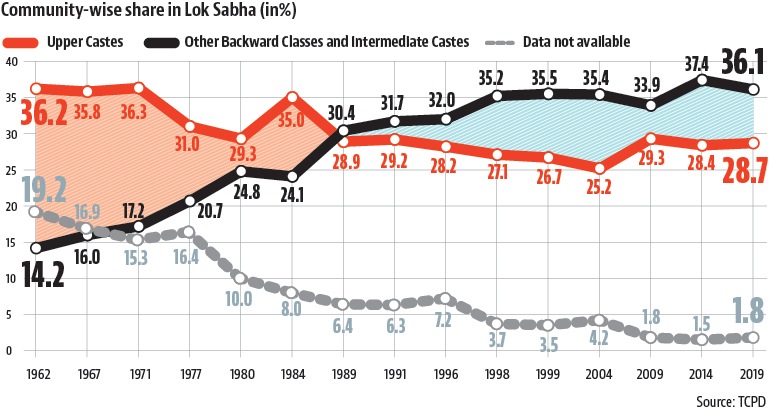
The advantage to upper castes continued even after India adopted a universal suffrage model of democracy after independence. Upper castes had a share of 44.8% in the 1962 Lok Sabha, the earliest period for which data is available in a database complied by the Trivedi Centre for Political Data (TCPD). While the share of SC-ST MPs has remained close to the share of reserved seats, Other Backward Classes (OBCs) and Intermediate Caste (IC) groups have gained in terms of political representation at the expense of upper castes. The rise in political power of the OBC and ICs at the national level, something which has been termed as “India’s silent revolution” by political scientist Christophe Jaffrelot, is the biggest, and perhaps irreversible, progressive political change which independence brought. To be sure, if there is one community which is grossly underrepresented in legislatures in India, it is the Muslims.
.
But caste has been co-opted by class in India’s political trajectory
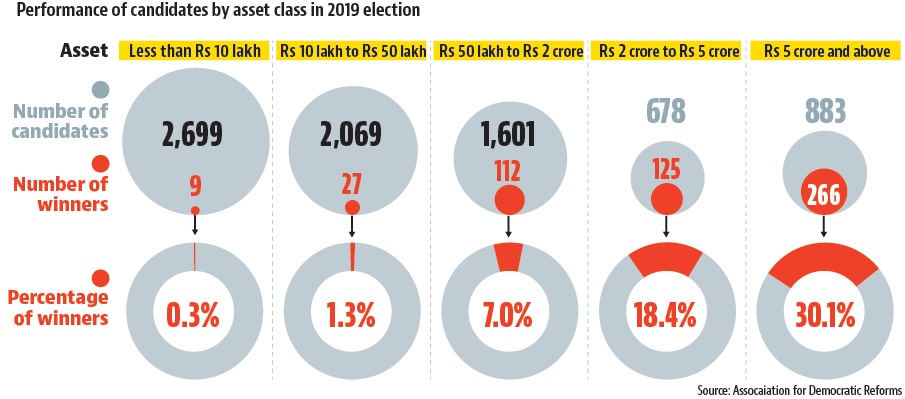
While India’s legislatures are more egalitarian in social terms, Ambedkar’s cherished ideal of ”one man-one vote-one value” has not been realised. This is best seen in a wide gap between average assets of MPs and India’s per capita income. According to an analysis by Association for Democratic Reforms (ADR), a not-for-profit watchdog, average assets of a member of the current Lok Sabha was ₹20.93 crore. 266 MPs of the 542 seats for which elections were held in 2019 had assets of ₹2 crore or more, compared to just 9 with assets below ₹10 lakh. The chance of winning for a crorepati candidate in the Lok Sabha 2019 is 21%, whereas chance of winning for a candidate with assets less than ₹1 crore is 1%, the ADR analysis added. The per capita GDP of India in 2019-20 was just ₹1.52 lakh (at current prices). These statistics show that social equality in politics in India is skewed, as only a small section of the population has a real shot at gaining political representation. To be sure, the fact that India has had uninterrupted democracy (barring the two-year period of the Emergency) and peaceful transitions of political power, is in itself no mean achievement.
.
This is not to deny the progress India has made since August 15, 1947
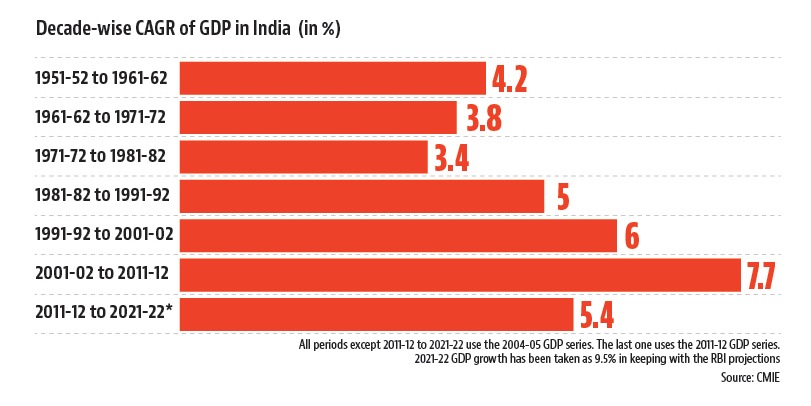
India still has miles to go before it can claim to have achieved a decent standard of living for its 1.3 billion people. But this does not take away the fact that India has made significant gains since independence. From being a country, which was dependent on foreign aid to even provide food to its population, India is now the sixth largest economy in the world in terms of GDP. The country’s economic rise has been a gradual achievement even as the policy paradigm in which these goals were pursued has changed radically from a state-led planned economy model to a deregulated and liberalised regime after the 1991 reforms. Unlike what is believed commonly, not all of the pre-reform period was insignificant in terms of economic achievements. In fact, on critical fronts such as share of manufacturing in GDP, things have not changed drastically in the post-reform period.
.
The challenge of moving from de jure to de facto equality of opportunity
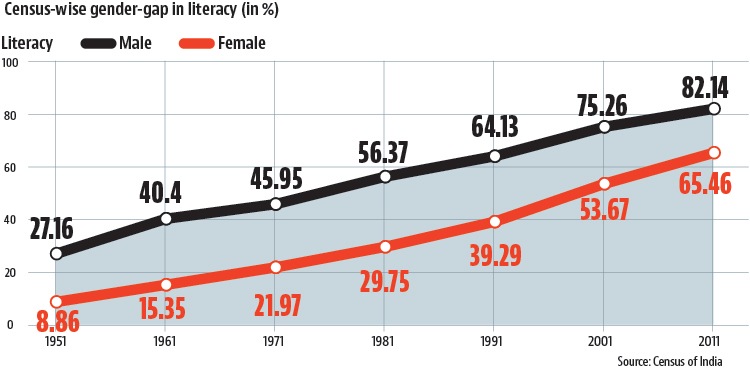
According to the 1951 census, the first after independence, less than 20% of Indians could read or write. Just about 2.63 lakh students were enrolled in higher education in 1950-51. The figures would have been much lower for the socio-economically deprived. Female literacy in 1951 was 8.9% compared to 27.1% for men. These gaps have come down. The gender gap in literacy has been almost eradicated among children today.
.
The playing field is still skewed when it comes to education
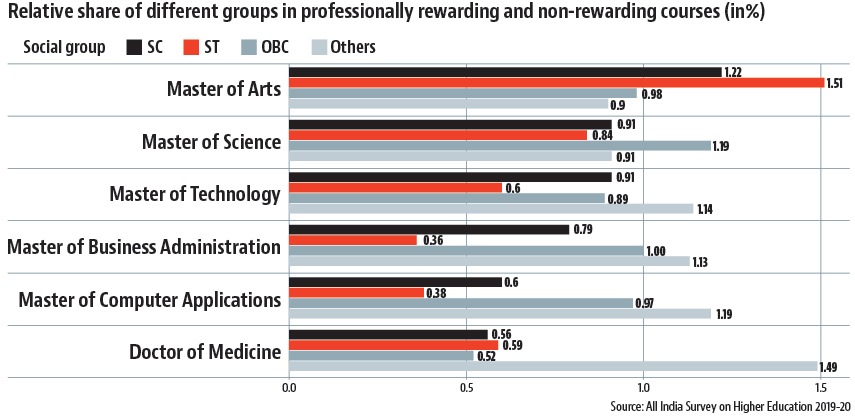
Differences by caste have also fallen when it comes to enrolment in higher education; and reservation policies have made a contribution towards this achievement. But this does not mean that India has created a level playing field across caste-class-gender today. As the economy gets modernised and the so-called skill premium increases, the old elite is preserving and perpetuating its advantage by creating an advantage in access to education with the best possible professional rewards, while large sections of the underclass are frustrated with educational endowments which are of little help in the job-market.
.
The continuing quest for freedom from patriarchy
India can be reasonably proud when it comes to breaking the glass ceiling for women in politics. Even though women have a small share in representation in legislatures, they have occupied the two highest constitutional positions, prime minister and president, in the country. This is significant.
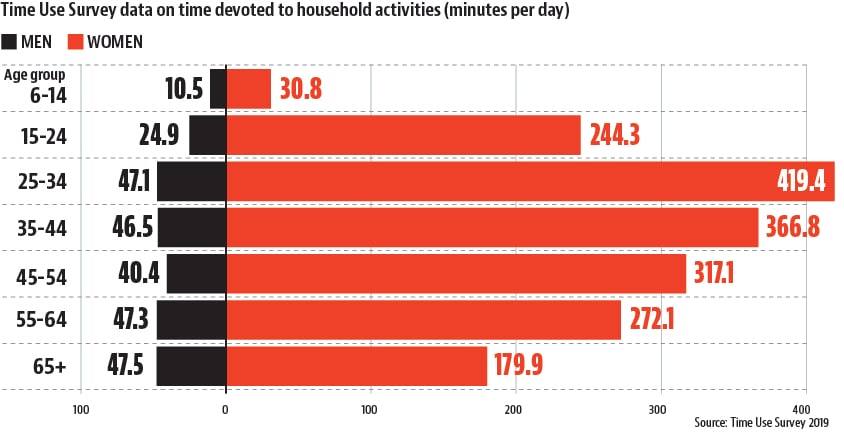
The political story aside, patriarchy is quite entrenched in Indian society. This is best seen in the huge gap between the ability (or lack of it) to work, evident in the difference in the labour force participation rate for men and women. While it is true that India has overcome its old taboos which confined women inside the house, what has not changed is the unwillingness of men to shoulder household responsibilities, making it difficult for women to compete on an equal footing in the professional world. India’s first Time Use Survey, which was conducted in 2019, captured this inequality in the best possible way. If there is one change which India should target between its 75th and 100th Independence Day, it should be eradicating the fetters of patriarchy on its women workers.
 ABOUT THE AUTHORRoshan Kishore
Roshan Kishore is the Data and Political Economy Editor at Hindustan Times. His weekly column for HT Premium Terms of Trade appears every Friday.


