
 E-Paper



Mardon Wali Baat: An interactive web comic is helping reimagine masculinity

 Prefer HTon Google


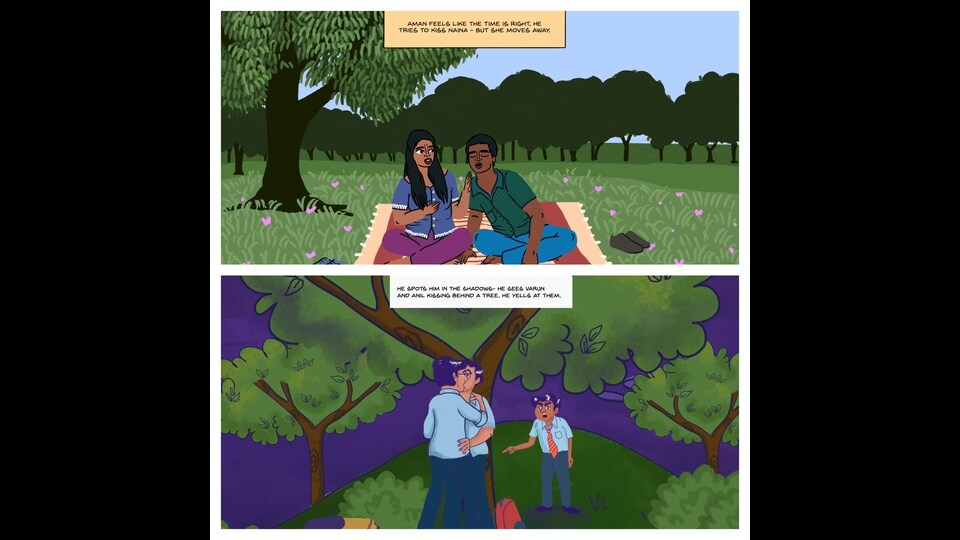
The comics explore stories of first dates, consent, homosexuality. At each stage in the tale, the viewer pick the course of action, and experiences its impact.
How does one know whether to kiss a person on a first date? It’s a universal dilemma, and one easily solved with a question. But a question is fraught with fear of rejection and awkwardness and, oh why not just do it instead?
An online masculinity project takes that last question, untangles it with a great degree of clarity, and explains a lot else about a good first date. It does this in simple interactive web comics that let the viewer choose what steps to take at every stage (and deal with the consequences or — Oh, if only life were the same — simply hit the back button and start over).
Vitally, it also works in how the young man got the idea that just going in for a kiss was the best way out.
The project, called Mardon Wali Baat (or, The Thing About Manhood) was launched by Delhi-based non-profit organisation The YP Foundation (TYPF; in which YP initially stood for Youth Parliament) earlier this year. Its four scenarios — relating to intercaste relationships, parental control and homosexuality, with more scenarios to come — aim to help young men explore definitions of masculinity, as well as power equations, gender equations, empathy, and themes of sexuality and consent.
The interactive comics are designed for urban Indian men aged 18 to 26, says Sagar Sachdeva, 30, TYPF director of programmes and policy engagement. With each choice they make, as they explore a scenario through its likely routes, a message appears explaining why the option they picked may or may not be the ideal one.
Six writers and three illustrators worked with the TYPF programming team to build the storylines on mardonwalibaat.com, over six months, drawing insight from the NGO’s research. “The interactive format allowed us to explore and create different tones and subtext,” Sachdeva says. For example, they could weave in moments of emotional manipulation such as when the boy tries to pressurise the girl into kissing him, by telling her how much time and money he spent organising their date.
The aim is to engage not just with the privileges of masculinity but with the pressure to perform it in certain set ways, which many young boys encounter, Sachdeva says.
The story of how the project was born is telling too.
TYPF team members conducting workshops in Uttar Pradesh and Rajasthan, typically on themes such as sexual and reproductive health or gender-based violence, found that young men were invariably curious, peeping in through windows, sometimes disrupting sessions that were being conducted with women and girls. They were invited in, when possible, but remained reluctant to participate.
So the team tried a different tack. They began to head to college campuses with posters of two popular archetypes of masculinity: Superman and Batman.
“Asking men to describe what was appealing about these men led us to an understanding of the various types and phases of masculinities they experienced across caste and class lines,” says TYPF executive director Prabhleen Tuteja. Discussions about suits, masks and expectations led some to admit that they loved to dance, but danced in secret, because of disapproving family members. Others said they only grew their curled moustaches because it was the easiest way to not be asked one’s caste in Rajasthan.
At the same time, a lot of them were seeing themselves as victims of feminist movements. They were very interested in the question of “Mardangi kya hai? (What is masculinity).”
Online, TYPF reasoned, the young men could explore some of those issues in private, without risking ridicule or censure.
Eager to reach out to the same demographic offline too, TYPF published a handbook on how to conduct workshops on masculinity, earlier this year. It consists of a set of session designs titled Workshops on Beautiful Masculinities, “because we want to acknowledge masculinity to be self-affirming,” Sachdeva says. “We want our sessions to be a space for young people, especially men, to collectively rebuild masculinity as something beautiful that brings pleasure, rather than violence or isolation.”
The toolkit contains ice-breaker games and conversation-building activities that lead into discussions of key messages, and prompt participants to rethink the parts of their assumed identity, and how they include, exclude and affect other people.
Workshops designed using the toolkit have so far been held in Bhopal, Faizabad, Delhi, Varanasi, Indore, Lucknow, Kanpur, Raipur and at institutes such as IIT-Delhi, SAGE University and Banaras Hindu University, among others.
Asma Khan, 26, an on-ground project coordinator from Bhopal, says the sessions aren’t always easy to conduct. “It’s a struggle to hear the same ideas in session after session: that women never mean ‘no’ when they say it, that we are quick to lodge fake cases of domestic violence.” But, she says, the persistence and prevalence of the ideas is itself a reminder that it must be done.
Once you hear them out without judgement, it’s often surprising how readily they listen to you as well, Khan adds. “I’ve had boys come to me and say they have identified acts of micro-aggression or condescending behaviour towards their mothers and sisters and do not know how to apologise for them. It feels good to be able to help.”
One teen spoke of how he forced his sister to hand over her college admission form and let him fill it out; the realisation of how this must have made her feel was now upsetting him.
The regret is a good sign, Khan says. “It’s not easy talking to men about masculinity, as a woman. But the regret tells us that our messaging isn’t falling flat.”


