
 E-Paper



Meat: An excerpt from the new book by alternative-proteins activist Bruce Friedrich

 Prefer HTon Google


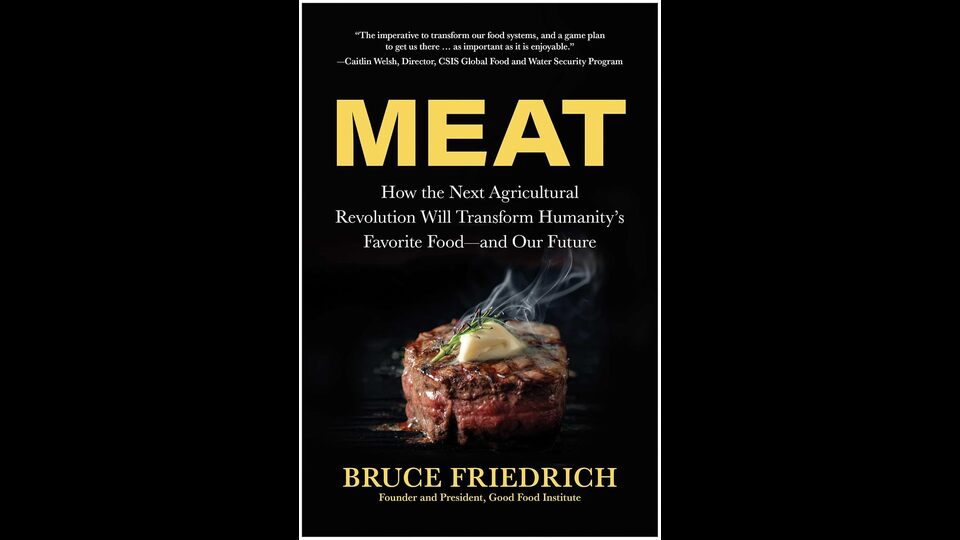
Are plant-based and lab-made meats the future of animal agriculture? An excerpt from Chapter Eight: The Innovation Playbook from Inconceivable to Ubiquitous.
Failures of the Human Imagination: “It hasn’t worked yet. Ergo, it can’t work.”
The human mind isn’t very good at imagining something happening if it has never happened before. Plants have never tasted exactly like meat; that must mean they can’t taste exactly like meat. No one has ever produced actual animal meat in a factory; that must mean it can’t be done.
Usually this doubt isn’t fully conscious. It just feels true. When we’re asked if we’d switch to plant-based burgers that were indistinguishable from animal meat, we reflexively say no. Because of course a plant-based burger cannot be indistinguishable from animal meat.
If that’s your position, please take a moment to ask yourself: What’s the scientific barrier that causes you to think plants can’t perfectly replicate meat? Is it truly impossible, or just very hard? And if it’s just hard, how hard? Have you tried the Impossible burger, Impossible nuggets, or Impossible hot dog? Most people couldn’t tell the difference, and even for those who could, the products are close. Do you really think it’s impossible that science can get us to parity? Why, precisely?
Now cultivated meat: What hurdle do you imagine cultivated meat can’t overcome? Does Tufts biomedical engineering professor David Kaplan’s confidence in cultivated meat give you pause? How about the thousands of other researchers who are dedicating their careers to the field? Or the governments funding the science? Or the meat companies investing in it? What exactly feels impossible to you?
Think back to when you first learned about ChatGPT. You probably hadn’t heard of or imagined large language models (LLMs) like ChatGPT before they arrived. Even experts and superforecasters (people who have consistently outperformed relevant experts in predicting complex and uncertain events) who believed that ChatGPT-level capabilities were possible thought it would take decades before they reached the capacities they were showing by 2023. And then almost overnight we also had Claude, Grok, Gemini, and DeepSeek.
Or think further back, before you bought your first smartphone. Until 2007, it likely hadn’t occurred to you that you’d carry your camera, your music, your phone, and your email all on one device, or that you’d use that same device to hail a taxi, listen to books, find out the name of some random song that’s playing at Starbucks, communicate with someone who speaks a different language, rent a bicycle, and figure out how to bypass a traffic jam on your way to the airport.
Called “convergence” in tech circles, the idea that many features would converge into one device was controversial, with many experts convinced that the idea was folly. A typical headline from a tech industry consultant and futurist reads, “Device divergence always beats convergence.” Less than a year later, Steve Jobs introduced the world to the iPhone.
There are endless examples of technological innovations that went from inconceivable to indispensable (or at least ubiquitous) in a matter of a few decades. Here are a few of my favorites.
Artificial Ice: Unnatural, Impure, Inferior
In 1806, Frederic Tudor began trying to ship ice from Massachusetts to Cuba. After years of failure and mockery, he succeeded, and by 1833, he was shipping ice to India. Dozens of companies followed, and by 1855, Tudor had created an entire industry. By the end of the century, nearly every American home, grocer, and bar had an ice box stocked with natural lake ice. The idea went from inconceivable (ice in India during the summer—you must be kidding?!) to commonplace in under 30 years.
But the natural ice industry was not long for this world.
In 1851, John Gorrie patented the first ice machine, originally for medical use. Over the next decades, “artificial ice” machines spread globally. But they weren’t ideal for homes or food: too expensive, too finicky, and prone to oil or chemical contamination. Meanwhile, natural ice was cheap and familiar. The natural ice industry branded artificial ice as impure, unnatural, and inferior.
But the artificial ice industry fixed its leaks, cleaned up the product, and started running machines on electricity. That brought a major drop in cost and a huge jump in convenience. By 1914, artificial ice had surpassed natural ice in volume. Six years after that, the natural ice industry was essentially dead, hanging on only in a few rural areas. Artificial ice had taken over. Now, “artificial” ice is the only kind you’d even consider putting in your drink. It’s just ice.
A few lessons seem relevant: People didn’t know they wanted ice—until Frederic Tudor showed them. People didn’t want “artificial ice”—until it got better and cheaper and they could see the purity benefits. Early ice innovators inspired others. The technology improved. The price dropped. And what once seemed bizarre and unnatural became normal and preferable. It’s true that ice from lakes and rivers is more natural, but that doesn’t make it better.
Airplanes: They Weigh More than Air, Case Closed
In 1901, the US Navy’s Engineer-in-Chief called human flight “a vain fantasy.” Two years later, the New York Times predicted it would take between one and 10 million years before humans would fly. And even that would require fixing “the existing relations between weight and strength in inorganic materials.” In other words, human flight? Impossible.
In 1910, the Guardian dismissed the idea of airplanes in the military as useless and a waste of money: Planes flew so low to the ground that they could be shot down. Plus, planes couldn’t carry more than a few passengers, making reconnaissance impossible. The editorial concluded: “We cannot understand to what practical use a flying machine that is heavier than air can be put.” The next year, the general who commanded the French War College, Ferdinand Foch, declared that “airplanes are interesting toys but of no military value.”
Just a few years later, World War I was declared, and planes filled the skies, radically transforming military strategy.
Computers: a Dying Fad
In 1943, IBM president Thomas Watson said there might be a market for “maybe five computers.” In 1977, Digital Equipment Corporation’s CEO Ken Olsen declared, “There is no reason anyone would want a computer in their home.”
In 1981, the IBM PC was introduced, and expectations were high. Adoption did not match expectations, and four years later, Apple co-founder Steve Wozniak called home computers “a dying fad.” That same year, Apple CEO John Sculley stated that “a lot of myths about computers were exposed in 1984. One of them is that there is such a thing as the home computer market. It doesn’t exist.” In his view, computers were just for education and small business.
But Steve Jobs disagreed. He explained: “Our job is to figure out what [customers] want before they do. I think Henry Ford once said, ‘If I’d asked customers what they wanted, they would have told me, ‘A faster horse!’’ People don’t know what they want until you show it to them.”
In a Playboy interview in 1985, he explained that just as most people once couldn’t imagine why anyone would want to talk to a disembodied voice on a phone, most people couldn’t yet see what home computers would make possible. He predicted a nationwide communication network that would make home computers as essential as telephones.
He was right of course. Most other experts were wrong.
The Dot-Com Bubble: Shopping Online? Who Wants That?
The dot-com boom of the late 1990s is a textbook example of Amara’s Law and the Gartner Hype Cycle. Between 1998 and 2000, online companies soared in value, generally without the revenue to justify those valuations. In 1999 alone, more than 100 companies doubled their value the day they listed on the stock market.
And then came the crash. The dot-com heavy NASDAQ lost nearly 80% of its value, as trillions of dollars went up in smoke. The obituaries were swift and merciless: Who would buy pet supplies online? Or trust e-commerce startups to scale? Of course the bubble popped.
But it wasn’t the end. It was the beginning. In the years that followed, we got Google, Facebook, and digital streaming with Netflix. Amazon turned a modest profit in 2001 and then rocketed to $1 trillion in market value by 2018 and $2 trillion in 2024. The infrastructure caught up, consumers got broadband, and the original vision proved not just possible but transformative.
***
I could keep going: cars, rail travel, the telephone, light bulbs, electricity, radio, washing machines, television, satellite communication, smartphones, the internet, streaming music, AI, and on and on.
Most people didn’t see these things coming. Early on, almost everyone thought they wouldn’t work or would never catch on. Why? Because the early prototypes were expensive and flawed.
In short, most humans assume the current state is the permanent state: If ice makers are expensive and leak chemicals, of course artificial ice won’t replace natural ice. If hooking into the internet is too cumbersome to make online shopping viable, of course no one’s going to do it. If EVs are expensive and can only drive 80 miles on a charge, of course EVs won’t replace gas-powered cars. Sure, AI can play games and memorize chess moves, but it’ll never write like humans.
Here’s the thing: Once the kinks get worked out, adoption can move far faster than most people expect, including the experts. Cars, artificial ice, airplanes, computers, the internet: Once they solved their technical flaws and brought down costs, adoption hit the S-curve, and they moved from “this will never happen” to near-universal adoption within a few decades.
If you’re having trouble imagining plant-based and cultivated meat replacing industrial animal meat, I invite you to ask yourself whether your doubts sound a little like the people who couldn’t imagine cars replacing horses, artificial ice replacing natural ice, or an airplane ever flying.
I believe that plant-based and cultivated meat are the future. As discussed in the previous two chapters, there don’t appear to be any scientific hurdles that would make either endeavor impossible. And since both products use a fraction of the land, water, and other inputs, first principles point to far lower costs than even conventional chicken at scale. If I’m right, then the main question is: How soon?
(Excerpted with permission from Meat: How the Next Agricultural Revolution Will Transform Humanity’s Favorite Food - and Our Future by Bruce Friedrich, published by Benbella Books; 2026)


