
 E-Paper



Read an exclusive excerpt from Bondhu, a biography of filmmaker Mrinal Sen

 Prefer HTon Google


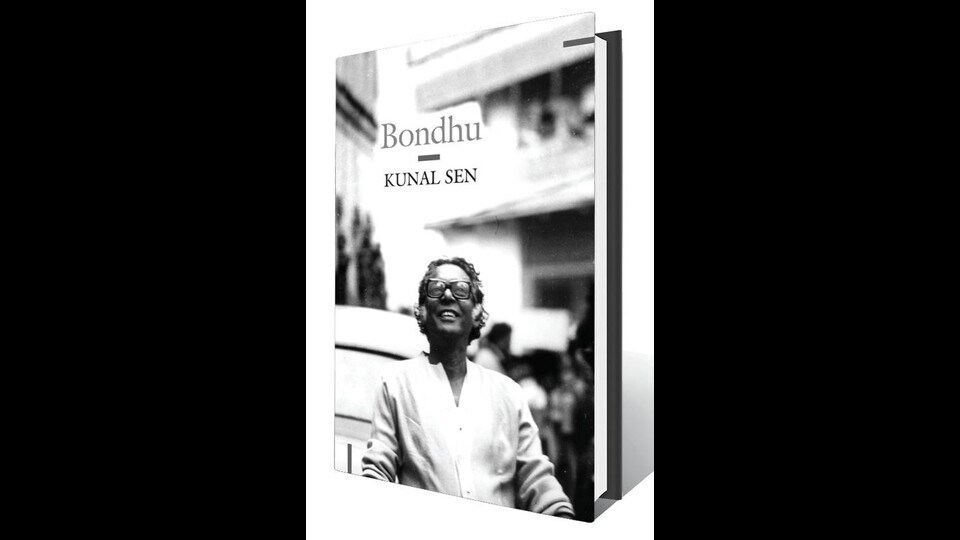
The book, written by his son Kunal Sen, offers intimate portraits of family life, early struggles, and the evolution of one of India’s greatest filmmakers.
I heard a story from my mother about how, right after she and my father got married, they moved to a room on the roof—known in Bengali as chilekothha—and did not have anything substantial to eat for a couple of days. Then one afternoon my mother insisted my father do something about their situation. He promised to borrow some money, buy some rice and come back immediately. My mother believed him, and decided to start the coal-fired stove since it took quite some time for the fire and heat to build up. As the coals began to glow red, she put her rice-cooking handi on the fire and put the water to boil. Any moment now, she thought, my father would return with some rice—but there was no sign of him. My mother began to feel sorry for him, perhaps desperately begging someone for money. So she kept adding water to the pot, letting it boil over and over as she waited for his return.
Suddenly she heard a knock on the door. Opening it, she saw it was one of his friends, Nripen. He asked if Mrinal was home. My mother explained that he had gone out a while ago to do some shopping. Nripen immediately corrected her—my father had been chatting with him and some other friends in the neighbourhood park. He had excused himself a little while ago and then not returned. So Nripen was wondering if he had come back home. When Nripen left, my mother burst into tears. After a while, my father came home with a sullen face and announced that he had tried very hard but not been able to get any money.
My mother said that Nripen had stopped by, looking for him.
My father exploded: ‘Shala!’ Bastard.
My mother poured water over the burning coals, put out the fire and went to bed.
That story was both funny and sad. I hated my father’s selfishness. But looking back with the knowledge of his eventual success, one can lionize his passion and see how that adda in the park with his friends was more important to him than the hunger. Good or bad, that spirit kept him and his friends going, and eventually translated into success for some of them.
His preoccupation with adda never ended. All his life, until he was too old to do so, his living room was never empty. A steady stream of people would walk in unannounced, from early morning until late into the evening. The adda sessions were curtailed a little when he was busy with a production, but they never fully stopped. We always advised him to cut them down and focus more on his work, but he was incapable of and unwilling to change this habit. It remains a mystery to me how he managed to make films, write articles and books and maintain all his professional correspondence while spending most of his waking hours in the company of his friends and, later in his life, his admirers...
…He was always surrounded by friends, though the nature of the circle changed over time. In the early days, they were all fellow travellers, equals, with similar views, similar ambitions, similar trajectories. Many from that group drifted away over the years, for various reasons. Tapas Sen was the only one who stayed close all through my father’s life. Hrishikesh Mukherjee and Salil Chowdhury moved to Bombay and became part of the commercial film world. Though every time they met my father, which was no longer very often, I could still see a spark of the old camaraderie.
Whenever Salil-kaka came home, he and my father would ask each other about common friends from the IPTA days. Sometimes Salil-kaka would sing songs from their activist past. But it was also clear that they lived in different worlds now, that the only common thread was the nostalgia for their time together, when they shared the dreams of a revolutionary future.
My father would sometimes stay with Hrishi-kaka in Bombay. Once, when I was four or five, my father took Ma and me to Bombay, and we all stayed at Hrishi-kaka’s Andheri home. Later, Hrishi-kaka’s son became a good friend of mine through a shared interest in electronics, and I’ve stayed quite a few times at their beautiful sea-facing bungalow in Bandra. However, my father and Hrishi-kaka were making different kinds of films, and slowly it was but inevitable that their intellectual lives would drift far apart.
Ritwik-kaka (Ritwik Ghatak) stayed in Calcutta, and though he and my father were both trying to make films with the same objective, another force was pulling them apart—Ritwik-kaka’s severe alcoholism. I don’t recall ever seeing him sober. No one in my immediate surroundings drank. Therefore, as a child, I was both curious and afraid of drunkenness. Whenever he came to our house, he would be senselessly drunk and abusive, often accompanied by people who could hardly stand straight. I don’t recall a day when he and my father had a normal conversation. During my high-school and early college days, on numerous occasions, local boys would knock on our door and report that they’d found Ritwik-kaka lying drunk somewhere. It was then my job to organize a rickshaw to take him home. I was afraid of him if he visited us when my father was not home; he would engage in incoherent and dismissive conversations about my education. Unfortunately, Ritwik-kaka and my father, who could have had the most meaningful conversations, never did so in their later years. They occasionally met, there were casual exchanges of information, but those lacked any kind of depth. The constant veil of an alcohol-induced haze made impossible any meaningful communication.
In the winter of 1976, after many such incidents, Ritwik-kaka was admitted to the hospital for what would be the last time. My father was beside him when he died. His wife, Surama, taught in a school far away, trying to protect her three children from the chaotic life he had created. All of them came to Calcutta and stayed with us until things settled down. It was as if we were one big family. What his addiction took away, it tried to return on his death. When my mother died, I found a tattered letter addressed to her from Surama Ghatak, in which she’d written about the deep bond between the two families. My mother, for some reason, saved the letter in her handbag. I will never understand why we have such romantic notions about extreme addiction among artists. It is nothing but a disease that destroys families, destroys integrity and ultimately destroys humanity.
Even though his earliest circle dissipated over time, my father continued to surround himself with friends. My earliest memories are from the early sixties, when we lived in a tiny two-room ground-floor flat on Manoharpukur Road (in Kolkata). The living room was small, almost entirely occupied by a sofa bed and a few low cane stools or moras. And by visitors who came to my father throughout the day, friends as well as coworkers from his latest production. The friend circle in those days comprised people connected with the film-society movement, writers, family friends and artists. As far as I remember, the topics of their conversation spanned cinema, politics, literature and everyday banter. My father wasn’t that successful yet, so there were no fans or admirers.
(Excerpted with permission from Bondhu by Kunal Sen, published by Seagull Books; 2023)


