
 E-Paper



Read herrings: Poonam Saxena celebrates Hindi crime writer Surendra Mohan Pathak, at 85

 Prefer HTon Google


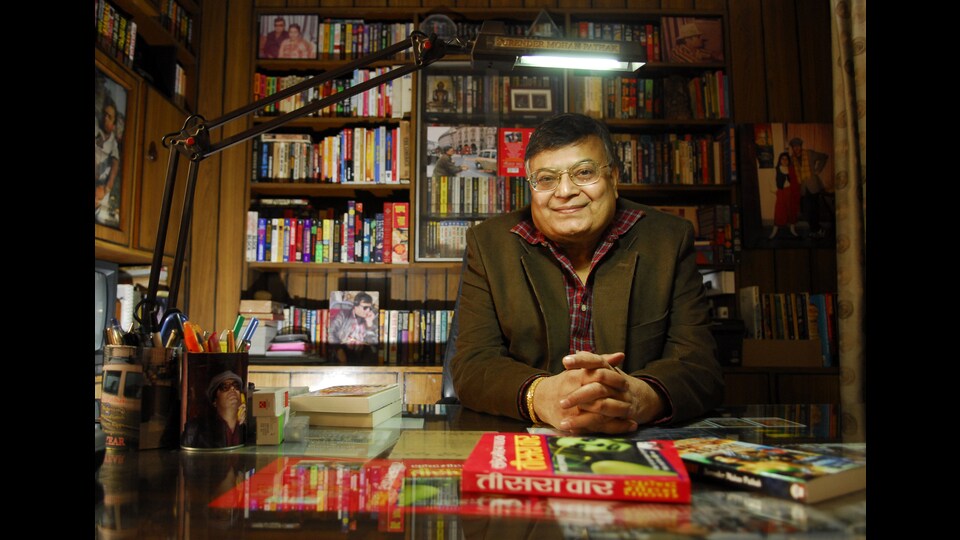
His books are a mix of Hindi, Urdu, Punjabi and English. These are the many Indias he has known. What keeps the pulp-fiction legend ticking?
In 1977, the Hindi crime writer Surendra Mohan Pathak published Paisath Lakh Ki Dakaiti (The 65 Lakh Heist), a nail-biting novel about a daring bank robbery.
Though he had written 93 books before this one, and was reasonably well-known, this would become his biggest hit and establish him as a top-drawer author in his field.
Pathak, born in February 1940, turned 85 this year. His aura remains undimmed, even though the glory days of Hindi pulp-fiction themselves are long over.
These low-cost paperbacks, published on coarse, recycled paper and known in the trade as pocket books or lugdi (Hindi for pulp), were wildly popular in the 1970s and ’80s. There were as many as 70 publishers releasing new titles in those years, most operating out of Meerut and Delhi.
The books were easy to carry, often had colourful covers featuring sexy women, macho-looking men, guns and blood spatter, and did brisk business at railway stations, bus depots and local lending libraries.
They weren’t always about crime. Some combined romance and family drama (like the novels of Gulshan Nanda, many of which were turned into blockbuster Hindi films).
In the crime and mystery sub-genre, writers such as Om Prakash Sharma (called the grandfather of the genre) and younger ones like Ved Prakash Kamboj, Ved Prakash Sharma and Pathak ruled the roost. All except Pathak are now gone.
In his 60-year career, Pathak has written about 300 novels. There was a time when he churned out a book a month. He calls his novels “products”, his readers “consumers”, and himself the “manufacturer”. (“I have become Coca-Cola, I have become Colgate,” he once said, in an interview.)
His fans are a loyal, committed lot. The most ardent call themselves “SMP-ians”, throng his events and follow his work closely.

Pathak’s key heroes and anti-heroes each have a series of their own, running into several-dozen books. His most popular character is Sardar Surender Singh Sohal aka Vimal. Originally a simple accountant from Allahabad, Vimal is framed by his wife and her lover in an embezzlement case, and forced to go on the run. Spurned by family and society, he now pulls off audacious heists, but seldom keeps the money for himself. At last count, there were 47 novels in the Vimal series, including The 65 Lakh Heist.
Perhaps Pathak’s second-most-popular character is Sudhir. The protagonist of a 23-novel series, he is a detective who describes himself as “Dilli ka khaas kism ka harami (a very special kind of Delhi bastard)”.
My favourite is Sunil, a fearless investigative reporter with a daily newspaper called Blast, who smokes Lucky Strikes and rides a powerful Augusta motorbike. The smart-talking reporter is surrounded by a cast of colourful characters, including a pukka Punjabi called Ramakant Ambarsariya aka Malhotra who owns a Youth Club (Sunil has to constantly correct his mangled Urdu) and an upright policeman, Inspector Prabhudayal. Sunil often succeeds in solving cases, much to the inspector’s chagrin.
Pathak eschews lengthy descriptions in favour of snappy dialogue. His books are an evocative mix of Hindi, Urdu, Punjabi and English, reflecting the life he has led. He spent his early childhood in Lahore, where, pre-Partition, people spoke in Punjabi but wrote in Urdu.
The family moved to Jalandhar just before Independence, and from there to Delhi in 1948. It was in Delhi that Pathak learnt Hindi. He soon became a voracious reader of Hindi fiction, particularly the jasoosi upanyas (detective novels).
A classmate, Ved Prakash Kamboj, who would become a lifelong friend and fellow writer, introduced him to the Urdu mystery-novel master Ibn-e-Safi. Pathak was hooked. Over the years, he also read English and American writers such as James Hadley Chase and Erle Stanley Gardner, both of whom enjoyed a huge following in the 1960s and ’70s. (He even translated many Chase novels into Hindi.)
Pathak left home and graduated in Science, from Jalandhar’s DAV College (where ghazal singer Jagjit Singh was a classmate), then returned to Delhi for an MA in Maths.
Meanwhile, by 19, Kamboj had already written his first novel. The young author introduced Pathak to another writer he had befriended: Om Prakash Sharma, who lived with his wife and seven children in a dark two-room house in Delhi’s busy Sadar Bazaar neighbourhood; worked as a loom operator by day; and stayed up at night to write mystery novels by the light of a battery-operated bicycle lamp.
Inspired by these two writers, Pathak took his first tentative steps towards becoming a full-fledged author. His first short story, Sattavan Saal Purana Aadmi (A Fifty Seven Year Old Man) was published in Manohar Kahaniyan magazine in 1959. His first novel, Purane Gunah Naye Gunahgar (Old Crimes New Criminals; the first in the Sunil series) was released in 1963, by a publishing house called Neelam Jasoos.
Over time, this self-confessed sidekick of Kamboj and Sharma overtook them in popularity. Even greater recognition came his way about 10 years ago, when he was discovered by an English-speaking audience, through the concerted efforts of Minakshi Thakur, then an editor with HarperCollins. She built up the Surendra Mohan Pathak brand, creating merchandise, organising events, and publishing him in Hindi and in translation.
Pathak found himself in the spotlight, invited to literature festivals and interviewed extensively by the media. The plain-talking, bespectacled man spoke about holding down a mundane job with the government-run telecom-equipment makers Indian Telephone Industries for over 30 years, even as he churned out his pacy thrillers.
Still, his own story was exciting enough for him to write an autobiography — in four volumes!
(To reach Poonam Saxena with feedback, email poonamsaxena3555@gmail.com)


