
 E-Paper



Teeming with flavour: Swetha Sivakumar on insects as food

 Prefer HTon Google


You don’t have to swallow a cicada. Foods such as ground cricket flour are becoming popular as a source of protein, in some smoothies, protein bars.
If we go by just numbers, Earth is technically a planet of insects with a few humans living on it. About 80% of all animal species are insects. There are between 200 million to 2 billion insects for every human. If we estimate the average weight of an insect at 1 mg, that would be 200 to 2,000 kg of insects per person.
Insects dominate the world both in number of species and total weight.
We need insects more than they need us. These six-legged creatures are vital to Earth’s ecosystem. They are essential for pollinating two-thirds of all flowering plants. Predatory insects like ladybugs, wasps, and ants control pest populations. Dung beetles and carrion flies recycle organic material by breaking down waste; without them, many plants would die out, waste would accumulate, and food chains would collapse.
To feed the growing Earth’s population, the United Nations Food and Agriculture Organization (FAO) predicts that global agricultural production must increase by 70% by 2050. There is a rising demand for animal protein, but the conversion ratio for livestock is quite poor. Currently 80% of the world’s farmland is used to feed livestock, which only provides 18% of global calories.
Edible insects, meanwhile, are cold-blooded and thus more efficient in converting their food into protein. Crickets, for example, need six times less feed than cattle and four times less feed than sheep.
Feeling queasy about some of the insects?
No problem, there are 2,100 edible species to choose from. Insects like grasshoppers, crickets, and mealworms are high in protein. On average, insects are 35% to 60% dry weight protein. They also contain more minerals like iron, zinc and magnesium than beef does. Insects that are in the early stages of life like caterpillars or beetle larvae are higher in fat. Plus, insect farming emits significantly fewer greenhouse gases and produces excellent fertiliser from insect waste.
Moreover, biological pathogens, like disease-carrying bacteria, are less of a threat from insects than from other animal products due to genetic differences. Insects are less similar to humans than pigs, so diseases affecting insects are less likely to affect humans. However, food-borne illnesses can still occur, so insect farmers need to take measures to prevent cross-contamination with other livestock, soil, etc.
There are many cultures where insects are eaten, not just as a calorie source but because they are prized delicacies. Red ants are prized by many tribes including the Paliyar and Bathudi tribes where it is made into chutney. These ants produce formic acid in their bodies to spray as a defence mechanism. For humans, this formic acid tastes sour, a lot like lemons, which is why the dish has a strong lemon or lemongrass flavour.
In parts of South America and South-East Asia, palm weevil larvae and adults are consumed in several ways. The larva is eaten raw, boiled or roasted. When roasted they can get crispy due to their high fat content (10% to 30% fat).
Humans have been eating termites for over a thousand years. In rural Africa, flour ground from them is cooked and fed to children for their high protein levels.
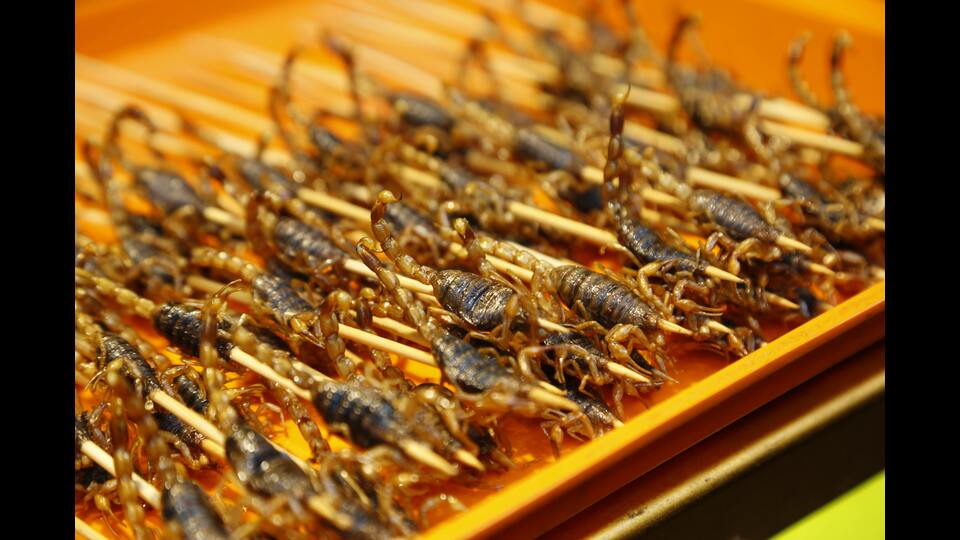
In Thailand, scorpions are fried and sold on skewers at roadside stalls. Its taste can be compared to that of crab. Catching scorpions can be challenging. To avoid poisoning, the insect’s tail and poison sac are carefully removed.
Catching dragonflies is a common childhood activity in countries like Indonesia and China. Children wave reeds dipped in palm sap in the air to get them to stick. Once caught, their wings are removed, and they are eaten boiled or fried. They are low in fat and incredibly healthy.
While the nutritional argument is strong, for most people, the emotional resistance to eating insects is high. A commercially packaged format may help overcome the resistance. For example, ground cricket flour is available as powders that can be added to breakfast smoothies. Or how about a grasshopper protein bar post-workout? To get people excited about eating insects, some environmental agencies are looking to chefs for solutions: to use innovation and creativity to bring them into a space of familiarity. Case in point, Gordon Ramsey loved the red ant chutney during his visit to India shining a large spotlight on this delicacy.
If you thought eating insects was bizarre enough, scientists are researching the benefits of cockroach milk. The female Pacific beetle cockroach, native to Hawaii, is unique among insects because she feeds her young ones a yellow “milk” from her brood sack. Researchers examined the crystals in this milk and found that it is three times richer in calories than buffalo milk and incredibly nutritious. There is still a lot more research needed before cockroach milk finds its way into supermarkets. Now, it’s an example of the possibilities, if we opened our minds just a tiny bit.
(To reach Swetha Sivakumar with questions or feedback, email upgrademyfood@gmail.com)


