There is a track that has become an unlikely earworm for me over the past few weeks.
It’s called Bird’s Word and it isn’t really what you’d call a song in the traditional sense. It’s more a spoken-word recital, delivered in the form of a litany, and it’s like a history of the blues, jazz, and soul — delivered in a little over six minutes, with congas, bass, and sax playing in the background.
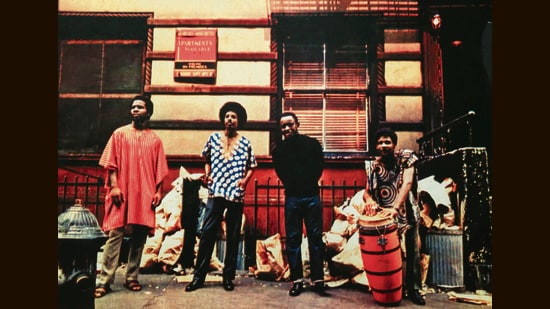
It’s a poem, really, written in the 1970s by the late Jalaluddin Mansur Nuriddin (birth name: Lawrence Padilla), one of the founders of The Last Poets, a poetry collective and spoken-word group formed in the late 1960s.
For a jazz aficionado, the track is pure gold. Nuriddin’s lyrics trace a potent and triumphal history of black music, and pay tribute to the early blues greats:
“As Billie began to sing praises to the blackman’s thing /
The good Brother Monk threw in some funk /
So that the whole world could see /
What he is, was and always will be /
A genius creatively! /
Then Miles began to set new styles /
That put us miles ahead /
As Dizzy set us free to be ourselves /
And ride to heaven from hell in the latest /
El-Do-Ra-Do, comin’ for to carry us home!”
***
The Last Poets were formed in Harlem on May 19, 1968, the birth anniversary of Malcolm X, three years after the black American revolutionary was assassinated.
The group, whose original founders included the two surviving septuagenarians Umar Bin Hassan (birth name: Gilbert Jerome Huling), and Abiodun Oyewole (birth name: Charles David), is the progenitor of hip-hop.
Known as the Grandfathers of Rap, The Last Poets blended powerful and revolutionary political poetry with rhythmic musical performances that challenged racial injustice and celebrated Black consciousness.
They lived by their ideals. In 1970, Oyewole, then in his early 20s, served time in North Carolina for his role in an armed attack on an office of the Ku Klux Klan (KKK).
Those were revolutionary times. The Last Poets were at the forefront of the movement. And their influence was expansive.
They inspired other spoken-word performers, including Gil Scott-Heron (author of The Revolution Will Not Be Televised, inspired by The Last Poets’ When the Revolution Comes); and rappers such as Public Enemy’s Chuck D, Tupac Shakur, Mos Def, and the hip-hop band The Roots.
And they’re not done. With a tally of more than 20 albums, The Last Poets’ two remaining members released a new one last month. Africanism was recorded in 2019 and features music by Tony Allen, the legendary Nigerian drummer and former musical director of the late Fela Kuti’s ensemble, who died in 2023.
The album offers a powerful fusion of Afrobeat and spoken-word poetry. The Last Poets’ raw and passionate delivery is amplified by Allen’s driving rhythms, creating a dynamic and energetic sound.
The lyrics harness the power of music to comment uncompromisingly on the social and political. Their style, often confrontational and intense, can seem challenging but never irrelevant. It employs raw, unfiltered language that is intentionally provocative.
The poetry of this band has always been a form of linguistic warfare against oppression, played out in rhythmic speech later adopted as the style of hip-hop.
But perhaps one of The Last Poets’ most remarkable achievements was transforming poetry from an academic, often-sanitised art form, into a powerful tool of social critique.
They showed that a literary art could be a weapon of popular resistance. A weapon that remains razor sharp, as their new album, Africanism, shows.
(To write in with feedback, email sanjoy.narayan@gmail.com)

 E-Paper