
 E-Paper



The Web Beneath the Waves: Wknd chats with the author of a new book on undersea internet cables

 Prefer HTon Google


These cords on the ocean floor make the internet possible. Who builds them? Who tends to them? An interview with journalist and author Samanth Subramanian.
There are about 900,000 miles of undersea cables lying on our ocean floors, holding filaments often as thin as a human hair. Together, these cables transmit 95% of all international data, and form the physical web that makes the internet possible.
The longest of these, named 2Africa, stretches 28,000 miles, along the coasts of UK, Portugal and West Africa, with the line now being extended to the Middle-East and India.
Each such cord has at its heart the actual glass fibres. Protecting these are layers of steel wire, covered in copper wire, covered in polymer fabric (for final waterproofing). The whole assemblage then simply sits on the ocean floor.
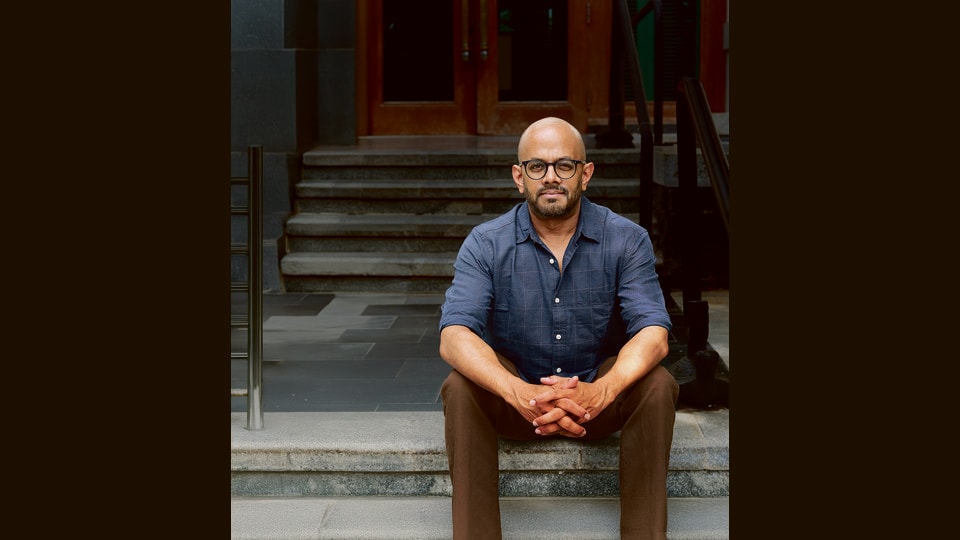
“For the longest time, there were about 100 to 120 cable cuts a year, nearly all of them accidental. There would be a geological event or a shipping vessel would chuck its anchor overboard, which would land on a cord and cut it,” says author Samanth Subramanian, 44, formerly a journalist with HT’s business paper, Mint.
Today, countries have taken to patrolling their deep-sea lines. (India, incidentally, has 17, regulated by the government of India and owned and maintained by communications companies such as Tata and Reliance, in frequent collaboration with global tech giants such as Meta and Alphabet.)
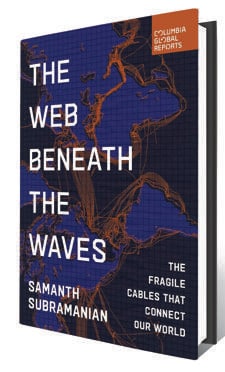
Subramanian’s new book traces such cords around the world. The Web Beneath the Waves traces elements of risk, geopolitical tension and corporate power grabs. “In recent years, various countries have been suspected of deliberately cutting their rivals’ cords,” he says.
A former cricket journalist too, Subramanian has previously written on: the roles fish play in coastal cultures across India (Following Fish; 2010); war-ravaged Sri Lanka and its people (This Divided Island; 2014); and the British-Indian evolutionary biologist JBS Haldane (A Dominant Character; 2019).
He is acting managing editor of the recently launched Equator magazine (click herefor the Wknd story on that unusual offering), and lives in London with his wife Padma Ghosh, who is a science communicator, and their eight-month-old son.
“I have grown increasingly aware of the importance of finding things that one likes and committing to them deeply... It’s such a bizarre, exciting and sometimes scary world, and there’s just so much to learn,” Subramanian says.
Excerpts from an interview.
* You’ve written about fish, geopolitics, war-ravaged Sri Lanka. How did this book, on undersea cables, come about?
In 2011, I came upon a 40,000-word essay by the science-fiction writer Neal Stephenson, published in Wired magazine in 1996. At that early juncture, he decided to track the progress of the longest undersea cable ever laid in the world. (The Fibre-optic Link Around the Globe or FLAG, which runs 17,400 miles, from North America to Japan via UK and India.)
Stephenson managed to make FLAG seem like the most exciting thing in the world. That stayed with me. Then, in 2022, a volcano erupted off the coast of Tonga, cutting its only international data cable. I remember reading about that and thinking: here’s a country that has just suddenly lost all access to the world, in a way. I wondered what that was like.
When I pitched the book, 26 years had passed since Stephenson’s essay and I wondered how the infrastructure had changed. While I was researching the book, the cables became even more of a geopolitical flashpoint. Countries were worried that rivals would cut their links. They started to treat these as national security installations, and quite rightly so, since the impact of a cut on the economy alone could be tremendous. This lent the book a kind of urgency. I spent about two-and-a-half years reading, travelling and doing interviews, and I became, as Neal Stephenson put it, a “hacker tourist”.
.
* What kinds of people did you meet? What does it take to keep this deep-sea world intact and running?
Most of the characters in this world are men, oddly. I talked to captains of repair vessels, whose crews have struggled to do their very delicate work — splicing together broken ends of fibreglass wires — amid storms and difficult weather.
I talked to people who manage cable depots, which are coastal facilities that store, maintain and deploy the crucial fibreoptic lines, and are located near ports.
It’s a very closed industry, with its own myths and urban legends. There’s one man who has been leading work in this area, for various companies, for so long — over 50 years — that there are two fibre pairs in a cable system named after him: Rick and Perry. (The man, Rick Perry, currently works with Vodafone.)
.
* So, we know these things are out there. We have some sense of how pivotal they are. What did you learn that you think most people don’t know, and should?
The one thing people don’t think about is that the internet is a very material thing.
We know there are data centres somewhere, but because the phone is in our hands and because we use wi-fi, we tend to think maybe that data just bounces off satellites in space or goes to a tower and then comes to us.
We don’t realise that 95% of international data traffic goes through undersea cables. Stop to consider that, and one’s conception of the internet really changes, because it suddenly becomes something that’s extremely territorial, and vulnerable.
I was also surprised to learn how politicised this infrastructure has become.
For instance, two of every three new cables laid today are laid by one of the four American tech giants: Meta, Alphabet, Microsoft and Amazon. That says a lot about corporate control of data and privacy.
It is also a cause for concern that, if a West African country or a small Asian country is under-served by the internet and needs a cable to land on their shores, such companies have enormous leverage.
.
* In the book, you also describe grey-zone warfare, “in which ghost ships cut the cables of other countries”…
In recent years, certain countries have been suspected of deliberately cutting rivals’ deep-sea cables. Taiwan, for example, suspects China of cutting its cables a few times. The Baltic States think Russia could do that.
The UK is so worried about its undersea infrastructure, it has deployed two vessels to patrol its territorial waters round-the-clock.
The reason it’s called grey-zone warfare is because it’s quite easy to do such damage in a seemingly innocuous way. One could send a fishing boat out to snag a link and no one would be able to say whether it was deliberate or not.
.
* It doesn’t help that the locations have to be public…
For 150 years, ever since the first telegraph cable was laid, the locations and coordinates have remained public, because if we are to protect these links from accidents, it is best for ships and fishing boats to know where they are.
While working on this book, I asked certain government officials whether they would rethink this policy of publishing the coordinates, and they said that, for the first time, they were considering it.
.
* Speaking of the geopolitics, how is the map of these cables changing?
Well, look at a map of telegraph cables in the late-19th century and a map of fibreoptic cables today, and you will see that they’re strikingly similar.
There’s a big swatch running from Western Europe to USA. Another big loop going from UK around South Africa and into India. Which is how cables were laid in the colonial era.
Telegraph lines were laid in part to make sure colonial powers could control these faraway territories. Those routes are still being mirrored.
That’s basically a reflection of the fact that, in 150 years, the distribution of wealth and power around the world has not changed that much. Maybe with the exception of China. The only really radical change in the map is the increased number of cables in China and parts of South-East Asia.
.
* How does technology like Starlink’s fit into it all?
It is tempting to think about satellites as a viable alternative to cable. You know, we have Starlink, and we have all these other constellations of satellites in orbit. Maybe they could take on some of the burden, you might believe. But it’s not a long-term solution simply because of how our consumption of data has exploded.
So it’s impossible to think of these satellites as a complete and permanent alternative.
.
* If we can squeeze in a personal question, who is Samanth Subramanian when he isn’t writing? How do you most like to spend your downtime?
I have a few chief interests, like everyone. I try to go to as many Test matches in the English summer as possible. I also have a long-suffering teacher of Hindustani vocal music. I have studied Carnatic music in the past, and that is basically the only music I listen to.
I have grown increasingly aware of the importance of continuing to find things that one likes and committing to them deeply. It’s a very rewarding and mentally refreshing process. It teaches you a lot, but on an even more profound level, it teaches you a lot about yourself.
This is such a bizarre, exciting and sometimes scary world we live in. And there’s just so much to learn.


