
 E-Paper



Wolf pack: 80 years since the death of Hitler, why does his legacy endure?

 Prefer HTon Google


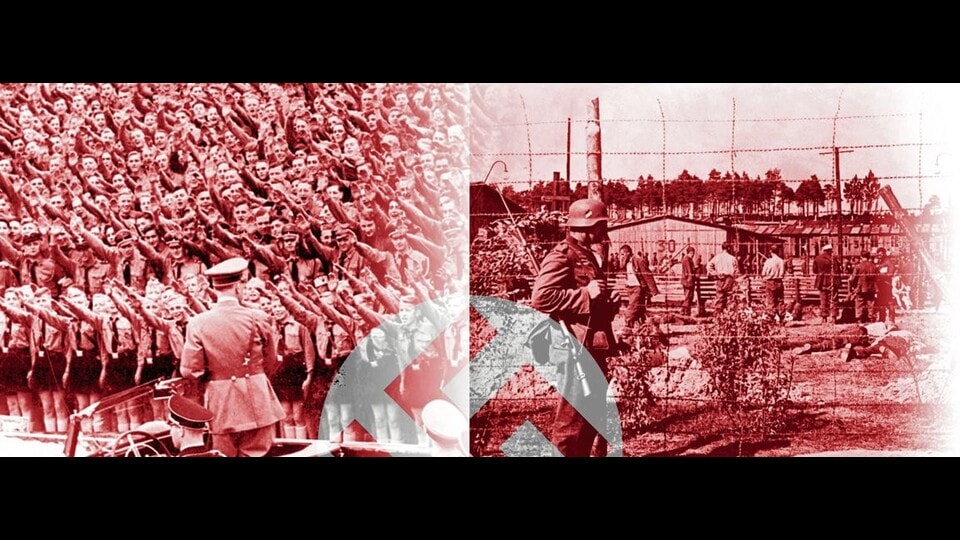
The ‘little wolf’ who caused 11 mn deaths didn’t act alone. He recognised a context that galvanised a nation. What was it? Can we keep it from happening again?
Alan Bullock, the British historian who wrote the first comprehensive biography of Adolf Hitler, in 1952, considered the Nazi leader “the most evil man in history”.
It is a view that has endured, though history has no shortage of mass murderers. Stalin, Mao, King Leopold of Belgium, Winston Churchill, Pol Pot, Mengistu Haile Mariam of Ethiopia, and, going back in history, rulers such as Genghis Khan and Timur have caused millions of deaths.
That didn’t prevent British politician Jack Aaron from recently calling the German dictator “brilliant”. Or stop Carl Paladino, a Republican candidate for the US Congress, from saying he “was the kind of leader we need”. Or cause Kanye West to think twice before singing “N***a, Heil Hitler”.
In 1990, even before the worldwide web was publicly available, American author and attorney Mike Godwin formulated what came to be called Godwin’s law. “As an online discussion grows longer, the probability of a comparison involving Nazis or Hitler approaches one,” he said.
While Godwin hoped to reduce trivialising references to Hitler for the purpose of scoring points online, West’s track appears to be a logical culmination of his law: a natural progression of online posts from demented statement to deranged song.
Hitler, who died by suicide in 1945, has been trivialised often, through so-called “dank memes”. In modified video clips from the German movie Downfall (2004), he rages over everything from Disney’s acquisition of Marvel to the use of jaggery in sambar. More often, he is treated as an outlier, a “he who cannot be named”, a monster whose deeds placed him outside humanity.
But his impact and influence endure. Nazism may be a dirty word, but its tactics are adopted all over the world.
Hitler wrote the playbook for the authoritarian takeover of a democracy, a playbook that has been followed with remarkable success by rulers chasing varying degrees of authoritarianism (and with varying degrees of the brutality associated with it).
US President Donald Trump, who has made references to a possible (and currently unconstitutional) third term, for instance, has said that he “needs the kinds of generals Hitler had”.
But ascribing to Hitler a power he did not possess has its pitfalls too.
It was not Hitler alone who killed 11 million people, including 6 million Jews. What he did was recognise a context. It was Hitler’s adoption of a specific set of tactics for that context that saw an entire nation support an ideology that rested on the concept of their racial superiority and the need to exterminate the enemy within, the “ungeziefer” or “vermin”.
He read the mood of his country so accurately that not only was he voted into power, he and his Nazi party enjoyed a 70% to 80% approval rating in 1939, six years after the first concentration camps were built (for political prisoners).
As an intelligence officer after World War 1, Hitler was originally asked to infiltrate the outfit he would later lead: the German Workers’ Party (DAP), a new and obscure far-right group with a platform that combined anti-Semitism, nationalism and, improbably, both anti-capitalism and anti-Marxism.
He was so impressed by their ideas that he signed up as a member a few months in (late 1919), and began to rise through the ranks. As head of propaganda, he created a unique and striking visual design for the party’s posters, and designed the reverse-swastika flag.
Hive mind
In February 1920, at a beer garden in Munich, he made the speech that would define the party’s mission, announcing a 25-point programme. DAP was renamed the National Socialist German Workers’ Party, or Nationalsozialisten, or Nazi.
That last term was the pejorative, coined as an epithet to mean something akin to “country bumpkin” or “regressive hillbilly”.
The name suited Hitler fine.
He was clear about the people he wanted to reach. He wanted the rabble, the riffraff and the fervent communist. He wanted people who wanted an overthrow of the existing social order.
It was only with the support of the rabblerousers that he could implement the plan he described as “unchangeable”; one that “only finds its completion through its fulfilment”.
The early aims of the Nazi party were indistinguishable from those of the communists, and were designed to appeal to the newly poor of Germany. The party promised to break from the slavery of vested interests, ensure a total confiscation of all war profits, nationalise all businesses that had turned into corporations. The key difference was the Nazis’ rabid anti-Semitism.
Once he had the support of the poor, he proceeded to charm the rich.
Here, he had help from an unexpected quarter. Rich women found Hitler fascinating. They flocked to his speeches and helped him make inroads among the elite. These women included Helene Bechstein, the wife of Edwin Bechstein and the owner of the Bechstein Piano Company; Elsa Bruckmann, born a Romanian princess and wife of a powerful publisher; and Winifred Wagner, daughter-in-law of the composer Richard Wagner.
Bechstein adored her “little wolf”, supplied him with an expensive wardrobe and taught him the ways of the aristocracy, including how to use their many forks. Bruckmann vied with her to introduce Hitler to anyone who could help the Nazi cause.
When he spoke to a group of German industrialists ahead of the 1932 election, he made such an impression that significant funding for the Nazi party followed.
Eventually, after the party’s electoral success that year, 16 of Germany’s biggest industrialists wrote to President Paul von Hindenburg, asking him to make Hitler the Chancellor of Germany. After all, had he not told them in a private meeting that he planned to seize absolute power because “private enterprise cannot be maintained in the age of democracy”.
Amid all that would follow, the list of businesses that supported his regime remained a who’s who of German industry. Ferdinand Porsche accepted a contract to design the Volkswagen Beetle as a “people’s car”; his manufacturing plants would go on to make military vehicles too. Mercedes-Benz supplied bulletproof cars for Hitler and his inner circle. Hugo Boss famously made the SS uniforms. Allianz insured concentration camps. Deutsche Bank expropriated Jewish businesses. Adidas made shoes for Hitler Youth; its founders, Adolf and Rudolf Dassler, joined the Nazi party in 1933. The engineering firm Topf & Sons built the crematoria ovens.
Peddling hate
Through it all, the propaganda arm of the party used radio and film, the new technologies of its day, to push the Nazi agenda. Particularly significant was the Fabrikationen or Fake News division, which broadcast entirely fabricated articles intended to cause outrage.
With the widespread support he received, he was able to hollow out institutions while appearing to abide by the law. He even delivered on the promise of a better economy, at least at first.
Ultimately, Hitler’s playbook remains as relevant as ever: a strong man promising to return his country to greatness, exploiting a feeling of national decline; a disdain for democratic processes; a scapegoating of minorities, where the “other” is portrayed as the cause of the decline; media manipulation; a need for spectacle; the undermining of institutions and free speech; a constant assault on truth; and the normalisation of political violence. And as long as it lives on, so does the man.
(K Narayanan writes on films, videogames, books and, occasionally, technology)


