
 E-Paper



Wood you believe it?: The bloodied, grisly story of cinnamon

 Prefer HTon Google


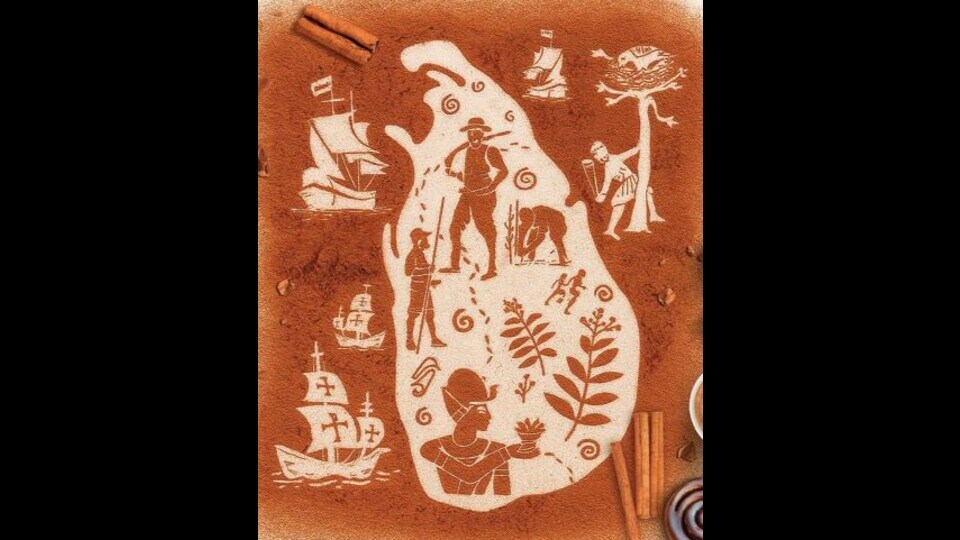
Pepper got all the attention. But cinnamon’s tale involves pharaonic funerals, empires and devastated landscapes. Meet the spice that ‘also’ changed the world.
It was once considered so precious, it was used in offerings to the gods. Today, it’s in soaps and spa treatments, Coca-Cola and candles, lattes and doughnuts. How did cinnamon get everywhere?
The spice was once the stuff of legends.
Arab traders spun elaborate tales to keep Europeans from finding out where they sourced it. They said, for instance, that there were giant birds who gathered these bits of bark from “unknown trees”, and built nests with them. The traders left huge chunks of meat for the birds to carry away; when the nests cracked under the weight of the meat, the cinnamon supposedly rained down to the ground. Other tales told of cinnamon that came from marshes protected by giant bats or winged serpents.
By the 1st century CE, the bark was so expensive that a pound of it cost the equivalent of several months of the average wage in Rome.
Europe remained hooked. This spice was considered a panacea, flaunted as a status symbol. Then a new era dawned. Constantinople fell to the Ottoman Empire, in 1453. The search for new trade routes began.
The craze for this spice, among others, would drive history, commerce, trade and exploitation. In the case of cinnamon, most of this activity would be focused in Sri Lanka, with Indonesia, the Philippines, and the Malabar coast in India emerging as smaller hubs.
***
Cinnamon has historically grown most widely in Sri Lanka, South-East Asia and China. But only Sri Lanka grew Cinnamomum verum or true cinnamon: thin, flaky, with a delicate and well-rounded flavour.
Elsewhere, it was Cinnamomum cassia: thicker, darker and more pungent.
(Vietnam and Indonesia have their own variants, C. loureirii and C. burmanni respectively.)
In India, the term for cinnamon (used for both varieties) comes from the Chinese variant: dalchini; literally, “Chinese wood”. Confusion over the two key variants, incidentally, persists even today, with a lot of cassia sold as true cinnamon.
Madagascar and Seychelles now grow true cinnamon too. Sri Lanka, however, leads production, supplying close to 90% of this variant of the spice to the world.
***
There is evidence that cinnamon has been making its way around the world for at least 4,000 years, though it isn’t clear what variant is referred to in the ancient records, or what route it took.
What is clear is that it was used in funeral rites in Ancient Egypt, and perfumes in Ancient Greece and Rome, as well as in food and beverages consumed by the elite. Across China, South Asia and Europe, it turns up in recipes for a range of concoctions used to alleviate fevers, colds and digestive ailments, and in aphrodisiacs. Across Ancient Egypt, Greek and Rome, it was also used in offerings to the gods.
Volumes rose sharply in the 10th century, amid a boom in Indian Ocean trade.
Cinnamon and other spices were erroneously thought to protect against illnesses such as the plague. As a result, demand boomed during the bubonic plague outbreak of the 1300s.
By the 14th century, travelling scholars such as Ibn Battuta of Morocco were making their way around the world, replacing myths with first-hand accounts.
It wouldn’t be long before the secret of cinnamon was out.
***
By the 16th century, Europeans didn’t just know what to look for. Trading companies knew exactly where to look.
Sri Lanka’s forests, where cinnamon trees grew in the wild, began to draw attention. In 1517, fleets carrying Portuguese merchants and soldiers began to arrive.
At this point, the right to collect and trade in this spice was vested with the local king. The harvesting of the inner bark of the tree, which was an arduous and complicated process, was performed by a community that had developed expertise in this area: the Salagama, also known as the Chalia, and believed to have roots in southern India.
They provided this service as a form of rajakariya or royal duty, in return for the land they lived off and farmed on. Upon their arrival, the Portuguese began to make inroads into this trade, setting up trading stations and working to secure exclusive rights to buy and sell the spice.
By the mid-17th century, the Dutch East India Company had swept in and ousted the Portuguese from the coastal regions and secured treaties with local rulers to establish a monopoly over cinnamon trade. The Dutch determination to capitalise on demand saw them intensify the pressure on the Salagama, and on the forests. Hundreds of cinnamon trees were felled in a single season. Labourers were pushed to work longer hours and meet larger quotas.
In the first half of the 18th century alone, the Salagama community delivered almost 16,000 tonnes of the spice.
The Dutch now had a global monopoly.
Cinnamon would drive the Dutch East India Company’s profits, generating the revenue that would make it possible for the tiny nation of the Netherlands to run an empire that stretched all the way to Indonesia.
***
Meanwhile, in Sri Lanka, the Salagama community found themselves trapped.
Records show that even children were forced to participate in the arduous stripping of the trees.
When Salagama workers attempted to flee the Dutch-administered districts, records show that they were flogged and fined. At one point, the Dutch even issued decrees to prevent members of the Salagama community from marrying into other communities, to keep them from changing their caste and moving away from cinnamon peeling.
It had now been over 200 years since the first colonial ships arrived. Trees of the right age were becoming harder to find. The Dutch began to re-examine their model, and the first plantations were set up, in the 1770s.
Eager to shore up supply, they began to encourage local chiefs to set up cinnamon plantations, in addition to establishing them on their own lands. Some of the owners were members of the Salagama community, who turned their expertise in the industry into social and economic mobility.
***
The British would sweep into Ceylon next. Their East India Company gained control of the Dutch territories and the Kandyan kingdom between 1796 and 1815. However, their focus was on newer cash crops such as tea, coffee, rubber and cotton.
The French, meanwhile, had simply ferreted cinnamon plants out of Dutch colonies in the 18th century and planted them in Seychelles, where they continue to flourish. Between the more-widespread cultivation and the plantation model, global prices began to level out.
Farmers still harvest cinnamon much as they did in the early days of the plantation model: the plant is coppiced so it assumes the form of a bush, rather than a tree and the bark is harvested from plants older than three years.
The peeling is still so delicate a process that it is done by hand. Skilled labour remains a challenge.
There are no invaders sailing into the bay, but new threats have emerged, chief among them: poor soil, shifting climate and, ironically, fluctuating prices.
(Rachna Shetty is a research specialist with MAP Academy, an online platform encouraging greater engagement with South Asia’s art and cultural histories)


