
 E-Paper



Rage bait: Why Santanu Hazarika’s art is the moodboard of our time

 Prefer HTon Google


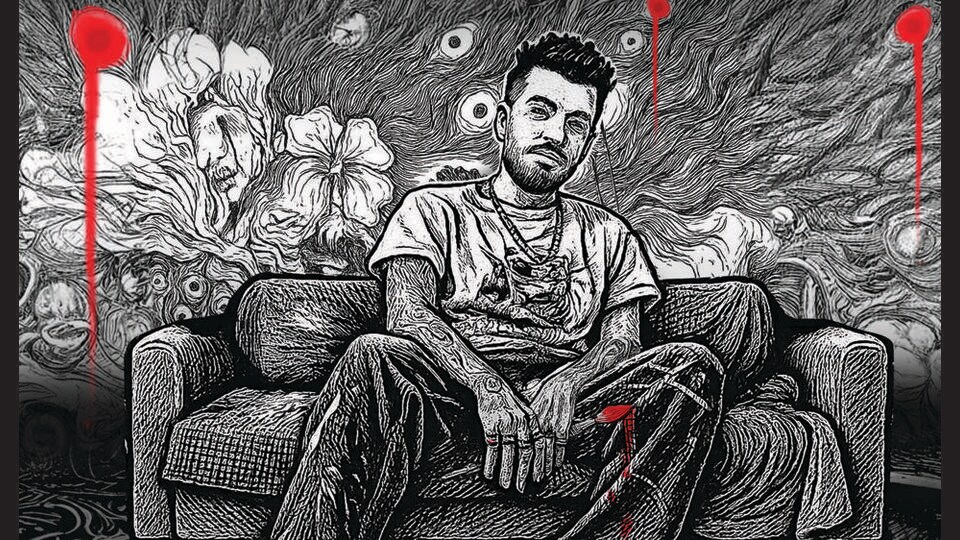
Santanu Hazarika’s art shows up on sneakers, motorcycles and speakers. It’s got heavy metal-meets-anime energy. How does one channel rage into raging success?
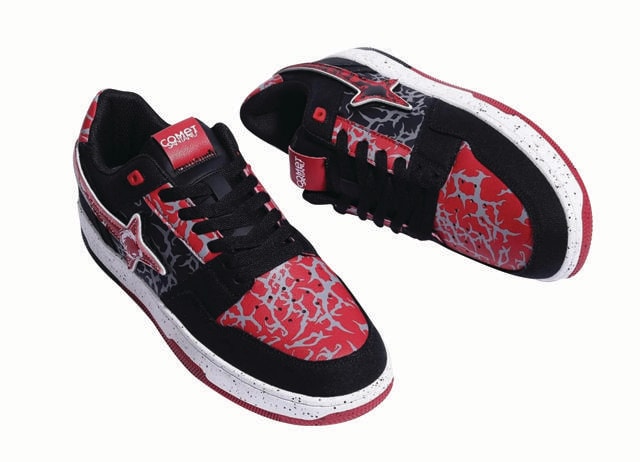
Within art circles, all eyes are on Santanu Hazarika. Outside art circles, all eyes are on Hazarika too – we just didn’t realise it. The 33-year-old artist has been putting his stamp on everything. Been eyeing Comet sneakers? Last year, he designed a red-black-and-white pair with a thorny pattern and paint splatters – it sold out in two hours. Browsing tech? He did a collab with Zebronics, putting brooding dragons on speakers and mousepads in 2023. Dreaming of a luxury ride? He gave the BMW CE-02 Electric motorcycle a cyberpunk-futuristic customisation in 2024. Into gaming? Here he is again, designing the Valorant Championship Tour jersey. Open Spotify. Hazarika designed the visuals for Ritviz’s song Mehrbaan, Raftaar’s rap album Zero to Infinity, and the posters and promos for Badshah’s 2022 Paagal tour.
You might know Hazarika more intimately, actually. Earlier this year, he worked with the innerwear brand Bummer, putting a flood of tiny black-and-white illustrations of pigeons and urban life on briefs, boxers and bras.
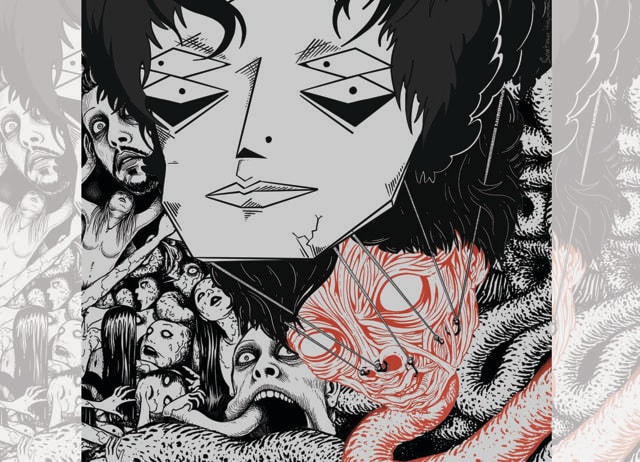
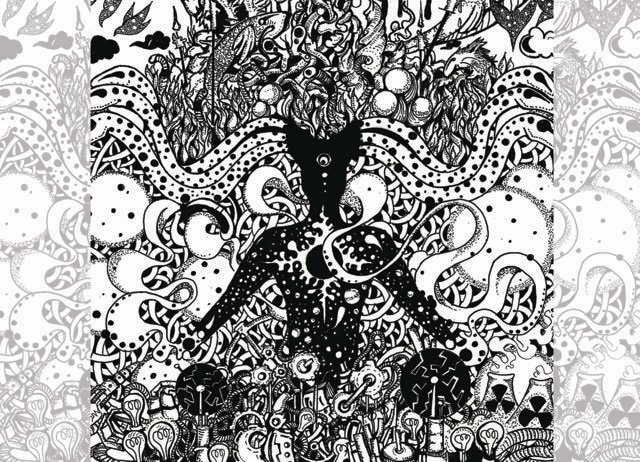
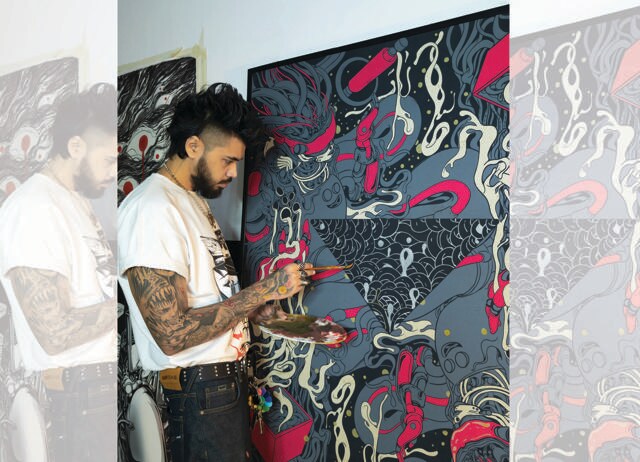
Hazarika’s own work, showcased in galleries, is angry, nightmarish, beautiful. He’s filled canvases with alien-like creatures worshipping at pagan altars, meadows filled with skulls, and sinister tangles of limbs, torsos and hair. One of his favourite pieces is a reworking of the Mona Lisa, giving that iconic face vampire-like teeth and features that bleed. It’s as if heavy metal, graffiti, and anime decided to be chaotic roommates in his mind.
Commercial brands turn to Hazarika to give their products edgy appeal. Younger Millennials and Gen Zs see their anxieties reflected in his snaking motifs. Hazarika says he’s proud of representing the underdog. How did his work become the moodboard of the moment?
Rough drafts
Most 1990s kids from metro cities remember how life transformed when India’s markets opened to global trade. One year, Pepsi appeared at kirana stores; the next year, there were Spykar jeans and Biotique cosmetics in the shops; satellite channels on TV; Kwality ice-cream in the freezer. What a time to be alive!
In Assam, where Hazarika grew up, staying alive was the bigger win. Bomb threats were common through the decade of insurgent movements and political unrest. Kids grew up recognising the sound of a blast. Art was Hazarika’s escape. He was, by his own admission, a “shy, introverted school kid and always felt like a misfit”, and remembers being fascinated by a Dragon Ball Z-themed pencil box at age eight. It got him thinking about character design and merchandising. Comic books became an endless source to copy artwork from. The skills won him social cred. He’d trade his Spiderman and Superman sketches for videogames and money to buy Pokemon cards.
Assam’s political turmoil has been hard on his generation, Hazarika says. “It’s what birthed a subculture — people who skateboarded, listened to rock and metal, and sprayed graffiti.” Hazarika’s art, full of angst, restlessness and rebellion, became his outlet.
Ink outside the box
Hazarika enrolled in an engineering course after school. “My parents thought if I became an artist, I’d end up starving and lonely,” he says. But two years in, he knew he was in the wrong field. Depression set in. “I would keep doodling in my notebooks during lectures. That’s all I could do.”
Then, in 2014, when Hazarika was 23, a friend tagged him in a Facebook post about Red Bull’s Doodle Art competition. He sent in his entry for fun: A black-and-white depiction of Lord Vishnu, inspired by The Seven Secrets of Vishnu, by his favourite author, Devdutt Pattanaik. He was up against some 32,500 entries from around the world, but Hazarika won. The Red Bull people flew him to Cape Town, South Africa, to receive the prize: A deal with the brand to create a T-shirt design. “At last, my parents acknowledged that I could make a living as an artist!”
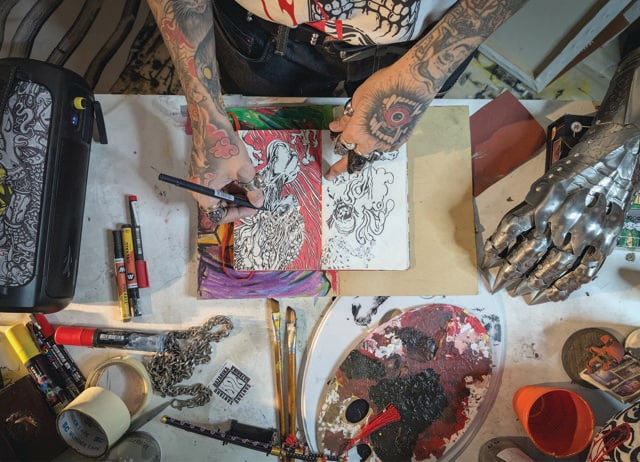
He played it smart. Early in his career, Hazarika committed to building an artistic style “with recall value” that suited commercial and personal projects without seeming like either was a compromise. He set himself up as an artist, and not a graphic-design provider who merely slapped themed motifs on products and sent in his invoice. And he tempered his dark, rage-against-the-system visuals to appeal to mainstream audiences who like their angst in smaller doses.
For the sneakers, one of his favourite commissions, Hazarika drew from the OG notebooks from engineering class. For Ritviz’s song, Mehrbaan, which featured the Pakistani artist Hasan Raheem, he fashioned a miniature Mughal painting that included a single rose with an eyeball in its centre. That little detail appears throughout the music video. “It’s always a bit of a tussle creatively, deviating from your usual style,” he admits. “But people come to me and tell me they love the album covers I’ve done.”
Dark matter
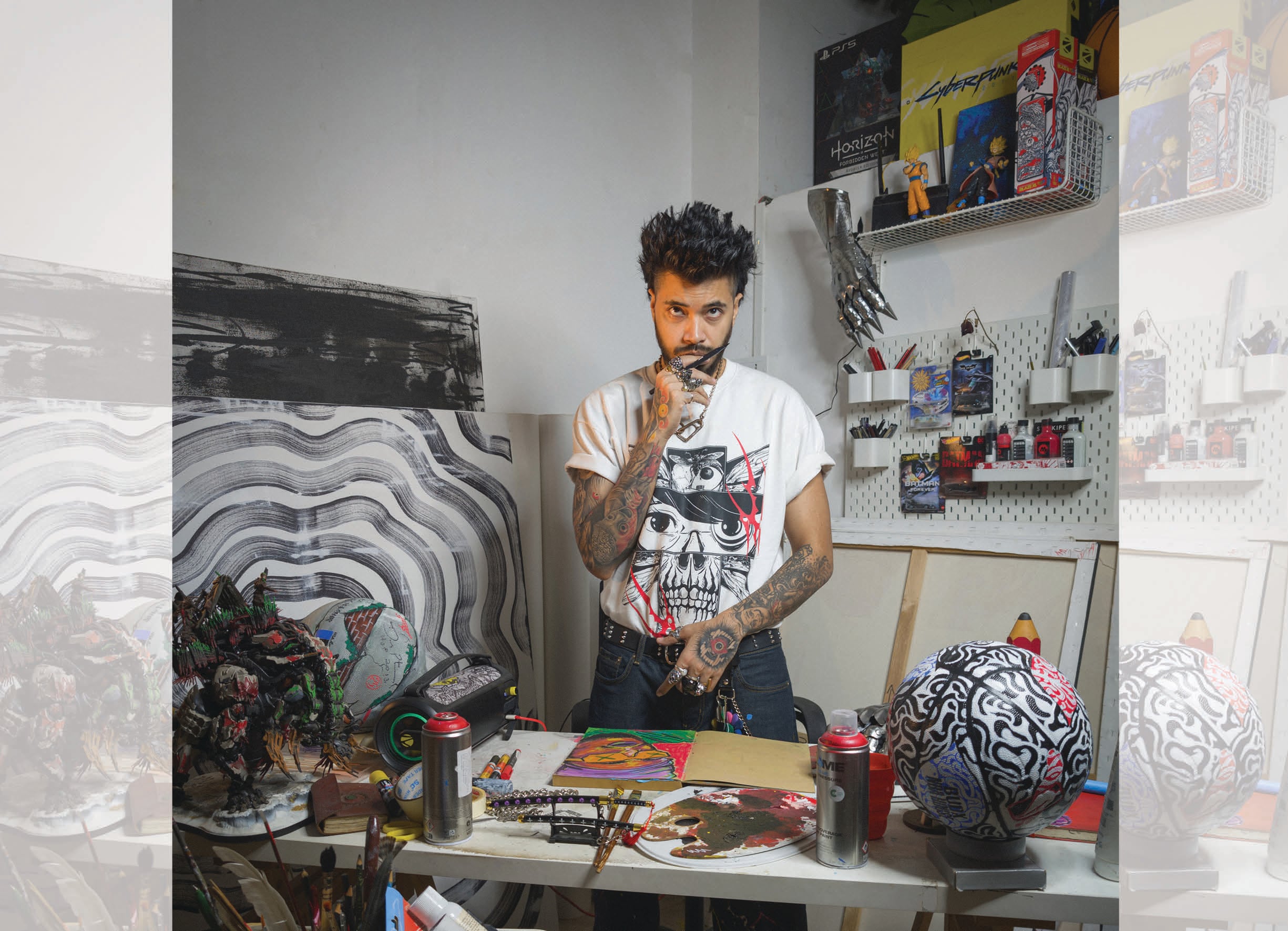
Hazarika’s collaborations are complex. He doesn’t just decorate a jersey, a soundbar or a basketball; instead, he’s the brand’s ambassador, social media marketer and creative strategist through the duration of the collab. He works on the invitations, the event merch, the stage design, the presentations, even the Reels and social media posts. “They hire me for the vision and partnership, not just a single design.” This means that a project (and he typically works on seven to 10 at a time) takes months to complete.
For the Budweiser x NBA launch in Mumbai last month, Hazarika designed limited-edition beer-can-themed collectibles and custom-printed basketballs. He spray-painted T-shirts and jackets live at the festival. At another event, he “destroyed” a pair of Our Own Pace cargo pants with bleach and paint as part of a promotion.
He might seem like a rock star, but there’s a bit of engineer in Hazarika still. He works alone, and is at it all day, every day in his studio. He’ll work and rework and do an illustration again. And he loses himself in details we’ve not yet noticed on the Porsche, undies, canvases and mobile-phone themes. “When I’m working on a piece of art, time ceases to exist,” he says. “It’s like being in a fever dream.”
How do you deal with creative block?
“I just lie down if nothing’s working. My solution for lack of inspiration is ‘Let’s go and sleep. It’s a tomorrow-me problem’.”
Who’s on your music collab wishlist?
“I’d love to work with Tool, the progressive metal band from California, whom I listen to a lot. Their posters and artwork are phenomenal.”
What are you up to in your downtime?
“Playing videogames. I’m obsessed with Elden Ring. If I’m in the mood to vegetate on the couch, I watch an anime or a show. I recently re-watched Dorohedoro, and also finished Devil Man, Neon Genesis Evangelion, and Bleach: Thousand Year Bloodwar. If I’m back home in Guwahati, I trek or drive or find a lake to dive in.”


