
 E-Paper



Mumbai surgeon warns about the dangers of kids eating while staring at a screen: ‘Fatty liver, insulin resistance…’

 Prefer HTon Google


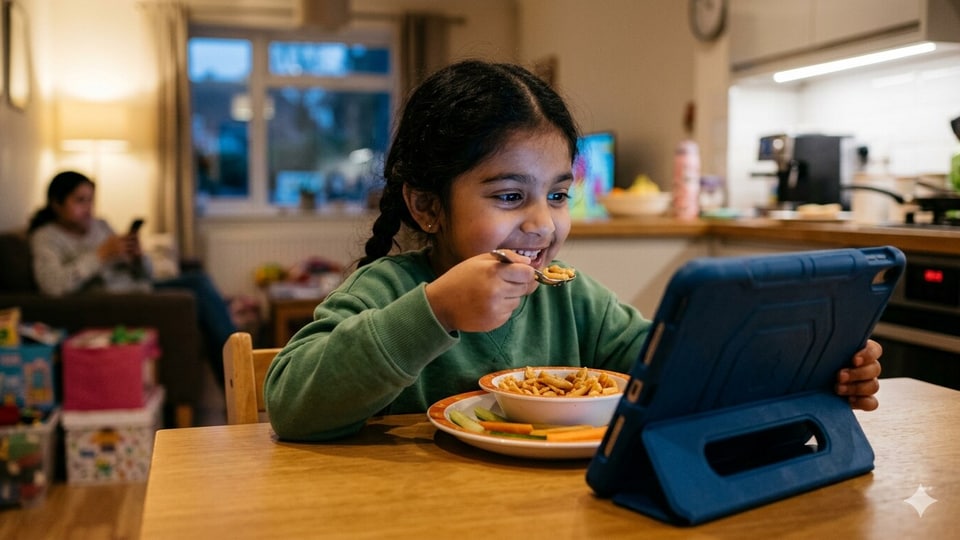
Children nowadays cannot finish a plate without external stimulation. This not only shapes their relationship with food but can also lead to health concerns.
Back in the day, before the constant presence of screens, mealtimes were a chance to slow down – filled with family conversations, shared moments, and mindful eating. Today, that experience looks very different. As screens have increasingly been used to pacify children during meals, many now rely on that distraction just to finish their plate. What may seem like a harmless habit is quietly reshaping their relationship with food, potentially leading to more serious long-term health consequences.
Dr Manan Vora, a Mumbai-based orthopaedic surgeon, health educator, and co-founder of NutriByte Wellness, is drawing attention to this crucial yet often overlooked aspect of childhood development that could shape future generations and their relationship with food. In an Instagram video shared on April 13, he explains how the habit of eating in front of screens is rewiring children’s brains, potentially setting the stage for early-onset obesity and other metabolic disorders.
A generation growing up with screens
Dr Vora points out a growing concern – that we may be the first generation raising children who struggle to eat without a screen in front of them. He warns that this habit can have serious consequences, linking it to rising rates of childhood obesity and early-onset metabolic conditions such as fatty liver disease and insulin resistance, even in children as young as 10 to 13.
He highlights, “Parents, listen up. We're raising the first generation that can't eat without a screen, and it's making our children obese. Children between the age of 10 to 13 with fatty liver and insulin resistance.”
He states the following reasons why this is happening:
The food-entertainment association
Children who grow up eating with screens in front of them often begin to associate food with constant entertainment. Dr Vora explains that over time, this weakens their ability to recognise natural hunger and fullness cues without external stimulation, leading to more distracted, mindless eating and a higher risk of overeating.
The surgeon notes, “They learned that food needs entertainment. Cartoons during meals became the norm. Now, their brain can't register hunger or fullness without that external stimulation. They're eating mindlessly, the same way you finish popcorn at the movies without even realising.”
Screens take over hunger hormones
Dr Vora points out that blue light from screens can suppress melatonin – the hormone that regulates sleep – while also disrupting ghrelin, which drives hunger, and leptin, which signals fullness. Together, this creates the unholy trinity of increased hunger, heightened sugar cravings, and a persistent inability to feel satisfied even after eating.
He explains, “The screens hijack their hunger hormones. Blue light suppresses melatonin and disrupts ghrelin (the hunger hormone) and leptin (the satiety hormone). So they feel hungrier, crave sugar, and never feel full even after eating.”
The junk food dopamine loop
According to the surgeon, junk food and screens both trigger dopamine release – the brain’s reward chemical. When paired together, this creates a powerful feedback loop that can rewire a child’s brain, conditioning them to crave unhealthy foods whenever they are in front of a screen.
He explains, “The dopamine loop made junk food addictive. Scrolling gives dopamine, junk food gives dopamine. Together they rewire your child's brain to crave junk the moment they hold a phone.”
Dr Vora concludes with a powerful message: “Now, you as a parent used the phone as a pacifier during their meals. You thought it made feeding easier, but somewhere along the way, you rewired how their brain processes food. So, if you're a parent who lets their child eat with a screen, remember your child's relationship with food is being shaped right now, not when they turn 18.”
Note to readers: This article is for informational purposes only and not a substitute for professional medical advice. It is based on user-generated content from social media. HT.com has not independently verified the claims and does not endorse them.


Catch your daily dose of Fashion, Taylor Swift, Health, Festivals, Travel, Relationship, Recipe and all the other Latest Lifestyle News on Hindustan Times Website and APPs.


