
 E-Paper



Lok Sabha Elections 2019: Indian institutions are imploding, says British journalist John Elliott
He is the author of ‘Implosion: India’s tryst with reality’, presenting a critical review of Prime Minister Narendra Modi’s government

 Prefer HTon Google


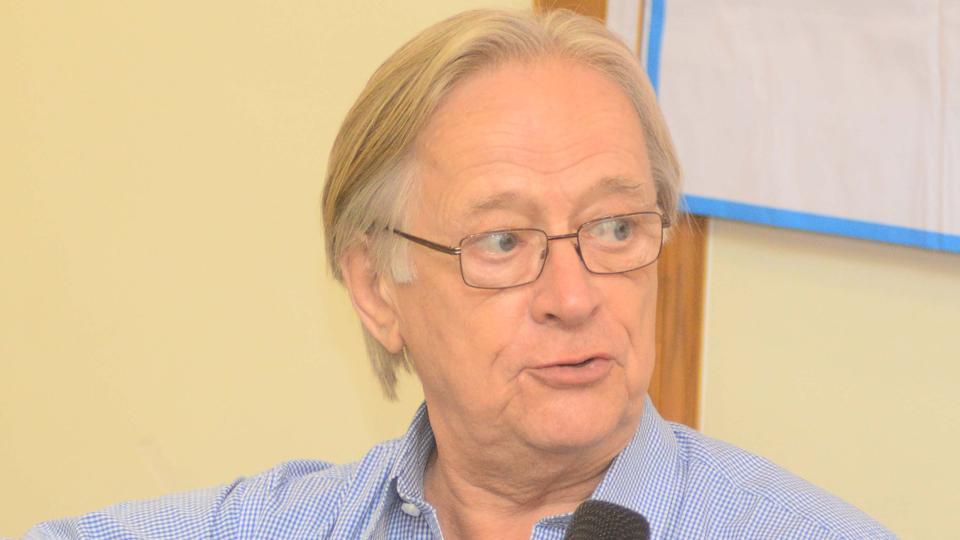
A former Financial Times journalist who was based in New Delhi for more than 25 years, John Elliott is the author of ‘Implosion: India’s tryst with reality’, presenting a critical review of Prime Minister Narendra Modi’s government. He has also written previously for The Economist, Fortune and New Statesman. Elliott was in Pune on Wednesday to speak at the Rotary Club of Pune Riverside. Following are excerpted portions from an interview with Abhay Vaidya.
What are your first thoughts about the 2019 elections?
I think it’s probably the most important election that India has had for many decades. Voters in this election have a clear choice about the future direction of India for at least the next five years and quite possibly longer. As to whether the Bharatiya Janata Party (BJP) retains power: in this context I will bracket the two of them- Narendra Modi and Amit Shah- leading a government and a party that believes in Hindutva, a Hindu India, sweeping aside the secular traditions set by Nehru after the debate in the ’40s and ’50s about whether India should become a Hindu nation.
So the choice is whether India continues with more of Hindutva and all the things that means- for the minorities, for freedom of expression, and more of the unruly behaviour that we’ve seen over the past two or three years. Or whether, India goes for a more gentle, secular approach of the Opposition parties and the Congress.
It’s also a question about economic development and driving forward changes in the way India is run: corruption, efficiency, the way the government’s run, crony capitalism and all the other things that need to be sorted. So the choice isn’t just between Hindutva and a more gentler approach, but you also have to factor in who’s going to run the country better in terms of economy, efficiency and improving the living standards of the people. So, it’s a complicated election.
What according to you is the expected outcome of this election?
At the moment I go along with the general view that the National Democratic Alliance (NDA) will probably get a slim majority in the Lok Sabha. But it will need the support of one or two allies to produce a good, working government. The short answer is that I will go with the general view that the NDA will just get through, but in an election like this with so many variables, who knows.
Why did you title your book ‘Implosion: India’s tryst with reality?’ Implosion means exploding within?
The headline should have been ‘declining institutions’. By the time I wrote this book in 2014, institutions were imploding. Implosion is a gradual process. A building can implode in a matter of seconds; but this is disintegrating.
The judiciary in the 1980s was broadly not corrupt, the army was not politicised and the bureaucracy-and-politician nexus was not as bad as it is today. We also had coalitions from 2004 to 2014 which meant that the Parliament was not as strong.Those things were getting worse and I felt that the country was failing to cope with the change that was coming faster. Since Modi came to power, I would argue that Modi has weakened institutions, undermined the Election Commission, the Reserve Bank of India (RBI), the judiciary, Central Bureau of Investigation (CBI), academic institutions, the Hinduisation of academic institutions has been faster…and you need strong institutions to run a country. The issue here is that the changes that the Modi government is making won’t just last for five years…..they will take long time to re-build.
What is your assessment of Prime Minister Modi? You’ve seen him now for five years as the Prime Minister?
He wants to go down, I imagine, as the greatest leader since Nehru, and once he’s achieved that, become the greatest leader, pushing Nehru aside. So far, he hasn’t achieved it. As an observer I think many people who took a gamble on him and said, let’s give him a chance, are disappointed because he has not driven the changes he had promised.
What do you feel are the biggest challenges facing India?
The long term challenge is poverty, obviously, and by poverty I mean the poor being poor; bad health services and bad education. It means a large part of the population is not well served in terms of education/literacy, health services and in being poor. That’s the long term challenge and arguably to deal with that the BJP should be stronger than the Congress, because the Congress is only over-simplifying it; it believes in throwing money at the poor rather than getting change. In order to deal with this challenge, you have get leaders who will mobilise that change in the government. But you need strong leaders who care; not a strong leader who is egoistical.
Any positives of the Modi regime?
(Laughs) Yes of course, many. He got the infrastructure projects moving again; they sorted out problems in power distribution, although the electrification of villages is grossly exaggerated. They’ve simplified business procedures but again, they over state it.
He has introduced many schemes. Swachh Bharat was possibly his bravest and most important social reform. I think it’s extremely brave to put yourself out there as the prime minister and try and change a culture in a positive way. To get people to accept toilets and use them- it has enormous health implications.
Cleaning India hasn’t happened; cleaning Ganges hasn’t happened; the streets in most places are dirty.
Modi boosted India’s image abroad, he’s been an extrovert PM; but there’s not much to show for foreign policy. With China he had the biggest challenge since 1962- the government stood firm on Doklam. But the policy on Pakistan has been a disaster.
He has improved things, but the disappointment is that he hasn’t done enough.


