When Uttarakhand and Himachal Pradesh went to the polls in 2014, the Bharatiya Janata Party (BJP) swept the nine Lok Sabha seats in the two Himalayan states and the drubbing of the then-ruling Congress party was a precursor to it being bundled out of power in both two years later.
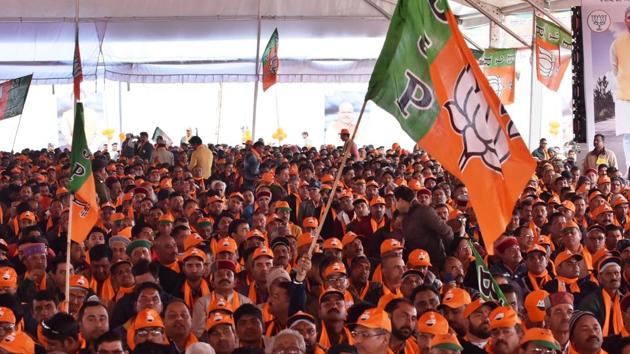
Five years down the road, both states have BJP governments at the helm and Prime Minister Narendra Modi is still popular, but the Congress believes it can secure enough swing votes to make a dent in the saffron party’s LS numbers.
In Uttarkhand, the Congress retained about one-third, and in Himachal, about 40% of the votes polled despite suffering losses in the 2014 Lok Sabha and the 2017 state assembly polls. Although the politics of the two states is quite different, there are certain similarities at the ground level. Incumbent chief ministers Trivendra Singh Rawat (Uttarakhand) and Jairam Thakur (Himachal) are generally popular, a fact acknowledged even by Congress leaders, and the BJP has better ground presence than the Congress, which is facing infighting in the local units.
Both parties have started preparing for the Lok Sabha polls by holding booth-level meetings and conducting surveys to decide candidates by the end of March.
{{/usCountry}}Both parties have started preparing for the Lok Sabha polls by holding booth-level meetings and conducting surveys to decide candidates by the end of March.
{{/usCountry}} 
The local issues dominating the discussion are employment, road infrastructure development, corruption in local offices, tourism (one of the biggest contributors to the states’ gross domestic product [GDP]), and local transfers.
Of course, the Congress’s plans can be upset by one discussion currently uniting the otherwise disparate hill states: Nationalism.
The February 14 Pulwama suicide bombing, which killed 40 troopers, and the subsequent air strike on a terrorist camp in Pakistan’s Balakot had a big impact in Himachal Pradesh and Uttarakhand, two states with a high population of retired personnel from the paramilitary and armed forces.
The BJP is now attempting to grab the advantage, steering the conversation towards patriotism and nationalism, while the Congress is trying to keep the focus on job creation and agriculture.
In Uttarakhand, BJP spokesperson Devendra Bhasin said the air strikes were in the interest of the country, while Congress president Pritam Singh called the BJP’s stance on the issue an “eye wash”.
In Himachal Pradesh, BJP state president Satpal Satti echoed Bhasin even as Congress leader Sukhwinder Singh Sukhu said the elections were about the “unkept promises” of the Modi government.
Political experts said the BJP had the advantage in the first round (Pulwama attack) but lost the edge somewhat after the Balakot air strike.
“The BJP is better placed than the Congress as Uttarakhand lost four jawans and it has been able to take political mileage of it. But, I don’t know whether the sentiment will remain till the polling day,” said SMA Kazmi, a Dehradun-based political analyst.
Harish Thakur of Himachal Pradesh University said the people in the state realised that all the brouhaha was for the elections and therefore, the BJP was not getting much traction. “At most, it may help BJP in some parts of Kangra and Hamirpur, which has large population of ex-servicemen,” Thakur said.
Sipping hot tea on a rainy day in Dehradun’s posh Rajpur road, 25-year-old Rajender Singh Negi described chief minister Rawat as a “good man” who is not very “effective” in running the administration.
“I met the CM three months ago and requested him to his transfer my sister to Dehradun. Despite his assurance nothing has happened,” he said, while pointing out that transfers and postings were a big political issue in a state, where at least half of the employment is generated by the public sector.
He got support from Aman Rawat, who hails from Tehri Garwhal and said Rawat’s predecessor and Congress leader Harish Rawat was much more accessible. But Alok Gaur, who works in a local hotel, differed. He said that the BJP government had introduced a transparent and effective administrative system, wherein people didn’t have to rush to politicians to get their work done.
“Only the BJP thinks about everyone,” Gaur said, referring to the 10% reservation for the economically weak sections in the general category introduced by the Centre. The reservation is a talking point in the hill state, where upper castes --- Rajputs and Brahmins --- dominate the political scene. Since formation of the state in 2000, all chief ministers have been Rajputs or Brahmins.
Former CM Harish Rawat said the 10% reservation can help the BJP but can also alienate the scheduled castes, who backed the saffron party in 2014, especially in Haridwar and Nainital-Uddamsingh Nagar Lok Sabha seats. Rawat is keen to contest again from Haridwar, the Lok Sabha seat he won in 2009, but one his wife Renuka Rawat lost to BJP leader and former chief minister Ramesh Pokhriyal in 2014.
Rawat, the only Congress leader to have pan-Uttarakhand appeal, expressed confidence that the SC voters will return to the Congress and said the outcome will depend on candidate selection. That should not be a problem for the Congress, which has only a handful of influential leaders left, after an exodus to the BJP before the 2017 assembly polls.
On the other hand, the BJP is facing a problem of plenty. Except Tehri, where incumbent MP BC Khanduri has expressed a reluctance to contest the seat citing ill-health, all other sitting MPs have staked their claim.
Apart from them, three cabinet ministers --- Harak Singh Rawat, Yashpal Arya and Rekha Arya --- have also expressed an interest to contes the polls. Former Congress chief minister Vijay Bahuguna, who joined the BJP before the 2017 assembly election, is eyeing an LS ticket, most likely from Tehri, a seat he won in 2009.
Uttarakhand BJP chief Ajay Bhatt said there were “no vacancies” for the Lok Sabha seats. “Our party is full of mass leaders. We have five former chief ministers,” said Bhatt.
The BJP believes the construction of the all-weather Chardham road, which passes through all five Lok Sabha seats, and the image of PM Modi will help the party retain all five seats.
“The road will give a big boost to tourism and will be a major employment generator,” said Uttarakhand’s higher education minister Dhan Singh Rawat, brushing aside allegations that the government overlooked environmental norms to build the highway in a hurry.
With general elections approaching, Congress leaders have started parallel mass contact programmes. State president Pritam Singh has started Parivartan Yatra, Harish Rawat ‘Maer Mait’ (my campaign) and leader of the opposition in the state assembly, Indira Hridayesh, Jan Aakrosh Yatra.
The separate yatras, BJP general secretary Vinod Bansal argued, indicated infighting in the Congress.
Political analyst Surendra Singh Pagti said the infighting in the Congress may hurt its chances, but that the BJP was facing a bigger challenge.
“There is dissatisfaction among the BJP cadre over appointment of turncoats from the Congress in the cabinet and in prominent boards and corporations. Also, accessibility to this government ministers is a raging issue among people,” he said.
At the iconic Fascination restaurant on the Mall, the Lok Sabha elections are hotly debated over cups of Palampur green tea. On the table is lawyer Anil Chauhan, who belongs to the upper Himachal region, and Kamlesh Pathania, a government employee from Kangra in the lower Himachal region.
Chauhan criticizes the incumbent BJP government for ignoring the apple belt of upper Shimla. “All the new projects have been started in lower Himachal, particularly in Mandi (chief minister Jairam Thakur’s home district),” he alleged. Pathania counters by saying that the Congress had pampered upper Himachal by diverting all projects there.
The two regions represent the traditional divide in the state politics. All Congress chief ministers, including the longest-serving Virbhadra Singh, were from upper Himachal and all of the BJP’s CMs, including incumbent Jairam Thakur, belong to lower Himachal.
But the two regions are slowly coming together “With the passage of time, the divide has diminished and the people vote more for performance than region,” said Harish Thakur.
Both Chauhan and Pathania agreed that the BJP was better placed than the Congress as there was no major controversy against the ruling party and the opposition appeared to be in tatters, especially after a brawl at Congress headquarters between Virbhadra Singh and former state Congress president Sukhwinder Singh Sukhu factions resulted in injuries to three Congress workers.
Himachal Congress president Kuldeep Rathore said the incident was history and that the party is “now” united to take on the BJP, elaborating on the measures being taken to connect with the party workers and voters. His counterpart in BJP, Satpal Singh Satti, said the chief minister had visited 64 of the 68 assembly constituencies and they mapped 2.5 million beneficiaries of state and the central government schemes. Conversations with people from different regions and professions indicated the BJP may not be able to retain the 53.85% vote share it got in 2014 but it has an edge over the Congress.
In the 2017 assembly election, the BJP lost about five percentage points as compared to 2014 and won, but was still ahead of the Congress by about seven percentage points. Bridging that difference will not be easy for the grand old party.
Like most elections, three issues dominate the Lok Sabha polls --- horticulture development (mainly apple), road construction and transfers and postings of government employees, mainly teachers.
The 700,000-odd government employees among the state’s 6.8 million people can swing any poll outcome.
“The employees, especially the teachers, are not very happy with the government’s transfer policy and it can have implications for the Lok Sabha polls,” Thakur said, recalling that the BJP lost all Lok Sabha seats in 1992 primarily because of government employees’ anger against then Shanta Kumar government for introducing a “no work, no pay” rule.
Pathania and Chauhan said the 2014 aura of the PM may have lost its sheen but there isn’t much anger against him either. That, added to the nationalist fervour, may give the BJP the edge in the hills.