
 E-Paper



Congress’ calculation behind surprise role for Priyanka Gandhi in UP
Congress president Rahul Gandhi’s statement after the appointment of Priyanka Gandhi and Jyotiraditya Scindia as the general secretary for east and west Uttar Pradesh gives an indication of what could possibly be the Congress strategy behind this move.

 Prefer HTon Google


By appointing Priyanka Gandhi as a Congress general secretary in charge of East Uttar Pradesh, the Congress has sprung a surprise before the 2019 elections. The move comes after the Congress was kept out of the Samajwadi Party (SP), Bahujan Samaj Party (BSP) and Rashtriya Lok Dal (RLD) alliance in the state.
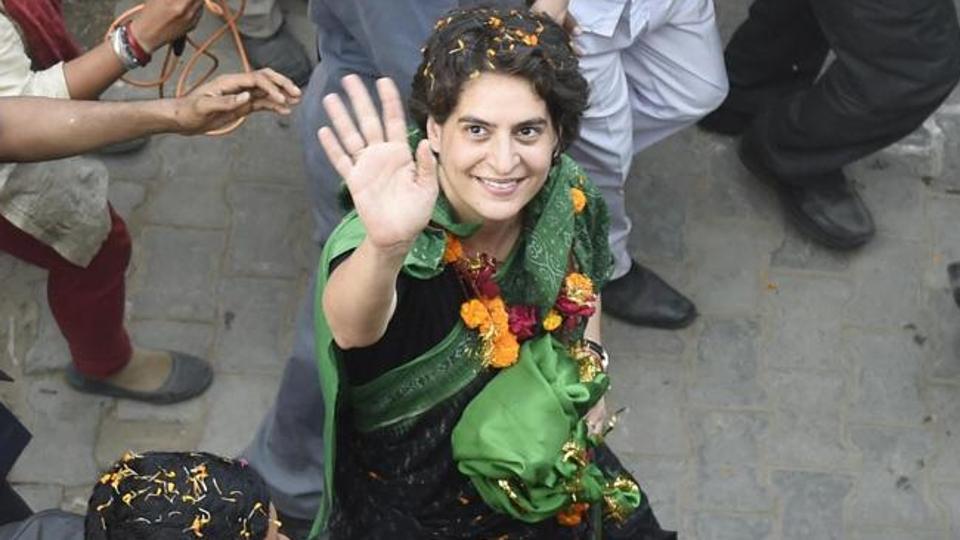
If there can be one takeaway from this move, it is that the Congress has willingly raised the stakes for itself in Uttar Pradesh for 2019. Arithmetic suggests that this is not a good move.
Uttar Pradesh played a key role in the Bharatiya Janata Party (BJP) getting a majority in the Lok Sabha in 2014. It won 71 out of the 80 seats in the state. The BJP repeated this performance in the 2017 assembly elections. The BJP had a vote share of 42.6% and 40% in the 2014 and 2017 elections.
Both in 2014 and 2017, the combined vote share of the BSP, SP and Congress was almost 50%. The Congress had the lowest vote share among these three parties; 7.5% in 2014 and 6.3% in 2017. What does the Congress expect to gain by not being a part of the BSP-RLD-SP grand alliance?
Will it not end up helping the BJP by lowering the combined vote share of what could have been an extremely formidable opposition alliance?
Congress president Rahul Gandhi’s statement after the appointment of Priyanka Gandhi and Jyotiraditya Scindia as the general secretary for east and west Uttar Pradesh gives an indication of what could possibly be the Congress strategy behind this move.
“We have no enmity with Mayawati ji and Akhilesh ji, in fact I respect them a lot. We are ready to cooperate with them wherever possible. Ultimately the aim of all three of us is to defeat BJP, but yes our fight is to save Congress ideology”, said Gandhi, according to ANI.
This statement, when read with statistics on the Congress’s historical performance in Uttar Pradesh shows that the Congress might be planning to open a second front against the BJP in Uttar Pradesh and hopes to inflict further damage to the BJP’s tally.
Let us first look at the performance of four key parties — BJP, BSP, Congress and SP — in Uttar Pradesh since the 1996 Lok Sabha elections. We choose 1996 as the cut-off year because this is the first time the SP contested a Lok Sabha election. Congress’s performance in the state shows a pattern with the combined performance of the two national parties and regional parties against each other.
In elections where the combined vote share and seat share of the Congress and the BJP was higher than that of the BSP and the SP, the Congress performed particularly badly, whereas the BJP swept the state. In 2009, which was the Congress’s best performance in Uttar Pradesh in terms of seat share after 1984, the BSP and SP won more than half of the seats in the state. The BJP on the other hand recorded its worst vote share in the state after the 1991 elections. In effect, it is the BJP, more than the SP and the BSP that have hurt the Congress in the state.
What explains this trend? Going further back in time can help us answer this question.
The Congress was the dominant party in Uttar Pradesh until the 1977 elections, when it could not win even one seat. It recovered from the setback in the 1984 elections, but has steadily lost ground since 1989. Chart 2 captures the Congress’s growing irrelevance in Uttar Pradesh politics by plotting the percentage break-up of Congress candidates by their position in a Lok Sabha seat.
The period up to 1984, except 1977 has majority of Congress candidates who finished first. In 1989, although the share of first position candidates came down, majority of Congress candidates still finished second.
In the post-1991 period the party has seen a sharp increase in share of candidates who finished third or further behind in Lok Sabha elections. This basically shows that the Congress was not even in the fray in most seats in Uttar Pradesh during this period.

The Congress’s reverses in the 1989 elections can be attributed to rebellion by VP Singh, an Uttar Pradesh politician who was a minister in the Rajiv Gandhi cabinet. Singh was expelled from the Congress over the Bofors controversy and fought the 1989 elections by forging a rainbow coalition with endorsement from both the left and the right sides of the political spectrum.
The VP Singh-led government implemented the Mandal Commission recommendations in 1990, which gave a big boost to already rising Other Backward Class (OBC) politics in the Hindi belt.
The Congress, which had a primarily upper caste leadership, could not adapt itself to the tectonic shift the rise of OBC politics brought in the states of Uttar Pradesh and Bihar. An even bigger blow for the Congress came after the demolition of the Babri mosque in 1992, leading to a large consolidation of Hindu votes including Congress’s upper caste vote bank in favour of the BJP.
Seen as having lost a significant section of its Hindu vote bank, even the Muslims deserted the grand old party in favour of the BSP and the SP, who were in a better position to defeat the BJP.
How is this discussion relevant here? On January 21, 2019 Hindustan Times published a detailed field based report on the political situation in Uttar Pradesh. It said, “From western UP’s Jat-dominated terrain through the heart of central UP all the way to Purvanchal, the BJP swept the 2014 Lok Sabha and 2017 assembly elections. This was primarily because it won urban pockets; constructed multi-caste coalitions of upper castes (Brahmins and Thakurs), non-Yadav OBC groups and non-Jatav Dalits; and got the support of farmers. On the other hand, social groups loyal to the other parties, Yadavs, Jatavs and Muslims fragmented between SP and BSP, and to a limited extent in the case of Muslims, the Congress. With the SP and BSP formalising their alliance last week, the Opposition vote is set to consolidate…But the ground reality in the state indicates that the BJP’s old coalition is cracking now. And so it will confront twin challenges. As groups antagonistic to it unite, key sections of its own vote base have, at best, lost their enthusiasm, or at worst, turned hostile.”
The Congress, it seems, is hoping for the repeat of 2009 elections. A united SP-BSP-RLD has already dealt a body blow to BJP’s aura of invincibility, which it had come to acquire after the 2014 and 2017 victories in the state. The Congress, on the other hand, has acquired fresh momentum after its victories in the three Hindi belt states of Rajasthan, Madhya Pradesh and Chhattisgarh.
At a time when the BJP is vulnerable and the BSP-SP alliance looks all set to make large gains compared to their 2014 performance, Congress is hoping to inflict further damage to the BJP by what could be described as putting its best foot forward in Uttar Pradesh. Whether or not this strategy works, will only be known in May 2019.


