
 E-Paper



Agra’s 36 hotspots pose hurdles on road to normality
The district has reported the maximum of 851 Covid-19 cases in Uttar Pradesh and a death toll of 31.


They are here, there and everywhere, both physically and psychologically. Thirty-six heavily barricaded hotspots in Agra district are a daily reminder to people here that the Taj city is far from being on the road to normality.
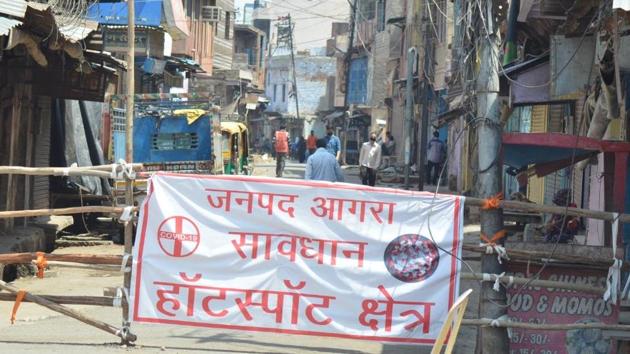
The district has reported the maximum of 851 Covid-19 cases in Uttar Pradesh and a death toll of 31.
Agra’s tryst with the coronavirus began on March 2 when five positive cases were reported. The area where the affected family resided — Master Plan Road — was isolated from the remaining city.
As the number of infected patients grew, more hotspot areas were marked.
“Besides being a hurdle in movement on the road, these containment zones are almost like a psychological barrier. Till they continue to exist, one cannot expect normality,” says Dr Madhurima Sharma, head of the department of Hindi at St John’s College here.
“Even if movement is allowed within the city with opening of markets, these containment zones will certainly keep one away,” Sharma says.
“I recently went out to buy medicine. When I realised that I was quite close to a hotspot area, I dropped the idea and went to another locality for purchasing the medicine,” adds Dr Sharma.
“With so many hotspots, no one can expect normality in our city. The value of ‘jaan’ (life) is deemed higher than ‘jahan’ (worldly affairs),” says Rajeev Gupta, former president of the National Chamber for Industries and Commerce.
“With so many hotspot areas in the city, only shops for essential items would be approached. Thus, normality seem to be a far-fetched idea for Agra,” adds Gupta.
“Anybody moving in the city for some distance comes across such containment zones where the roads are blocked. A suitable ambience for trade seems to be a distant dream with so many hotspots in the city,” says TN Agarwal, president of the Agra Vyapar Mandal.
The footwear industry in Agra mostly has local workers who live in the hotspot areas, where the smaller units are located.
The Taj Mahal, an attraction for tourists the world over, is in Tajganj, a major hotspot which has 64 Covid-19 cases.
Some other hotspots have industrial units and commercial centres.
HOW A HOTSPOT IS DECLARED
Agra’s chief medical officer Dr RC Pandey says once a coronavirus case is found in a locality, the area is termed as a containment zone or hotspot.
“Earlier, it used to be within a radius of one kilometre from the place where a Covid-19 case was found, but now we have reduced the area to 400 metres,” he says.
“We apply certain restrictions and speed up sanitization in this area. The stress is on social distancing and movement within the containment zone is restricted to the best possible extent,” he adds.
“After 21 days from the last Covid-19 case being reported, the area is removed from the list of hotspots,” Pandey says.


