
 E-Paper



Lucknow: One more story from history unearthed at Chhatar Manzil
The Uttar Pradesh Rajkiya Nirman Nigam (UPRNN) on Sunday unearthed another story of the historical Chhatar Manzil and Kothi Farhatbaksh.

 Prefer HTon Google


The Uttar Pradesh Rajkiya Nirman Nigam (UPRNN) on Sunday unearthed another story of the historical Chhatar Manzil and Kothi Farhatbaksh.
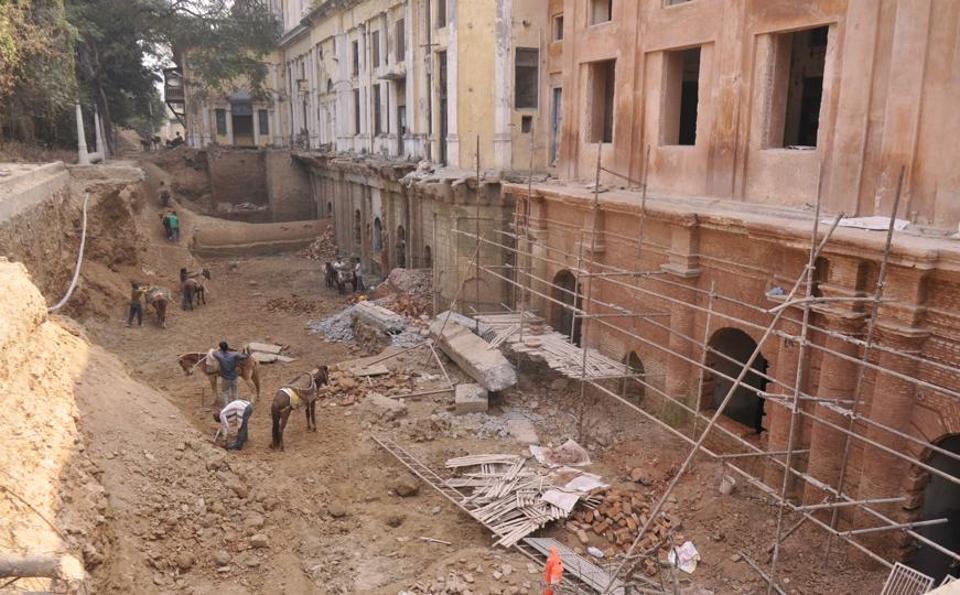
UPRNN is the constructing agency for the state government’s ongoing project aimed at beautifying and strengthening the city’s two most iconic heritage structures.
In May 2017, UPRNN had carried out a similar, but short, excavation exercise at Chhatar Manzil after which they discovered a 15 by 15 room lying buried beneath the imposing structures that constituted the seraglio (palace complex) for ‘begums’ of the nawabs of ‘Oudh’.
But now they have excavated a complete story that was lying buried since ages.
Officials said the discovery was made at Chhatar Manzil’s Gomti-river-facing facade when the labourers began to dig the structures basement.
“Instead of the foundation we discovered pillars going deep inside the ground. On further excavation, we noticed a complete story that was lying buried,” said SP Khandoori, project manager, UPRNN.
Khandoori said as they dug around 19.5 feet deep they found the hidden story of the over 200-year-old structure.
Officials said huge rooms, in shape of a tunnel that connects Kothi Farhatbaksh to Chhatar Manzil, were discovered during the excavation exercise, which is still on.
Besides, they said they discovered pillars, wall brackets, doors and windows that indicate the area that was buried was meant for living purpose.
Said to be built by major general Claude Martin in 1781, Kothi Farhatbaksh was another structure to witness the ‘trenching’ task. “Similar to Chhatar Manzil, here too pillars, with beautiful stucco work were unearthed from inside. So far we have dug around 16 feet and are going deeper,” said Nitin Kohli, a contractor carrying out the excavation.
“Our purpose is to reach the base and strengthen it. We are yet to reach it,” he said.
The excavation is being carried out under supervision of officials of Archaeological Survey of India, State Archaeology Department, Abdul Kalam Technical University and IIT BHU.
City historians, meanwhile, say the discovery would further deepen the mysteries related to the twin structures.
PC Sarkar, a noted historian who has penned books on nawabi era structures said, “Living history being unearthed. It not only highlights the fascinating heritage of Oudh but also indicates the level of scientific expertise that existed in those days.”
Sarkar said, the discovery corroborates the write-ups of the early visitors to Kothi Farhatbaksh (then called Lakhi Pera), who had written about two floors beneath the level of the Gomti, where the original owner, Claude Martin, used to reside during summer months.
When the water level rose during monsoons, Martin would move to the upper floors.


