
 E-Paper



A glittering feat : Indian scientists help detect source of gold in the universe
Forty scientists from 13 Indian institutions contributed at various stages in detecting both events that has led to proving some theories and disproving others

 Prefer HTon Google


India and its scientists have played a critical role in detecting gravitational waves from a pair of colliding neutron stars that also released electromagnetic radiation or gamma ray bursts – this astronomical event was detected at the US-based Laser Interferometer Gravitational-Wave Observatory (LIGO) and the Europe-based Virgo for the first time on August 17, and by multiple electromagnetic observatories subsequently.
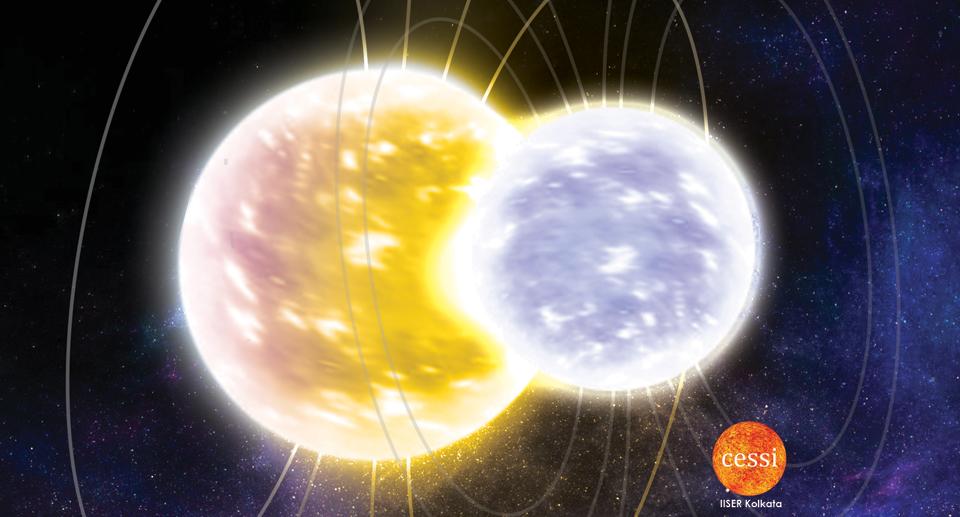
Data from the detectors along with 70 ground and space-based telescopes supports the theory that the collision of neutron stars is the primary source of gold and platinum in the universe.
Neutron stars, created by the deaths of giant stars, are the smallest and densest stars, as small as a city but with a mass of about 1.4 times that of the sun. A teaspoon of neutron star material weighs more than Mount Everest.
Forty scientists from 13 Indian institutions contributed at various stages in detecting both events that has led to proving some theories and disproving others. This involved developing fundamental algorithms that were crucial in computing waveforms for the signals – both gravitational and electromagnetic – by solving Albert Einstein’s equations, interpreting joint gravitational wave and gamma ray observations, improving the sensitivity of the detector to extract weak signals from terrestrial noise, and analysing data.
“This detection shines new light on how neutrons and protons, which are the basic constituents of matter, interact with each other. Basically, it informs us about nuclear physics in ways that terrestrial experiments cannot probe since we cannot create such dense nuclear matter in the laboratory. That’s why we go to the cosmos,” professor Sukanta Bose, Inter-University Centre for Astronomy and Astrophysics (IUCAA), Pune, and who is part of the detection told HT.
Bose recently co-authored a paper on how to strategically point telescopes to the sky to find electromagnetic counterparts to gravitational wave sources that was adapted by the Very Large Array radio telescope in New Mexico and which successfully observed electromagnetic waves from the merger.
“The usage of both gravitational and electromagnetic waves will help measure the expansion rate of the universe. The value of the expansion rate has a role to play in the ultimate fate of the universe; whether it will keep expanding or shrink in a big crunch,” Dibyendu Nandi, head, Centre of Excellence in Space Sciences India at the Indian Institute of Science Education and Research, Kolkata, told HT.
In addition to the contribution by Indian scientists, several Indian telescopes such as the Astrosat, Giant Metrewave Radio Telescope and the Himalayan Chandra Telescope also searched for various forms of electromagnetic radiation following the collision of the neutron stars.
The story so far
On August 17, gravitational waves from a pair of colliding neutron stars were detected for the first time at the US-based Laser Interferometer Gravitational-Wave Observatory (LIGO) and the Europe-based Virgo detector.
Neutron stars, created by the death of giant stars, are the smallest and densest stars known to exist. Though their mass is about 1.4 times that of the sun, they have a diameter of just about 20 kilometers.
Scientists tracked these neutron stars, weighing about 1.1 to 1.6 times the mass of the sun, for about 100 seconds as they spiralled towards each other in a final deadly dance and collided.
This is the strongest gravitational-wave signal detected so far since the location of the event was about 130 million light-years, which is relatively close to the earth.
The collision of the neutron stars generated electromagnetic radiation, or including gamma ray bursts that were detected by earth-orbiting satellites just two seconds after the gravitational waves thereby confirming conjectures that such collisions would emit both.
The concurrent observation of gravitational waves and gamma rays – only 1.7 seconds apart from each other also confirmed Albert Einstein’s theory that gravitational waves travel at the speed of light.
Till date, astronomers have detected four gravitational waves only from merging black holes. The first ever gravitational waves were discovered in September 2015, which led to Rainer Weiss, a physics professor at Massachusetts Institute of Technology, and Kip Thorne and Barry Barish, who are both physics professors at Caltech wining the Nobel Prize in Physics this year.
A total of 40 scientists from 13 Indian institutions are part of the LIGO-Virgo discovery paper published in Physical Review Letters.


