When the Citizenship Amendment Act came into force on Friday midnight, it marked a tectonic shift in how Indian citizenship would be determined. Piloting the Bill in Parliament and in interviews later, India’s Home Minister Amit Shah said that the CAA would, in time, be read with the National Register of Citizens (NRC). Their bare bones do not need to be re-stated. It’s enough to note that our citizenship – among the most fundamental of our identities – will be tested by a government that we elected as citizens, all of us may not pass the new test of citizenship and those that fail face an uncertain future.
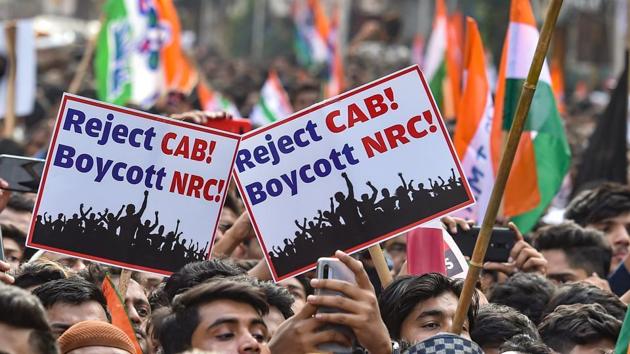
The purpose of CAA-NRC is ostensibly to weed out illegal immigrants from three neighbouring countries but implicitly threatens Indian Muslims as well as all Indians who do not possess documents of their ancestry here. They endanger post-independence India’s secular ethos as few measures in recent past have. No wonder then that the fight back, led primarily by students across the country, has been remarkable. This is clearly an inflection point in India’s history, a point at which silence is not an option and neutrality ceases to have meaning.
Protestors in campuses like Delhi’s Jamia Milia Islamia faced the full wrath of marauder-like police force. Students in other campuses like Aligarh Muslim University and Jawaharlal Nehru University among scores of others have been on the Narendra Modi government and BJP’s radar of surveillance, myth-making, vilification and violence but the state violence in Jamia brought out students on the streets across the country, including of elite institutions like IITs. India’s young showed the gumption and idealism to take on the Establishment. The protests are set to continue, including in Mumbai.
For once, Mumbai acquitted itself with honour. Its campuses saw student resistance against CAA-NRC as well as protests against the brute force used by Delhi Police. Other groups – teachers, trade unionists, theatre personalities, film personalities, women’s organisations – joined the resistance movement. Those who think that protests are only a traffic nuisance must note that Shah changed his tune from assuring Hindus to not worry about NRC to assuring Muslims that they will not face injustice. That’s the power of protests.
{{/usCountry}}For once, Mumbai acquitted itself with honour. Its campuses saw student resistance against CAA-NRC as well as protests against the brute force used by Delhi Police. Other groups – teachers, trade unionists, theatre personalities, film personalities, women’s organisations – joined the resistance movement. Those who think that protests are only a traffic nuisance must note that Shah changed his tune from assuring Hindus to not worry about NRC to assuring Muslims that they will not face injustice. That’s the power of protests.
{{/usCountry}}Mumbai, however, is not new to the politics around illegal immigrants. The bogey of “Bangladeshi Muslims infiltrating” and turning it Muslim-majority was the leit motif of the Assembly election campaign in 1995. Bombay was then recovering from the trauma of post-Babri communal riots and a belligerent Shiv Sena leading the Sena-BJP alliance campaigned hard on the issue. The alliance won.
A fortnight after Manohar Joshi took oath as chief minister in March, Sena’s newspaper Saamna headlined that its offices had received calls that Bal Thackeray and Joshi would be assassinated by a Bangladeshi Muslim. Thousands of Shiv Sainiks formed vigilante groups and began identifying these immigrants in ways they thought fit. The police came under tremendous pressure to take some action. Eventually, the Special Branch formed ten elite squads to identify Bangladeshi Muslims and deport them. Their action to storm slums – especially in Bengalipura, Bainganwadi, Reay Road, Trombay, Cheetah Camp, and Wadi Bunder – usually happened in the dark of the night leading all migrants in informal settlements to fear the midnight knock.
But how were the police to identify an Indian Bengali Muslim from a Bangladeshi illegal immigrant? Senior-most cops had then told me that the former may not have proper documents while the latter may have got documents made in the grey market for a few hundred rupees. Many Bengalis with Muslim names, including artisans who had lived here for decades, faced police action or fled the city. It had become dangerous to even speak the language in some slums.
From the Sena-BJP’s campaign of more than three-five lakh Bangladeshis in Bombay, the Sena-BJP government spoke of half that number and then pared it down to about 50,000. Eventually, not more than a few dozen were arrested and deported to Bangladesh; the first contingent had only nine. The campaign drifted and was given a quiet burial. Ironically, Uddhav Thackeray’s Sena today sounds less certain and less shrill about the issue.
Is illegal immigration a problem? Yes, especially in border states like Assam. Is the CAA-NRC the cure? No, for it de-citizenises all Indians to find a few non-Indians. Sounds like demonetisation, we know how it unfolded. Protest or speak up in ways you can.
Stay updated with all the Breaking News and Latest News from Mumbai. Click here for comprehensive coverage of top Cities including Bengaluru, Delhi, Hyderabad, and more across India along with Stay informed on the latest happenings in World News.
Stay updated with all the Breaking News and Latest News from Mumbai. Click here for comprehensive coverage of top Cities including Bengaluru, Delhi, Hyderabad, and more across India along with Stay informed on the latest happenings in World News.