
 E-Paper



Mumbai building collapse: Death toll rises to 12, Shiv Sena leader booked
Twelve people were killed and eleven others injured when a four-storey residential building collapsed in Mumbai’s Ghatkopar on Tuesday.


A dozen people, including two infants, were killed when a 35-year-old four-storey building collapsed on Tuesday in the Ghatkopar suburb of Mumbai, a tragedy that repeats almost every monsoon in India’s space-starved financial capital.
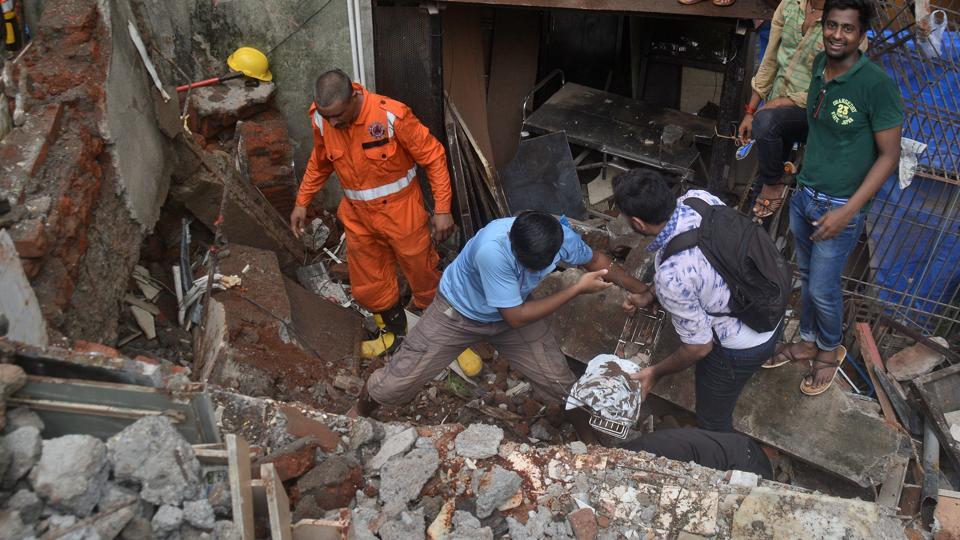
The Siddhi Sai building at Damodar Park near Shreyas cinema in western Ghatkopar came apart and trapped more than 20 people around 10.45am. Many of them are still under the rubble.
Among the dead were four old people, three-month-old Renuka Thak and Krishu Dongre, who was one-and-a-half years old.
The ground floor housed a nursing home, which was vacant, while the rest of the building was occupied by three or four families on each floor. Lalit Thak, who lost daughter Renuka, had shifted to the building from nearby slums three months ago.
Shiv Sena leader Sunil Shitap, who owns the ground floor and allegedly made structural changes that weakened the building, was charged with culpable homicide and detained by police.
Mumbai mayor Vishwanath Mahadeshwar denied Shitap was from his party and said: “Appropriate action must be taken against the culprit, whoever he is.”
Residents said pillars and beams were damaged when the ground floor was renovated and that caused the building to collapse. Civic officials, however, refused to assign a reason and said the cause will be known after investigation.
Binita Ramchandani, a resident whose mother was injured, blamed the Shiv Sena leader for the tragedy.
“Despite residents objecting his altering the building’s pillars, he went ahead because of his political clout. He was trying to convert it into a guesthouse,” she alleged.
Pravin Chheda, a Congress leader, said Shitap must compensate the people.
Municipal commissioner Ajoy Mehta ordered a probe while police are investigating if negligence is involved in the disaster.
According to the Brihanmumbai Municipal Corporation, there were 15 flats, three each on every floor, of which nine were vacant.
The fire brigade pressed 90 personnel, 14 engines, two rescue vans and nine ambulances in its rescue efforts. About 300 rescuers, including National Disaster Response Force members, were working late into the night, looking for signs of life and bodies trapped in the rubble.
Sanjay Pawar, from the nearby slums, said he dashed for the site after hearing a crashing sound that he initially thought came from a falling tree. Samriddhi Mayekar, another slum-dweller who worked at the building, saw the structure shake vigorously before it came crashing down.
Building collapses are common in Mumbai, especially during the monsoon that runs from late June to September.
The civic authorities conduct pre-rain checks and declare buildings unsafe when they find one. The Ghatkopar apartment did not feature among the dangerous buildings on the BMC’s list of 791 structures identified unsafe this year.
But Mumbai is susceptible with millions forced to live in cramped, ramshackle properties because of rising real estate prices and a lack of housing for the poor.
The city has been hit by several deadly building collapses in recent years, often caused by shoddy construction, poor quality materials or ageing buildings.
In 2013, 145 people were killed in three separate building collapses around Mumbai, the highest in recent years.
A dilapidated building left 12 people dead when it collapsed near the city in August 2015. Nine people died the same month when another old three-storey building collapsed in monsoon rain in the Mumbai suburb of Thakurli.
In a separate incident on Tuesday, a building partially collapsed in Kolkata after days of rain. Several people were trapped in the rubble, but there were no immediate reports of casualties.
With agency inputs


