
 E-Paper



Pest infestation in Mumbai’s mangrove depends on rain intensity; attack highest along MMR: Study offers solutions
Scientists have found a direct correlation between the intensity of rainfall over the city and annual pest attacks on mangroves, while indicating that the infestation


Scientists have found a direct correlation between the intensity of rainfall over the city and annual pest attacks on mangroves, while indicating that the infestation was highest at mangrove forests in the Mumbai Metropolitan Region (MMR), for any coastal area.
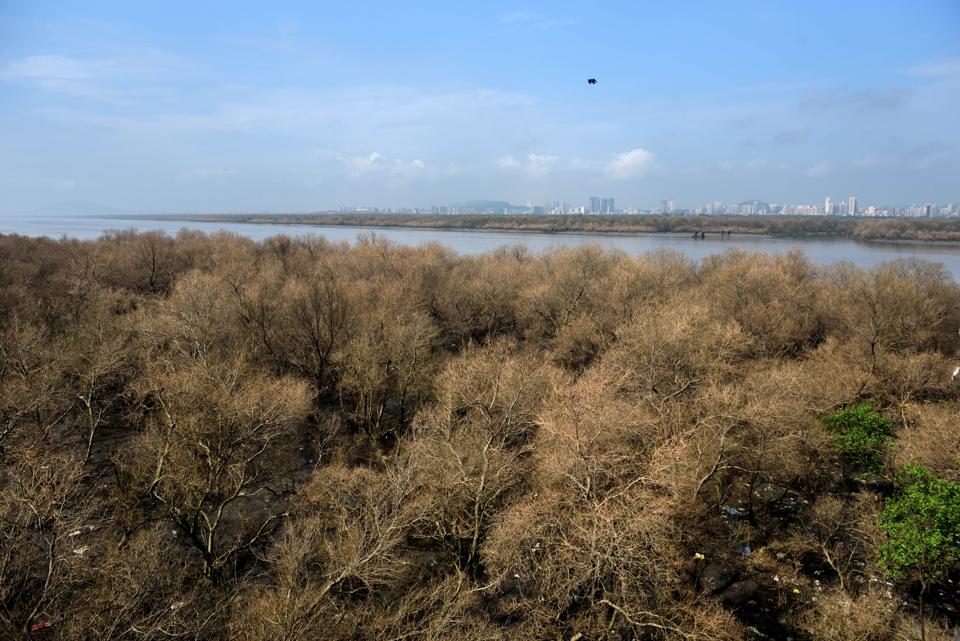
The Institute of Wood Sciences and Technology (IWST), Bengaluru, submitted its final report suggesting solutions for the annual invasion to the state mangrove cell last week after studying the phenomenon for the past three years.
“We found the intensity of the infestation varies every year and depends directly on the amount of rainfall received by the city during monsoon. Heavier the rains, worse the infestation,” said R Raja Rishi, principal investigator of the project, IWST.
The study documented that the city received 2,239.6mm rain in 2018, lesser than the annual average, which saw isolated incidents of the pest attack. In comparison, 3,670.4mm in 2019 (46% excess rain than the annual average) led to very high incidents of infestation.
“Pest attacks have been reported from mangrove forests across the Indian coastline, but the intensity and scale have been the highest in the MMR region. This is because the attack starts in the teak trees at Sanjay Gandhi National Park (SGNP) and surrounding territorial forests during summer and pre-monsoon, which is the primary host area. Whenever the climate is ideal [more rainfall], these pests move to mangrove forests within the region. By late October-November, they go back to the teak trees at SGNP, completing their lifecycle,” said Rishi, adding that availability of more moisture and rain makes conditions favourable for their movement to mangrove trees. “However, a more in-depth study is needed to understand their movement vis-à-vis climate parameters,” he said.
The report listed organic solutions as well as a pesticide to ensure mangrove trees are rid of five major pests among 20, led by the Hyblaea Purea moth.
“We have suggested the use of a botanical bio-pesticide Hy-Act that has been successful in reducing infestation of the identified pests. It has been developed by the Institute of Forest Genetics and Tree Breeding in Coimbatore and is not commercially available. Other natural measures include using neem-based solutions [neem oil] to control these defoliating pests,” said Rishi.
However, the study concluded with a caveat that more research was needed, whether to control this annual pest outbreak or leave it as is. “Owing to several beneficial and positive impacts on the ecosystem through contribution to the nutrient cycle and food chain [enhance fishery resources or food source for birds], we must examine whether this natural process should be interfered with or conserved,” said Rishi.
To get a better idea about this phenomenon, the state mangrove cell in 2017 appointed IWST to study this phenomenon and suggest measures to control the infestation. With 25 field surveys conducted between 2017 and 2019, scientists collected samples of affected leaves, barks and the pest species from four mangrove forests in Airoli, Ghansoli, Gothivali, and Gorai. They conducted local experiments and assessed damages through laboratory studies. In all, six species of caterpillars, five species of grasshoppers, two species each of semi loopers, snails and weevils, and one each of leaf miner, skeletonizer and bagworm were identified as defoliating pests affecting five different mangrove species. “Of these, the Hyblaea Purea moth was most threatening to mangrove trees, along with two similar moths and two snails,” said Rishi.
The mangrove cell said that some mangrove areas are already witnessing fresh green cover since rainfall reduced during the first week of October.
“Implementing the bio-pesticide on such a large scale is very difficult and may not be cost-effective at this moment,” said Virendra Tiwari, additional principal chief conservator of forest (mangrove cell). “Even in the teak trees in forest areas in interior Maharashtra where Hyblaea Purea infestation is there, pesticide spraying is not done. To spray the entire mangrove forests is not practical,” he added.
However, Tiwari explained that if some mangroves showed extremely poor survival rate or their immune system had weakened and pest attacks were happening too frequently, the cell may consider experimenting with this solution in small patches. “At least now we know this is happening and in most cases, mangroves mostly recover,” he said.
Stay updated with all the Breaking News and Latest News from Mumbai. Click here for comprehensive coverage of top Cities including Bengaluru, Delhi, Hyderabad, and more across India along with Stay informed on the latest happenings in World News.


