
 E-Paper



Sharp spike in Mumbai’s air pollution, worst AQI since March
Researchers said the rise in pollution levels was associated with the retreating southwest monsoon season.


With reduced rain activity and an increase in human-induced emission, the city recorded its worst air quality since before the Covid-19 lockdown on Friday while also recording the hottest day this season so far.
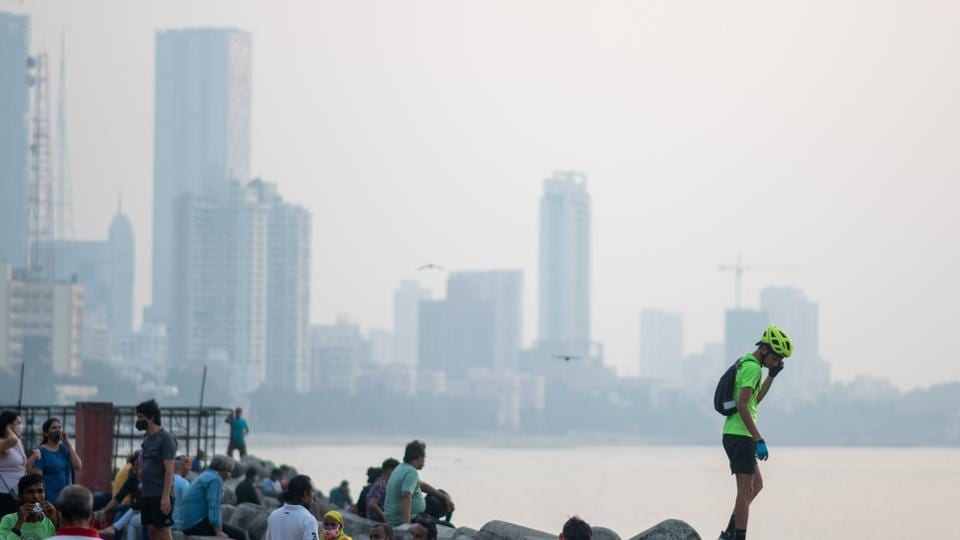
The pollutant-measuring indicator — air quality index (AQI) — was recorded at 118 (moderate) for PM2.5 pollutant (small pollutant particles that can easily enter the lungs and cause health ailments). A thin layer of smog was witnessed across the city’s skyline, according to the System of Air Quality Weather Forecasting and Research (SAFAR). On March 19, it was 130 (moderate), which means this was the first time since March 19 that Mumbai’s AQI breached the ‘moderate’ (101-200) category. On March 17 the AQI was 272 (poor) and on March 18 it was recorded at 172 (moderate).
The maximum temperature on Friday was 35 degrees Celsius at the Santacruz weather observatory and 34.6 degrees Celsius at Colaba, both 2.3 degree Celsius above normal.
On Friday, the concentration for PM10 (larger coarser particles) was 115 micrograms per cubic metre (μg/m³), against the safe limit of 100 μg/m³ for 24 hours. PM2.5 levels were 65 μg/m³ against the safe limit of 60 μg/m³ for the 24-hour mark.
Researchers said the rise in pollution levels was associated with the retreating southwest monsoon season. “This was expected as when conditions become favourable for monsoon withdrawal, there is a sharp drop in wind speed and rise in temperatures, especially for a coastal city like Mumbai. This allows pollutant particles to get suspended close to the surface and form a layer of haze,” said Gufran Beig, project director, SAFAR.
Also read: Covid-19 cases spike again in Kerala, experts say infection may peak by October end
Friday’s AQI, however, was an average from nine locations rather than 10 because the AQ monitoring station at Bandra Kurla Complex is under maintenance, said Beig. The highest pollution level was recorded at Navi Mumbai at 186 (moderate) followed by Andheri at 156 (moderate), Malad at 152 (moderate), Chembur at 149 (moderate), Worli at 128 (moderate). The remaining areas recorded ‘satisfactory’ AQI levels.
SAFAR categorises AQI levels for PM2.5 in the 0-50 range as good; 51-100 as satisfactory; 101-200 as moderate; 201-300 as poor; 301-400 as very poor and above 400 as severe. An AQI of 97 (satisfactory) has been predicted for Monday. An AQI of 104 (satisfactory) has been predicted for Saturday.
“Pollution levels are likely to be in the moderate category for at least two to three days. However, with a low-pressure weather system over the Bay of Bengal, the possibility of rain even around the Mumbai region could allow a marginal rise in wind speed,” said Beig.
The India Meteorological Department (IMD) has predicted a ‘yellow alert’ for the next five days for Thane and all other districts in south Konkan. However, only light rain has been predicted for the city and suburbs over the next five days.


