
 E-Paper



Maharashtra plantation drive: 3 crore saplings to be planted on July 1
Twenty percent of Maharashtra land is under forest cover. Our target is to increase the figure to 33% through Centre’s social forestry programme by 2019


What is Van Mahotsav?
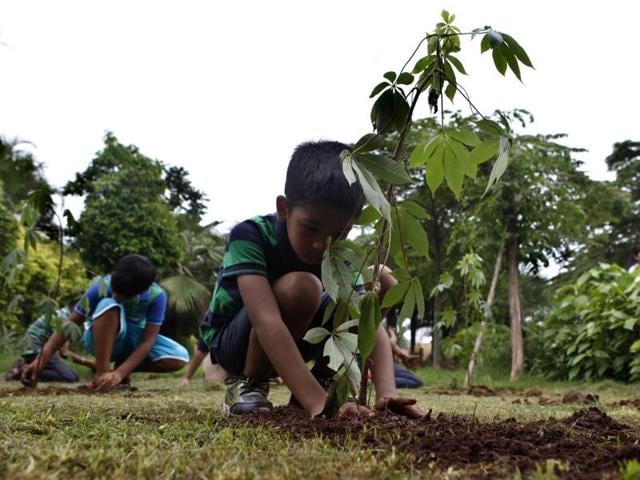
Van Mahotsav or Forest Day is an annual tree-planting festival from July 1 to 7 across India. Started in 1950 by the ministry of agriculture, millions of saplings are planted to increase green cover in forested and non-forested areas.
What is Maharashtra doing?
The forest department will plant more than three crore saplings on July 1. In addition to the forest areas, saplings will be planted in and around schools, hospitals, municipal parks, gardens, road sides and government buildings.
“Twenty percent of state’s land is under forest cover. Our target is to increase this figure to 33% through Centre’s social forestry programme by 2019,” said forest minister Sudhir Mungantiwar.
Of the 307 lakh hectares of total area in the state, 61.35 lakh hectares comprises forests. To increase the green cover to 33% means planting 400 crore trees.
“Sapling plantation has been conducted several times, but sustenance of trees is low. It is therefore necessary that the initiative becomes a mass public movement,” said forest secretary Vikas Kharge.
To participate: Contact deputy director, social forestry division or deputy conservator of forest of your district. Registrations open till 10 am, June 30.
Districts where saplings will be planted
2.14 crore sapling plantations by forest department
96 lakh sapling plantations by non-forest agencies
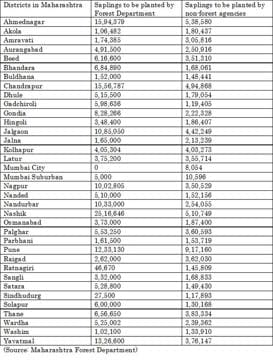
Pits for plantations are dug up across Maharashtra. For instance, 7,54,018 pits in Satara followed by 6,49,140 pits (Kolhapur), Sangli (5,02,420), Ratnagiri (1,69,453) and Sindhudurg (1,18,021).
“Digging pits will help carry out training, sensitisation and distribution of saplings much faster,” said Praveen Srivastava, additional principal chief conservator of forest, Nagpur, who is overseeing the programme.
A software developed by the forest department will use global positioning system (GPS) to identify latitude and longitude of saplings to be planted.
“Forest officers will geo-tag trees, click pictures of plantation pits, plantation process, and mention tree types and number of trees planted in the final report,” said Srivastava.
Which stakeholders can participate?
Corporate sector, private landowners, entrepreneurs, NGOs, educational institutions, paramilitary forces, railways, police, army and government departments.
What to keep in mind while planting saplings?
Select native plants
• Select diversity like trees, shrubs, climbers, grasses
• Protection from free grazing, fire and water for first 2-3 years.
(Source: Manasi Karandikar from Oikos Ecological Services, Pune-based consultancy firm working on ecological management aiding the plantation drive)
List of indigenous species to be planted
Ain, Amba, Badam, Chinch, Gulmohar, Jamun, Karanj, Neem, Peepal, Wad, Bamboo, Anjan, Arjun, Beheda, Bel, Bor, Sitaphal (custard apple), Fanas, Gulvel, Hirda, Kavat, Khair, Kanchan, Naral, Nilgiri, Teak, Cashew
ENVIRONMENTALISTSPEAK
“Planting trees is most essential to save our ecology. If a full-grown tree covers 10sqmt area, the canopy from 2 crore saplings over Maharashtra will substantially increase green cover, making it the first step to address climate change,” said Avinash Kubal, deputy director, Maharashtra Nature Park, Mahim. “Trees help reduce temperatures during summer, reduce carbon emissions and increase fruits, nectar for birds and butterflies.”
Stay updated with all the Breaking News and Latest News from Mumbai. Click here for comprehensive coverage of top Cities including Bengaluru, Delhi, Hyderabad, and more across India along with Stay informed on the latest happenings in World News.


