
 E-Paper



Indian on death row in Indonesia may have converted, married
While drug offenders must be sentenced, what the Indonesian authorities, and people, really need, experts say, is to be able to establish a strong intelligence network out of offenders turned approvers and informers — which will help them crack down on the kingpins instead of trying to lynch every minor trafficker they catch.


Gurdip Singh, on death row in Indonesia for allegedly smuggling drugs, got a temporary reprieve on the stormy night of July 27, hours before he was to face a firing squad at a prison on the island of Cilacap. But many questions remain about his case.
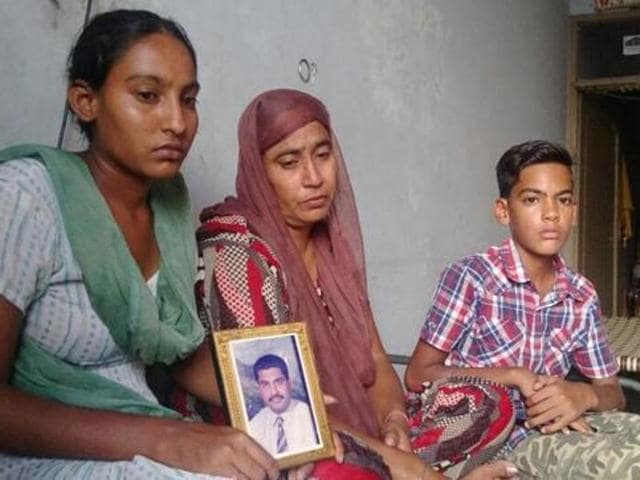
Was he a first time drug-carrier, doing the bidding of a Pakistani drug runner as his lawyer says? Or was he inept and maliciously dragging in an innocent Pakistani textile worker, as the Pakistani’s defence implies? No one quite knows.
A little-known detail is that while in prison, 48-year-old Singh married an Indonesian woman, has perhaps converted to Islam (reportedly adopting the name Muhammad Rijal) and now has two children with her.
Twelve years have passed since his arrest at Soekarno-Hatta airport in Jakarta, on August 29, 2004, after 300 gm of heroin was recovered from his socks.
And what has unfolded since that stormy night in July is the story of an Indian and Pakistani, both on death row in Indonesia, their lives hanging on the thread of political whims and the tug-of-war of international diplomacy.
Read | Not executed, but not safe: Gurdip’s fate hangs in balance in Indonesia
The story of Gurdip Singh, which exploded on Indian media at the end of July, is a complicated one.
His family learnt of the news of Singh’s suddenly announced execution the day before it was scheduled. Then they received news of his execution. His wife Kulwinder Kaur fainted. Then, a WhatsApp message arrived saying Singh was actually alive.
Kaur, 42, is subdued throughout our conversation. But her voice cracks when I ask her about her husband’s second marriage. “I had no idea,” says Kaur, who stays with her parents at Nakodar, near Jalandhar in Punjab, now. “I learnt of it after his execution was stayed.” The news is another overwhelming gust in the whirlwind that took over her otherwise routine life recently.
“He called (on the morning of the day his execution was scheduled) to say his son should cremate him when the body is sent back,” says Kaur. Singh’s son Sukhbir, now 14, was not even a year old at the time of his father’s arrest. “He said Sukhbir should at least see what his father looks like.”
The execution was stayed at the last minute. Singh was supposed to face the firing squad with 13 others. Of these, four were executed. The other executions were postponed for no other reason than, in Indonesian attorney general Muhammad Prasetyo’s words, “judicial and non-judicial considerations”. With the stay, Singh’s story has receded from Indian news. But for Singh and his family the prospect of the firing squad still looms.
According to Amnesty International’s report titled Flawed Justice: Unfair Trials and the Death Penalty in Indonesia, “It is almost impossible to determine exactly how many prisoners are on death row in Indonesia.” But Indonesia’s Community Legal Aid Institute, headed by Ricky Gunawan, provides the following figures: “178 Death Row cases. 105 for Drug Offences. 71 for Murder. 2 for Terrorism.” These numbers reflect the country’s transition from being a transit state for drugs to becoming a major market in the region.
President Joko Widodo has said Indonesia is facing an “emergency” with regard to incidents of drug abuse. In 2014 he claimed in a televised speech to university students (which has since been much-cited, but is not necessarily accurate) that 40 to 50 people die every day in Indonesia because of drug addiction. Widodo said then the government will deny all applications of clemency because “this crime warrants no forgiveness”.
Gurdip Singh’s Story
Gurdip Singh hails from Sitalpur village in Saharanpur district, Uttar Pradesh. He left home at 19 to work as a driver in Libya. He married Kaur in 1995. His wife says he “stayed for barely a month after marriage before going back to Libya”. Singh was the eldest in the family, says Kaur. “The family only had two tiny plots of farmland so Gurdip had to work abroad to earn enough to provide for three sisters and two brothers.” He returned from Libya in the early 2000s and bought a car to run a taxi service of his own in Saharanpur.
“But he would earn only around Rs 10,000,” says Kaur. “One sister was still unmarried. One brother still in school.” Also, they had had a daughter, Manjot (now 17). “Gurdip said he would get a job in New Zealand to be able to earn more,” Kaur says. He travelled with Kaur to Jakarta, in Indonesia, hoping to go on to New Zealand from there. Kaur says “agents” arranged for their travel and stay in Indonesia. “There was a Pakistani agent called Ali whom I had met once,” she says.
Read | Gurdip Singh innocent, his agent cheated him in Indonesia: Family
Kaur claims this is the same Zulfiqar Ali who is currently on death row with Singh. Ali, 52, is a textile worker from Pakistan, and was staying in Jakarta at the time Singh and Kaur arrived. Kaur returned to Saharanpur after “around five months” because she was pregnant and Singh had promised her he would come too, soon. Then she heard of his arrest.
“Ali ne mujhein phasaa diya (Ali has gotten me into this),” is what she says Singh told her after his arrest. “He said Ali had taken away his passport and refused to return it till he did this job for him.”
Zulfiqar Ali’s Story
Zulfiqar Ali’s arrest on November 21, 2004 was based on Singh’s testimony to Indonesian authorities. There has been an outcry over his death sentence by Indonesian, Pakistani and international rights groups and media.
“Zulfiqar Ali was not arrested red-handed carrying 300 g of heroin at Soekarno-Hatta airport,” Ali’s lawyer Saut Edward Rajagukguk has said. “He was arrested about three months later when spending time in Puncak (in West Java) with his girlfriend.” He claims the police asked Ali for a bribe and when he refused, he was tortured by the police and forced to confess that the drugs were his.
As a result of this torture, Ali had to go through kidney and stomach surgery. The Justice Project Pakistan claims a bribe of 400 million Indonesian rupiah was demanded from Ali at the time of the proceedings as well, to reduce his sentence from capital punishment to 10 to 15 years. Also, that he was threatened with a higher sentence for refuting the confession obtained from him through torture.
Indonesia’s National Commission on Human Rights Commissioner Hafid Abbas claims he had conducted an investigation which found Ali innocent, but his report was ignored by the government. Patrialis Akbar, the justice and human rights minister in the previous administration, issued a statement corroborating Abbas’ findings.
Finally, hours before the scheduled execution of Ali, Singh and 12 others, former Indonesian President BJ Habibie wrote to President Jokowi (his popular name) citing Ali’s case to ask for a moratorium on executions. Lawyers, who wish to remain unnamed, say this may be a conclusive reason for Ali’s execution, at least, being stayed.
A Mexican Stand-off of Narratives
Law, in practice, is often a matter of narrative. Ali’s lawyer, and various rights groups taking up Ali’s cause, say Singh retracted his confession — which had implicated Ali — before a notary. They claim to have a copy of the retraction, which the Indonesian courts did not admit. The reason the courts are not admitting this retraction, some activists say off the record, is the document did not have a date.
Singh’s lawyer Afdhal Muhammad, in a telephone interview, denies Singh ever issued this retraction. He maintains Singh was a mere carrier acting out of compulsion because his passport had been kept hostage. “The ‘boss’ in this case was Zulfiqar,” he says.
Muhammad was appointed Singh’s lawyer by the Indian embassy in 2014, a full decade after Singh was arrested. Before that, says Muhammad, Singh’s lawyers had been appointed by the Indonesian state.
The overwhelming support for Ali and the coverage of his case (see The Sydney Morning Herald, The Jakarta Post and Tempo especially) may well be warranted, but it subsumes smaller details and unanswered questions in Singh’s case.
Details like the fact that Singh was caught after he strode past the X-ray machine at Soekarno-Hatta airport, with two packets of heroin in one sock, one packet in the other, on a Sunday afternoon.
An Indian intelligence officer with an anti-narcotics specialisation who is posted in the Southeast Asian region, tells me on condition of anonymity, “This points to the fact that Singh was a first time trafficker, or at least new to the trade. An experienced trafficker would have kept the heroin concealed in a compartment inside his shoes or stitched in his clothes, in such a way that it would be difficult to find upon a routine body search.”
Other unanswered questions include, if Singh did not take the heroin from Ali, then who did he take it from? Drug rings often employ new carriers — strangers to points of collection and delivery — to prevent arousing the suspicion of drug enforcement authorities and to prevent others in the ring from being identified.
But even under torture, why would Singh implicate Ali? Even if he had done so with the aim of lessening his own sentence, why would he not reveal the truth about where he had, presumably, gotten the drugs from instead? Why did Ali buy his ticket to Surabaya in East Java? What was Singh supposed to be doing there? The bribes demanded from Ali, or threats made, do not erode the validity of these questions.
Singh’s narrative aims to refute Ali’s narrative and reduce his own culpability, while indicting Ali. Ali’s narrative too strives to demolish Singh’s narrative and makes him out to be not only a carrier of heroin, but also a perjurer. Indonesia’s Supreme Court has confirmed the death sentence for both men and a case review is unlikely to succeed unless Singh or Ali produces new evidence before the court. However, the plea of clemency before the President will not rely on legal procedure alone. The more convincing story will have a greater chance of winning clemency.
Other Arguments
Singh’s case review and clemency petitions plead his death sentence be commuted because the court had previously handed only 20 years of imprisonment to Australian national Schapelle Leigh Corby for carrying 4.2 kg of marijuana in 2009. Singh was carrying only 300 g of heroin and, according to his lawyer Muhammad, both narcotic drugs are treated at par for this purpose by Indonesian law (i.e. the fact that heroin may be considered by some to be a more harmful drug than marijuana is not a factor in this case).
International Politics, Indonesian Policies
In a scenario that is fast beginning to resemble an India-Pakistan border flare-up, officials from the Indian and Pakistani foreign services have each been in touch with the death row prisoner from their own country. There have been reports of Sartaj Aziz, adviser to Prime Minister Nawaz Sharif on foreign affairs (Sharif holds the foreign affairs portfolio himself, making Aziz the de facto foreign minister), seeking a meeting with Indonesian foreign minister Retno Marsudi on the issue of Ali’s impending execution.
Pakistan’s ambassador to Indonesia Aqil Naseem cited the Indonesian Human Rights Commissioner Hafid Abbas’ investigation to urge that Ali’s case be reviewed because of “serious breaches of a fair trial”.
Maryam Haq, legal director of Justice Project Pakistan, said, “Given that there is stronger evidence to support his innocence than guilt, it is now time for the President of Pakistan to appeal to our Muslim allies and save an innocent Pakistani’s life.”
Meanwhile Singh, (reportedly adopting the name of Muhammad Rijal) now has two children with the Indonesian woman he married. There is a precedent to this. Ayodhya Prasad Chaubey, who was executed by a firing squad in the month in which Singh was arrested (he was convicted of smuggling 12 kg of heroin), on August 5, 2004, had converted to Islam too during his prison stay of 10 years, hoping this would help him get clemency in a country with one of the world’s largest Muslim populations.
Singh’s second wife, 35-year-old Marwati Suryaji has been trying to gather support for him in Indonesia and visited his family in India. “We didn’t know she was his wife,” says Kaur. “We thought she was a friend helping him with his case.”
What has the Indian government been doing for Singh? “Madam (external affairs minister Sushma Swaraj) spoke to me twice,” Kaur says. “Earlier, when we had thought Gurdip’s execution would take place on August 26, she had said she would do whatever she could to try and prevent it.”
External affairs ministry spokesperson Vikas Swarup has spoken of two note verbales being issued at the time, from the Indian government to the relevant Indonesian authorities, to request that all legal resources be exhausted before the execution was carried out.
“Our embassy officials, consular officials are camping in Cilacap,” Swarup had said at a news briefing. “We have reached out to the Foreign Office, we are trying to reach out to the senior leadership of Indonesia.” Swarup added, in an email correspondence, “Our mission in Indonesia is working together with the legal representative for the case.”
This isn’t a one-off case for the ministry. Swarup also spoke of similar aid being provided to three Indian nationals — Subramanian Alagappa, Sivakumar Archunan and Chilladurai Perumal — convicted for murder in Qatar.
Yet the death sentences remain. Flawed Justice, Amnesty International’s report on capital punishment in Indonesia, illustrates how the revival of executions (between 2009 and 2012 there was what authorities called a “de facto moratorium on executions”) is especially disconcerting because of the unfair trials that lead up to them.
For instance, whether we wish to go by Ali’s or Singh’s narrative in their cases is beside the point. What is really relevant is their cases remain unresolved today, and to sentence two men to death for the trafficking of 300 gm of heroin (in India this would have induced a sentence of between 10 to 20 years and a fine of Rs 1 lakh to Rs 2 lakh) when their guilt to this effect has not been proven beyond reasonable doubt is grotesquely unfair.
Jokowi’s estimate of 50 people dying daily of drug addiction has been questioned because of the dated data (seven years old), limited sample size (2,143 people were asked how many of their friends died of drug use) and faulty methodology (the median number of such “friends” was then applied to the dated number of drug users, which comprised not just addicts but also those who had used drugs just once or occasionally). Consequently, the National Narcotics Agency conducted another study with purportedly improved methods, and put the number of drug deaths per day at 33.
But, significant for Jokowi, is a survey conducted in March 2015 by Jakarta-based agency Indo Barometer, according to which more than 84% of respondents agreed with the death penalty for drug traffickers and Jokowi’s approval rating was 57.5%, 15.5 percentage points higher than a few months ago.
Indo Barometer’s executive director Muhammad Qodari said Jokowi’s no-clemency-for-drug-offenders policy had contributed to the rise in his ratings. Qodari also said international pressure hardly affects Indonesian public opinion and that, in fact, it strengthens feelings of nationalism.
The reason 60.8% of respondents gave for supporting capital punishment for drug offenders was it would prove to be a deterrent. This logic seems to be driving the Indonesian government’s populist anti-drug policy.
Forget human rights for a moment. Nothing demonstrates the ridiculous impracticability of Indonesia’s current approach to drugs better than the idea, recently being toyed with, of executing drug dealers by force-feeding them their own supply. Or, better still, National Narcotics Agency chief Budi Waseso’s proposal last year that drug offenders on death row be housed in a prison surrounded by a moat full of crocodiles. Waseso went on to obtain two crocodiles from a farm to study their ferociousness and, upon being ridiculed, said, very seriously, that he was thinking of tigers and piranhas as well. The reason? Unlike human guards, said Waseso, “Crocodiles can’t be bribed.”
Without trivialising it, let’s study the feasibility of this suggestion. Experts pointed out that Waseso would not be able to erase the human element as guards would still be needed, now to monitor the prisoners and the crocodiles. Secondly, ferocious crocodiles, tigers and piranhas would not be able to gauge the difference between guards and prisoners, exposing both to equal risk. Biologists also pointed out aggressive crocodiles and tigers may attack each other because of turf wars, and this might be too much for prison authorities to handle.
Those crocodiles would be an apt metaphor for capital punishment in Indonesia. In the eight months since the execution of two of the infamous “Bali Nine” (nine Australians arrested for heroin smuggling operating, then, out of Bali) last year, the National Narcotics Agency actually reported a 40% increase in the number of drug users, suggesting the death penalty deterrence isn’t really working.
While drug offenders must be sentenced, what the Indonesian authorities, and people, really need, experts say, is to be able to establish a strong intelligence network out of offenders turned approvers and informers — which will help them crack down on the kingpins instead of trying to lynch every minor trafficker they catch. For this they will have to try to understand their enemy in this drug war, rather than resorting to a national demonisation which paints an accused drug offender in black or white like a character from Indonesian’s favourite soap opera-style TV shows, the sinetrons.
And as Ayodhya Prasad Chaubey reportedly said on the day before his execution: “We are only ordinary human beings. We only live once.”
(In arrangement with GRIST Media)


