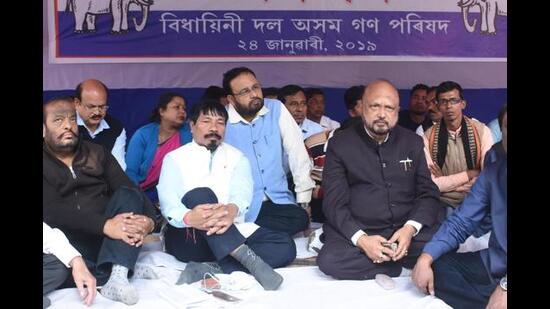
AGP: From fierce Assamese regionalism to BJP’s faithful ally
Carrying the burden of an inglorious track record and a fractured organisation, the AGP leadership today is in a much better position to rebuild the party by using the advantages that power brings than without
In 1986, Opposition parties across India called for a Bharat Bandh. Former Assam chief minister (CM) Golap Borbora appealed for the Asom Gana Parishad’s (AGP) participation. But despite writing to him, Prafulla Mahanta, Assam’s new CM and leader of the AGP did not concede. Assam remained open when the country closed down to protest rising petroleum prices. Mahanta defended his move because Assam required a different course of action, as its problems were not similar to other regions.
The AGP’s decision to stick with the BJP in the aftermath of anti-CAA protests could be seen as a pragmatic move by its leadership to buy more breathing space for the party. (ANI)
Coming to the present, the AGP today is playing the role of the Bharatiya Janata Party’s (BJP) junior partner in Assam. And it has faithfully stood by the saffron party through the rough and tumble of anti-Citizenship (Amendment) Act, 2019, (CAA) protests. It chose to do so despite the new legislation running counter to the Assam Accord (1985). Signed by leaders of the Assam Agitation (1979-85), the AGP was established to implement the Accord’s provisions.
The Accord calls for the expulsion of everyone illegally entering India after March 24, 1971. Contravening this provision, the CAA grants citizenship rights to persecuted Hindus, Sikhs, Buddhists, Christians and Parsis, if they entered India by 2014.
As the AGP observes its 37th foundation day, a pertinent question that could be asked: Why has a party that had once postured fierce Assamese exceptionalism now become a compliant second fiddle to the BJP?
There continues to be a strong perception in Assam that the AGP should have dumped the BJP during the anti-CAA protests. For many of them, what made the AGP leaders reluctant to join the opposition was their lust for power. By the same logic, they are also accused of betraying their party’s ideology of regionalism.
By standing with BJP even after it enacted the citizenship legislation, the AGP leadership has undoubtedly undermined the party’s foundational stand on illegal immigration. And by turning mute, the AGP also ensured that does not have to lose power. But having made these concessions, there is still a more significant question that could be asked. To what extent can the AGP’s leadership be blamed for having acted the way they did?
A longer-term view of the AGP’s political trajectory suggests that the leadership was under a compulsion to stick with the BJP. And this was largely due to the blunders committed by the AGP leaders of the past. The two spells of the AGP government led by Mahanta were scarred by exorbitant corruption, administrative mismanagement and breakdown of law and order. Having hardly anything to showcase in terms of governance, the AGP rapidly lost its popularity. In the subsequent period, under the leadership of Brindaban Goswami and Chandramohan Patowary, little was done to develop its organisation network, groom new leaders, reach out to more recent social groups, to regain its competitive edge.
When the AGP eventually reclaimed power in 2016, it was not by addressing these gaps. But by riding on the BJP’s back. Although the party has been part of the Assam government for more than five years now, the rot is so deep and political conditions have changed so much that AGP still has a long way to travel before it can hope to effectively stand on its own again.
Given this state of affairs, the AGP’s decision to stick with the BJP in the aftermath of anti-CAA protests could be seen as a pragmatic move by its leadership to buy more breathing space for the party. The last panchayat elections in Assam held before the 2021 state elections also rudely held out a mirror to the party. Swayed by civil society’s loud sub-nationalist rhetoric, the AGP went into the elections alone and ended up performing dismally.
Thus, in contrast to the accusations, the AGP leadership, in hindsight, seems to have astutely factored in the Assam’s political realities. This would mean awareness of all or either of these facets. One, that the AGP’s core constituency of Assamese-speaking Hindu voters has decisively shifted to the BJP. Second, organisationally the party is woefully weak to pull off any electoral miracles despite civil society and media’s anti-CAA push. Third, even by pooling with other anti-BJP parties, the Opposition would still fall short.
Any misadventure of leaving the BJP’s hand would have likely resulted in the AGP losing power. For a party that has grown severely weak, after staying in the wilderness for 15 years, that would have meant coming full circle. So, while it is true that the AGP leadership did not join anti-CAA, the decision was guided not merely by personal ambitions but involved the larger party interest.
It is accepted that power is indispensible to the survival of regional parties. And the AGP is no exception to this rule. Carrying the burden of an inglorious track record and a fractured organisation, the AGP leadership is in a much better position to rebuild the party by using the advantages that power brings than without.
Today, the AGP ministers in Assam government have a reasonably good performance record to showcase, the party is in a position to mobilise finances and dispense patronage in a comparatively better way, and its newly formed student wing is actively entering college and university unions across Assam. While these are minimal steps, the party today is in a much better position than a few years ago, when doomsday prophesiers predicted its imminent collapse. And going by the chaotic state in which Assam’s opposition finds itself today, it is therefore doubtful whether staying out of power would have helped it.
But to stand entirely on its feet once more, the AGP’s leadership would have to pursue the task of rebuilding the party with sincerity and patience. Also, by rebuilding, the AGP’s leadership would have to refashion the party to bring it in tune with Assam’s changed political realities. This would require the party to evolve a programme whose appeal goes beyond Assamese speakers, develop a base along religious and linguistic minorities and tribals, and develop a committed membership base.
Abhinav Pankaj Borbora is a doctoral student at the Centre for Political Studies, Jawaharlal Nehru University, New Delhi.

 E-Paper