The electoral sweep of the Aam Aadmi Party (AAP) in Punjab marks a significant turning point in the state’s politics and its reverberations are likely to be felt beyond its geographical boundaries. Though Punjab is a relatively small state in terms of its size or the number of electoral seats — when compared to states such as Uttar Pradesh, West Bengal or Tamil Nadu — it occupies an important place in the national imagination. Besides being located on the international border, it is also among the states with a strong sense of regional identity.
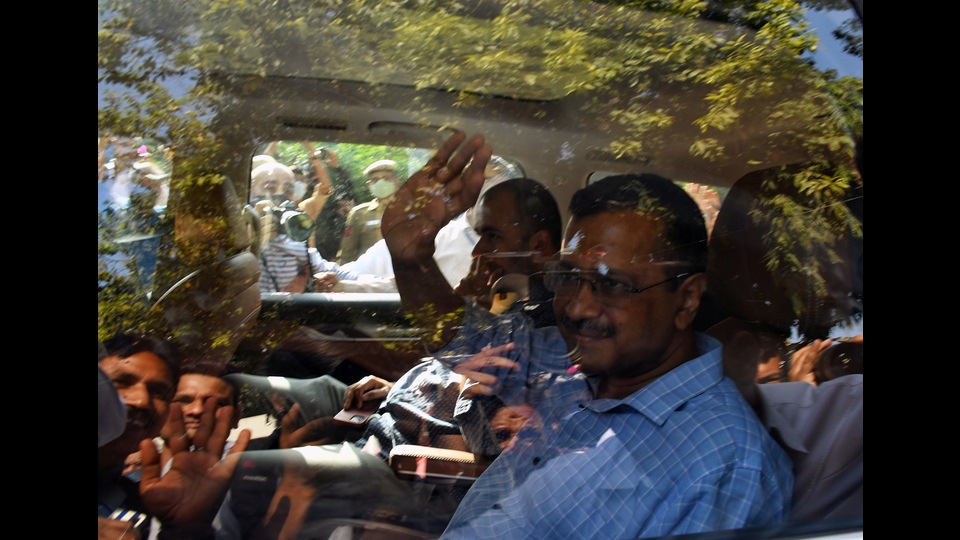
Delhi Chief Minister Arvind Kejriwal waves to the supporters, New Delhi, March 10, 2022 (Ishant Kumar)
Its regional politics has traditionally been represented by the Akalis, now divided into multiple political parties. The Akalis have also been the face of the Sikh panthic identity and politics. However, despite its distinct regional self-image, national parties such as the Congress and the Bharatiya Janata Party (BJP) have always been active and accepted. The AAP is the latest entrant.
Outside Delhi, it was in Punjab that the AAP found rather easy traction. It entered state politics during the 2014 national elections. Even when it could not win a single parliamentary seat in Delhi where it was in power, Punjab elected four AAP candidates to the Lok Sabha. Its performance in the 2017 assembly elections was also not bad and it emerged as the main opposition party. However, its victory in 2022 has a much larger significance. It has nearly completely undermined the traditional axes of Punjab politics, the most important of which has been Sikh panthic politics.
Many expected that this time, caste would play a bigger role in the elections, though Punjab has hardly been known for caste-based politics. Interestingly, Kanshi Ram, the founder of the Bahujan Samaj Party (BSP), came from Punjab. However, his party tasted only occasional electoral success in the state. Punjab is also not a land of Brahmanical Hinduism. Caste divisions do exist and persist in the region, with their specific local flavours. More importantly, at 32%, Punjab has the largest proportion of the Scheduled Caste (SC) population in the country, nearly double the national average. Though these numbers have never presented themselves in the form of a common Dalit political bloc, political parties have often been tempted by these interesting regional demographics of caste in Punjab.
Much before anyone else, in the last week of November 2021, AAP chief Arvind Kejriwal declared that his party would appoint a Dalit deputy chief minister (CM) in Punjab if it was voted to power. The Akalis followed suit and declared an electoral alliance with the BSP.
The ruling Congress went a step further and replaced its CM in the last year of his term with Charanjit Singh Channi, an SC, and went on to project him as its chief ministerial candidate. In their thinking, the electoral arithmetic was simple, the traditional voter of the Congress, plus SC consolidation behind it, would make for a winning formula.
However, this did not work. These assembly elections are going to be remembered for many things, and the politics of caste is one of those. Caste matters but caste alone does not determine electoral outcomes. It also works in complicated ways. SCs in every state are a conglomeration of several jatis, each with its own sense of self-identity, seeking its hissedari (share). SC communities also have a sense of hierarchy. And finally, a Dalit consolidation invariably also invites a counter consolidation of dominant and upper castes, which could prove counter-productive.
Punjab wanted change, a new narrative of citizenship. “We have seen the Akalis, we have seen the Congress, they are all the same, self-serving,” was a common iteration often heard from different parts of the state and from a cross section of voters. With an established presence in the state, the AAP could present itself as this new alternative.
In a sense, the process of political churn in the state’s politics was put in motion by the recent farmers’ movement against three now repealed central laws. Though a section of the farmers who decided to contest elections did not succeed, the movement turned out to be an important source of political change in the region. It undermined the local level divisions and schisms of caste and class and called for kisan-mazdoor ekta (unity between the cultivators and agricultural labour). In the process, it de-legitimised the thus far unquestioned authority of the regional political elite. It is not surprising, therefore, that almost all of them, including stalwarts such as Parkash Singh Badal, Amarinder Singh and the sitting CM lost their seats.
Finally, it will be interesting to watch what Punjab does to the AAP. The new party emerged in Delhi and has been almost completely controlled by Arvind Kejriwal. Anyone questioning his authority or leadership has been pushed out of the party. This includes three of the four Members of Parliament elected from Punjab in the 2014 elections. With its government in a much bigger state compared to Delhi, it will have to rethink its organisational-and-command structure.
Surinder Jodhka is professor of sociology at Jawaharlal Nehru University, New Delhi

 E-Paper