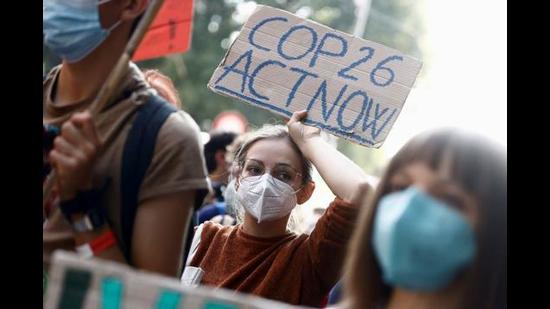
Climate and us | At Glasgow, leaders should deliver on statements of intent
The declaration of intent, however, doesn’t mean much unless that intent is formalised, accepted, and established in rules through the process of negotiation in the two weeks until November 12 when COP26 officially comes to an end
The Glasgow climate conference (COP 26) has started. Unlike earlier years, this time, over 120 world leaders, including United States (US) President Joe Biden, President of the European Commission, Ursula von der Leyen, Australian PM Scott Morrison, Prime Minister Narendra Modi and several others, will be making their opening remarks on November 1 and 2 during the World Leaders’ Summit at beginning of Glasgow talks, and not at the end.
The United Nations Environment Programme (UNEP’s) Emissions Gap Report 2021: The Heat Is On released on October 26 said net zero pledges cover more than half of current global GHG emission, but only 11 targets covering 12% of global emissions are enshrined in law. (REUTERS)
During previous climate talks, the high-level segment was scheduled at the end of the conference. But in recent COPs, that formula has changed. So, the world leaders are expected to set the tone for COP26 and declare their intent of keeping global warming contained to 1.5-degree C by the end of this century, even before negotiations start.
The declaration of intent, however, doesn’t mean much unless that intent is formalised, accepted, and established in rules through the process of negotiation in the two weeks until November 12 when COP 26 officially comes to an end.
Chinese President Xi Jinping and Russian President Vladimir Putin are not attending COP26. China announced in September 2020 at the United Nations General Assembly that its CO2 emissions will peak before 2030 and China will achieve carbon neutrality or net zero emissions before 2060. China is among 49 countries and EU 27 that has announced a net zero emissions goal so far.
The United Nations Environment Programme (UNEP’s) Emissions Gap Report 2021: The Heat Is On released on October 26 said net zero pledges cover more than half of current global GHG emission, but only 11 targets covering 12% of global emissions are enshrined in law. Net-zero pledges, which an increasing number of countries are committing to, would improve the situation, limiting warming to about 2.2 degree C by the end of the century, the report said. “However, the 2030 commitments do not yet set G20 members (accounting for close to 80% of GHG emissions) on a clear path towards net zero. Moreover, G20 members as a group do not have policies in place to achieve even the NDCs, much less net zero,” the report has warned.
China’s NDC, published on October 28, highlights just this. It’s a shade better than what China had submitted in 2016 but still falls far short of what it would take to achieve net zero emissions going forward. China has said it will peak before 2030 and achieve carbon neutrality by 2060; will lower its carbon intensity by over 65% from the 2005 level by 2030; bring installed capacity of solar and wind to over 1200 GW by 2030; increase share of non-fossil fuels in primary energy consumption to 25% by 2030 among others.
“We can’t sugarcoat it: Beijing’s new climate plan is disappointing and well off where the world’s biggest emitter needs to be. China has lowballed its target and missed a chance to be recognised as a global leader. The plan says emissions will peak before 2030 - for all our sake we need that date to be far sooner.
But we also need to recognise this is a symptom of a wider malaise - where big economies are announcing plans for plans and failing on finance promises, but manifestly failing to deliver the level of emission cuts we need to avoid brutal climate impacts,” Bernice Lee of Chatham House said in a statement.
Many experts have said China has not committed to much more than what it had promised in 2016. Lauri Myllyvirta, lead analyst at Centre for Research on Energy and Clean Air, tweeted that “China’s new climate commitment under the Paris agreement has been published. It turns the 2060 carbon neutrality target and CO2 emissions peak before 2030 into new formal pledges but doesn’t shed more light on the emissions trajectory over this decade.”
China’s role gains more importance when you look at the carbon budget numbers. A carbon budget is the cumulative amount of carbon dioxide (CO2) emissions permitted over a period of time to keep within a certain temperature threshold says Carbon Tracker. According to a recent analysis by Centre for Science and Environment, in the coming ten years China will take up 33% of the remaining carbon budget of 409 GtCO2 and India may occupy only 9.54% of the budget. Between 1870 and 2019, China occupied 13.4% of the global carbon budget; India 3.16% and the seven historical polluters — United Kingdom, US, European Union-27, Russia, Japan, Australia, and Canada —occupied 60.53% of the carbon budget.
The share changed quite a bit between 1990 and 2019 when China occupied nearly 21% of carbon budget. This means China went through a very intense phase of development mainly dependent on fossil fuels during those 20 odd years. “We cannot compare India and China. Its time we de-hyphenated the two,” Narain said during a recent briefing to climate journalists.
This brings me back to certain concerns that several climate experts have been raising. Are countries serious about net zero emission commitments or are waiting for yet-to-be-developed, sophisticated new carbon capture technologies in the coming years and a carbon markets mechanism that will help polluters to shift the burden of cleaning up on developing countries? The next two weeks will be critical in determining if these fears are true and if we are headed for a climate disaster with few countries taking serious action in the near term. People are desperate for an assurance that world leaders will be honest and live up to the existential challenge of solving the climate crisis this time.

 E-Paper