E-Paper



Climate and Us | In Glasgow, as expectations rise, negotiations remain stuck
Indian officials have said talks will breakdown if there is no resolution on climate finance, both a review of promised $100 billion and decision on a new, fairer and higher finance goal for the post-2025 period


Will the Glasgow climate conference go down in history as the meeting that managed to save humanity from the catastrophic climate crisis?
For now, this seems a bit unlikely because the Global north and south remain extremely divided over a number of important issues — how can the 1.5 degree goal be kept alive; the definition and nature of climate finance; how will rich nations compensate the poor for losses due to extreme climate events such as deadly cyclones and floods or slow onset events such as sea level rise. So many countries have so many redlines over so many issues that it now seems like the Glasgow outcome will be some sort of a compromise, which will pay lip service to each of these issues, but remain weak on the details.
Keeping 1.5 degrees in sight would mean not just working out implementation strategies of existing pledges but also improving on these pledges very soon. The recent pledges by countries at the COP26 has, for the first time, given the world a shot at keeping global warming to under 2 degree C, according to three new scientific analyses.
“#COP26 climate pledges mean Glasgow is getting closer to Paris! New @IEA analysis shows that fully achieving all net zero pledges to date & the Global Methane Pledge by those who signed it would limit global warming to 1.8 C. A big step forward, but much more needed!” tweeted Faith Birol, executive director of International Energy Agency on November 4.
One of the key concerns for developing countries is whether bridging this gap in ambition will be equitable and whether the developed world will come forward to support emerging economies with climate finance and new technologies to implement their pledges.
In Glasgow, a Scottish family is hosting me at their home. Hotels and Airbnbs were either fully booked or quoting astronomical tariffs during the COP26 dates; so I had requested a friend to help me find an accommodation. She put me in touch with an 82-year-old lady who is passionate about politics and the environment. Her daughter, a public interest environmental lawyer, and son, a sculptor, invited me to stay with them. The family is so concerned and excited about COP26 that they are tracking every deal closely. Each dinner is filled with discussions about climate politics and whether there will be justice for vulnerable countries with very low carbon footprints.
The daughter has been attending all climate protests in the city during the past week and hopes Greta Thunberg is heard. COP26 is a personal, emotive moment for them. There are many more such Scottish families who are hosting activists, delegates during the climate talks, one of the ways to ensure representation of people from different ethnic, social and economic backgrounds.
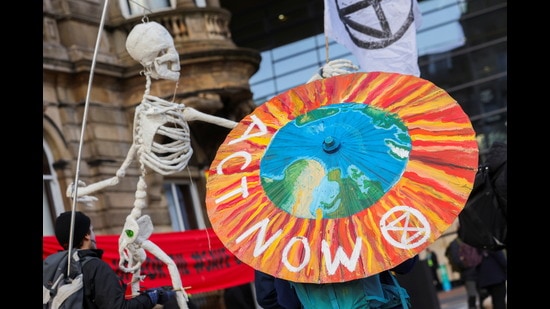
On Saturday, tens of thousands of activists, scientists and concerned citizens took to the streets all over United Kingdom calling for justice and action to stop the catastrophic climate crisis. Some activist-scientists in Glasgow chained themselves to draw attention.
But the negotiations seem far removed from the urgency being demanded by activists. HT reported on Saturday that several red lines exist on key elements of negotiations. The developed countries have not agreed to any independent review of the delivery of $100 billion. The Organisation for Economic Co-operation and Development (OECD) is keeping accounts of that fund. The developing countries have said OECD has been too generous and partial in its accounting of the money so they want a review. “The donors (developed countries) of course are deeply uncomfortable about such a review and number crunching. This I think will remain a red line,” said a senior official from the European Union delegation.
Indian officials have said talks will breakdown if there is no resolution on climate finance, both a review of promised $100 billion and decision on a new, fairer and higher finance goal for the post-2025 period. There is no agreement on the nature of finance either — will it be concessional grant based? Or will private capital being invested be counted as climate finance? “We have made it clear that we don’t consider commercial finance to be climate finance. It has to be concessional, and grant based. They are not agreeing to review also. Most of our nationally determined contributions (NDCs) are conditional on long term finance. I think if there is no agreement on finance, the COP process will weaken in coming years and countries will do whatever they can according to their circumstances,” said a senior official of the Indian delegation in Glasgow.
The negotiations seem cut off from public angst outside. The heads of states have left after making their pledges during the first week. The coming week is when difficult knots will have to be untangled and processes laid down. There will be loss of trust and disappointment among people if the Glasgow outcome doesn’t capture the urgency of the crisis.
The views expressed are personal