It’s been seven years since the PM’s Beti Bachao mission to address the child sex ratio. But, without its corollary, Beti Padhao, reaching its potential, the scheme is incomplete
Of the 1.87 million candidates who registered for The National Eligibility cum Entrance Test (Undergraduate) or NEET, India’s largest entrance exam for medical schools, over half, or 1.06 million, were girls and young women. That this has happened in a post-Covid-19 era where digital gender gaps and other persisting gender biases have disproportionately impacted women and girls make the NEET numbers all the more remarkable.
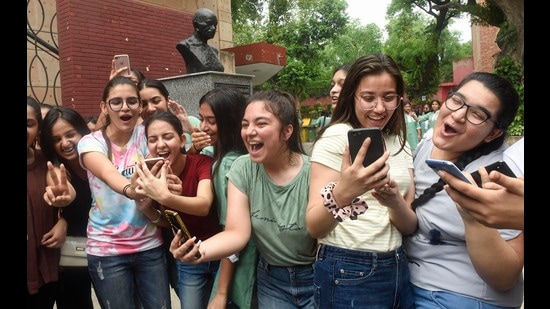
If there was ever a measure for aspiration for young women, it is to be found in the surge in numbers seeking to better their lives through education. (PTI)
If there was ever a measure for aspiration for young women, it is to be found in the surge in numbers seeking to better their lives through education. Women’s enrolment in higher education has increased twice as fast as male enrolment in the last four decades and today stands higher than that of male students, finds the All-India Survey on Higher Education for 2019-20. A comprehensive 2018 survey of 70,000 teenage girls’ aspirations by the Naandi Foundation and Project Nanhi Kali is a remarkable articulation of the dreams of 80 million girls. Its findings are a silver lining to India’s otherwise abysmal gender scenario: 70% wish to pursue higher education, 95.8% want to marry only after 21, and 74% want careers after marriage.
The girls’ dreams are founded on the bedrock of lived patriarchy, where they are burdened with housework in a way that their brothers are not; in the denial of basic freedoms such as mobile phones and leisure time in a way their brothers are not; and in the reality of watching their mothers beaten at home for minor transgressions such as a meal not cooked to standard. Added to the daily humiliations at home are the indignities heaped on them outside.
Two Dalit girls were forced to remove their uniforms and give them to two upper-caste girls for a class photograph in a Hapur primary school. A class 12 student died by suicide at a residential school in Tamil Nadu after leaving a note saying she was humiliated by her teachers for her academic performance. Girls in hijab were turned away from schools in Karnataka. And, the latest from Kerala, girls appearing for NEET asked to remove their bras for “security” reasons at the Mar Thoma Institute of Information Technology, 55 km from the state capital.
But the underlying issue remains. How do we encourage girls to continue to dream? Can there be systemic policy measures that address the humiliation of girls who wish to study? How do we sensitise systems and teachers to empower a generation of India’s most aspirational teenagers?
It’s been seven years since the prime minister’s flagship Beti Bachao mission to address the child sex ratio. But, without its corollary, Beti Padhao, reaching its potential, the scheme is incomplete. There is no shortage of studies confirming common sense knowledge: Investing in girls’ health, education, and livelihood creates a ripple effect that benefits society. How to nurture the seeds of something that can grow to full potential is our biggest challenge.
Namita Bhandare writes on genderThe views expressed are personal.
Namita Bhandare writes on gender and other social issues and has 35-plus years of experience in journalism. She has edited books and features in a documentary on sexual violence. She tweets as @namitabhandareRead More

 E-Paper