
 E-Paper



Goodbye Padmini, thank you for the ride
The maker of a photo series recalls the life of a vehicle and its owners — an indelible slice of Mumbai’s life and times that was recently phased out

 Prefer HTon Google


My inbox is slammed at the moment, with people sending me photos of the kaali-peeli as if to offer me condolences. I do feel like I am grieving the loss of a loved one —a fellow explorer, a loyal companion, backseat lover, a patient therapist, an old, dear friend. The Padmini was not just a car, it was where life unfolded.
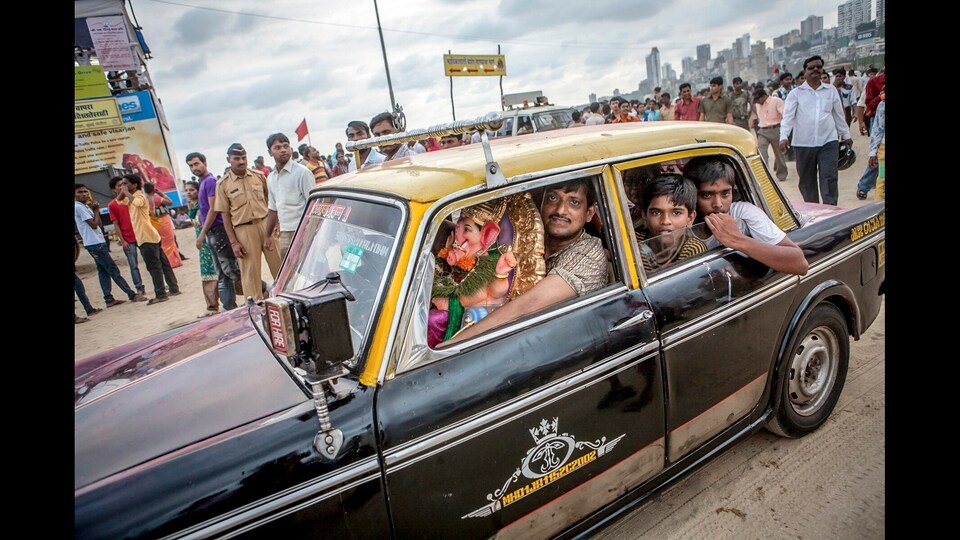
Sometimes it takes someone from the outside to make you see what’s right in front of you. That’s how my journey photographing the Padmini began. I met an Italian gentleman in Mumbai, who came to me with a proposal to document how the Fiat car had been appropriated by India and evolved a life of its own. The brief was to work on a book of photographs (it was titled ‘La Regina dei Taxi’ which translates to ‘the Queen of taxis’; it remains unpublished) that celebrated the Padmini in its full kitschy Bollywood technicolour glory. It sounded like fun; a “book project” is always music to a photographer’s ears, so I happily accepted.
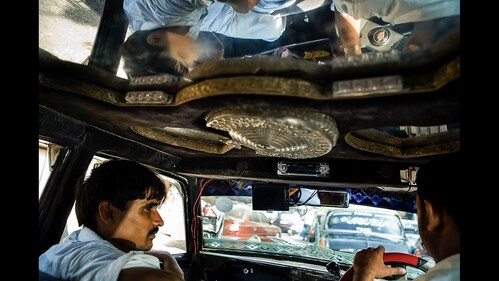
Kitsch they wanted and kitsch they got. It doesn’t get wilder than the interior of a Bombay black-and-yellow taxi. Mirrored ceilings, leopard-print seat covers, wallpapered doors with an assortment of flora and fauna, dashboards stickers with flags of the world, Bollywood heroines’ eyes staring back at you from the rear view mirror. One taxi I saw even had a pole in the middle, the kind you’d see at a strip club, with disco ball lighting. Inside each full metal-bodied car was a museum of its driver’s personality, unique, unabashed and a “trip” every time.
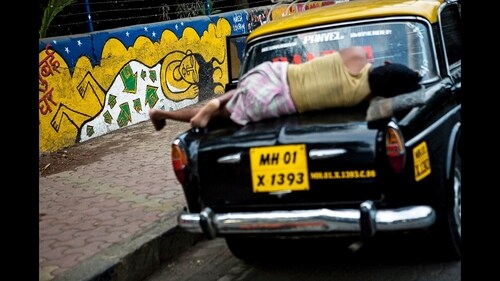
As I spent several months between 2010 and 2011 photographing these exciting automobiles, I began to see that for many of its inhabitants, this was a form of escapism. The reality of living in Mumbai for migrants from different parts of the country (especially from Uttar Pradesh, the land of Hindi film superstar Amitabh Bachchan) who had come to the Maximum City with Bollywood dreams, was dire. Ten men sharing a 10x10 room and sleeping in shifts because all their bodies couldn’t fit in there at the same time. Earning barely enough to survive and also to send back home. The story for me became as much about the people who drove the Padmini as it was about the car. Some of the romance wilted as it all got too heart-wrenching. I kept shooting, beyond the scope of the book, pursuing the human story.
During this time I continued to do paid assignments to stay afloat. I worked as a publicity stills photographer on Bollywood sets. I had the opportunity to work on a film with Priyanka Chopra, already an A-lister then (now a global celebrity) in 2011. After one schedule of the film in Kashmir, I respectfully pulled out of the project to go back to shooting taxi drivers. They asked me, “Why would you give up a chance to work with ‘PC’ to be with us?” In all myyouthful earnestness, I responded, "There are enough photographers to shoot her, I want to tell your story.” I still remember the delight in their eyes. They were only one degree away from Bollywood’s magic dust! Looking back, I may not have been able to make a big impact on their lives, but those moments spent together shooting, sharing meals and banter, brought us all a lot of joy and memories to cherish.
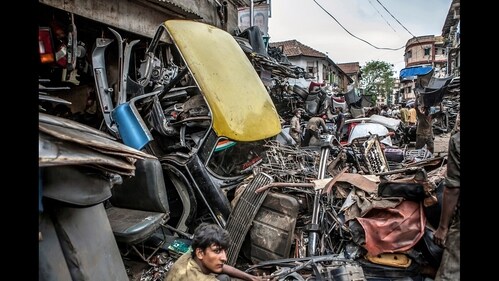
The Premier Padmini rolled off the Indian assembly lines from 1964 to 2001 courtesy the Premier Automobiles Limited, operating under Fiat’s licence. Initially known as the Fiat 1100 Delight, it was rechristened Premier Padmini in 1974. On October 29, 2003, the very last Premier Padmini taxi was officially registered at the Tardeo RTO. As the Padmini began to be phased out, newer black-and-yellow cars took their place on Bombay’s streets. According to regulations of the Maharashtra government, cabs older than 20 years are not allowed to ply on the streets, thus marking October 30, 2023, the Padmini’s last official day on the road.
If Mumbai were a film then Padmini was the lead character. It assumes many roles, and one of my most unforgettable evenings was when I decided to ride a ‘Padmini as Pimp’. The driver would take lonely men from the night to Kamathipura, Mumbai’s bustling red light district. He tried to strongly dissuade me from accompanying him into this murky world, but when I wouldn’t take no for an answer, he told me to duck inside the taxi and only shoot clandestinely from under the window sill. It felt like guerrilla shooting, with no consent — I felt dissonant and uneasy. I saw many disco taxis pulling up, dropping off men and taking some back, women leaning on them suggestively, their eyes glazed — the Padmini just being in the middle of it all, not judging. The pole made sense to me now. I didn’t go back.
This and many more stories colour my memory as I think about my days with the Padmini, which continued well into 2014 — long after my shoot for the book project was over.
My attachment to the vehicle, and appreciation for the men behind the wheel, grew manifold with my full immersion in the project. I made new memories and associations. It was the first time I had attempted to tell the migrant story through my lens, a dominant theme in my work ever since. The Padmini was already an inseparable part of my life, but it became inseparable from my work, too.
I didn’t know this is how it would end, but I’m grateful to the historical icon on wheels, and the drivers who let me into their lives to capture a bit of their souls, even as they stared at an uncertain future with their livelihood “cancelled”. In my photographs, they will live on forever as an indelible part of Mumbai history.
Fun fact: I got married around the same time I was shooting this project and it was such a part of me that I insisted my wedding car be the Padmini! It was beautifully adorned in marigolds, much to the amusement of my wedding guests and to the deep disappointment of my Malayali grandmother who’d have much rather seen me say my goodbye to single life in “something fancier, like a Benz!”
I left the city for good soon after in 2014. The Premier Padmini stayed a part of my life as I showcased these photographs on various platforms: a solo show titled Goodbye Padmini at the Bakehouse Art Complex in Miami in 2016, at photo festivals including the Delhi Photo Festival, the Goa Photo Festival and the Egaro Photo Festival in Agartala, as well as several journals.
And now, finally, I can say, goodbye Padmini, thank you for the ride.
Aparna Jayakumar is a photographer based in the UAE. She is the maker of ‘Goodbye Padmini’, a series of photographs on the iconic Mumbai taxi, which was exhibited and showcased across multiple platforms


