
 E-Paper



Hutong Cat | How India must negotiate the choppy waters of a resurgent Quad
It will require nuanced diplomacy, and quite possibly, calibrated restraint on India’s part to make the most of what Quad has to offer, and yet send a robust message to Beijing.

 Prefer HTon Google


China was wary of the Quadrilateral Security Dialogue, or Quad, from the beginning. In fact, from the time the bloc was notional.
Even before the four members of Quad had one of its first meetings in 2007, China, according to reports, had dispatched demarches to the four involved, asking them what the meeting was all about.
What had been floated as an arrangement among India, the United States (US), Japan and Australia, the “core group”, after the 2004 Boxing Day tsunami to coordinate humanitarian assistance, was gradually evolving into something more strategic.
China was keeping close track of it.
In 2007, the Communist Party of China (CPC)'s mouthpiece, the People’s Daily, questioned the intentions behind a naval drill between India, Japan and the US, held off the Japanese coast.
“It is absolutely not new for Japan and the US to sit down and plot conspiracies together but it is rather intriguing to get India involved,” the PD article said.
It went on to mention that then Japanese Prime Minister (PM) Shinzo Abe had “…repeatedly appealed for establishing a strategic dialogue mechanism among Japan, the US, India and Australia, a proposal described by media as having a self-evident objective”.
Later that year, Abe’s August 2007 “Confluence of the Two Seas” speech to the Indian Parliament became the ideological foundation for the Quad in its infancy.
“Japanese diplomacy is now promoting various concepts in a host of different areas so that a region called “the Arc of Freedom and Prosperity” will be formed along the outer rim of the Eurasian continent… By Japan and India coming together in this way, this “broader Asia” will evolve into an immense network spanning the entirety of the Pacific Ocean, incorporating the United States of America and Australia. Open and transparent, this network will allow people, goods, capital, and knowledge to flow freely,” Abe told Indian parliamentarians.
The bloc abruptly unravelled following Australia’s — under former PM, the Mandarin-speaking, Kevin Rudd — reluctance to anger Beijing, and possibly by New Delhi’s acumen that deep involvement in the bloc could have repercussions at the Sino-India border.
Quad went dormant for a decade. Until November 2017.
By then, in 2017, Abe was in the middle of his second term and India had emerged from a faceoff with China in the Doklam area of Bhutan.
China was poised as well.
“Xi’s China is poised to expand its global power and influence through the ambitious Belt and Road Initiative (BRI), expansive military build-up and modernisation, assertive foreign policy, and forceful public diplomacy. As a universally acknowledged economic juggernaut and global force that can now manifest its own national destiny across the interlinked and contested global commons, China wants to be treated accordingly,” was how Tuan Pham, a maritime strategist with the US navy wrote about China’s position in a review of the country in 2017.
The time was ripe for Quad to reassemble.
Officials from India’s external affairs ministry and counterparts from the three other countries met in Manila in November 2017 for consultations on issues of common interest in the Indo-Pacific region, resuscitating the bloc.
Even if the revival was low-key, Beijing followed the development and scrutinised the four separate statements minutely.
“The relevant proposal should be open and inclusive and should be conducive to the win-win cooperation and avoid politicising or excluding some relevant parties,” Chinese foreign ministry spokesperson, Geng Shuang said in Beijing.
Since then, the Chinese response to Quad has become increasingly sharper and critical — calling it an “Asian NATO”, and openly alleging that the bloc has come together with the single-point agenda to contain Beijing.
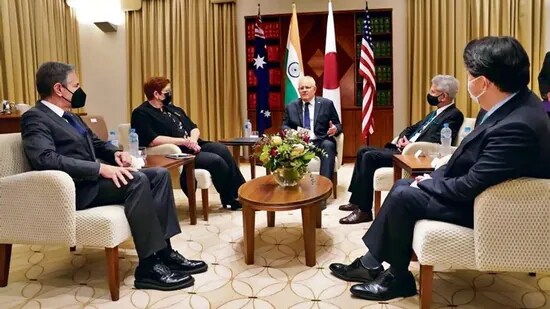
“The so-called Quad mechanism is, in nature, a tool to contain and circle China, and preserve America's hegemony,” current foreign ministry spokesperson, Zhao Lijian said earlier in February after external affairs minister S. Jaishankar, US secretary of state Antony Blinken, Japanese foreign minister Yoshimasa Hayashi and his Australian counterpart, Marise Payne met in Melbourne to deepen cooperation under the mechanism.
“It’s a man-made provocation of confrontation that undermines international unity and cooperation,” Zhao said.
A decade after its amorphous formation, Quad seems to have come back together with renewed resolve.
What happened in the intervening decade?
China’s ties with all four countries suffered setbacks despite strong, and expanding, trade ties with them.
China-US ties, for one, have been deeply acrimonious in recent years over wide-ranging issues including Washington’s ties with self-ruled Taiwan, which Beijing sees as interference in its internal matters, and alleged human rights abuses in Xinjiang and Tibet.
Beijing-Canberra ties plummeted after Australia in 2020 urged an independent inquiry into the origins of the coronavirus and participated in naval exercises with its Quad partners; China responded by restricting imports of Australian products.
A joint Japan-US statement issued after bilateral talks in Tokyo in 2021 “acknowledged that China’s behavior, where inconsistent with the existing international order, presents political, economic, military, and technological challenges to the Alliance and to the international community.”
The second paragraph of the statement listed shared concerns about China from “China’s unlawful maritime claims and activities in the South China Sea” to the need for “peace and stability in the Taiwan Strait” to human rights concerns in Xinjiang and Hong Kong.
India and China, of course, are in the middle of one of the worst crises in ties as they try to resolve the ongoing border tension along the Line of Actual Control (LAC) in eastern Ladakh.
China hasn’t helped in resolving the tension by painting India as the “aggressor” and absolving itself of any mistake.
Overall, Beijing’s diplomatic aggression — aimed at multiple countries — has actively aided the revival of the Quad.
A sign of India toughening its stand on the border was minister Jaishankar using this month’s Quad meeting in Melbourne to say that the “…situation (border tension) has arisen due to the disregard by China in 2020 of written agreements with us, not to amass forces at the border. So, when a large country disregards written commitments, I think it’s an issue of legitimate concern for the entire international community.”
But given India’s development status compared with the three other Quad countries — which are all first world, developed countries — New Delhi could do well to negotiate the choppy Quad waters carefully, especially if — some say when — the bloc acquires a military dimension.
Both the US and Australia are geographically far away from China; despite differences, Tokyo maintains a delicate balance of ties with Beijing, balancing diplomacy with strong trade ties.
India’s situation, quite literally, is unique, and so is its status in the bloc.
It also doesn’t share, at least not publicly and whether it’s right or wrong, the west’s critical views on Xinjiang or Hong Kong.
It will require nuanced diplomacy, and quite possibly, calibrated restraint on India’s part to make the most of what Quad has to offer, and yet send a robust message to Beijing.
Sutirtho Patranabis, HT’s experienced China hand, writes a weekly column from Beijing exclusively for HT Premium readers
The views expressed are personal


