Hutong Cat | The ‘chairman of everything’ cements his control over China
The adoption of the landmark “resolution on the major achievements and historical experience of the CPC’s 100 years of endeavours” puts the focus on “Comrade Xi’s” contribution in resolving problems faced by China for a long time, and its role in global politics
In September 2012, two months away from his globally high-profile crowning as the Communist Party of China (CPC) general secretary, vice-president Xi Jinping disappeared from public view. For a dozen straight mysterious days, starting September 1, Xi wasn’t seen at any public event nor quoted in official media.
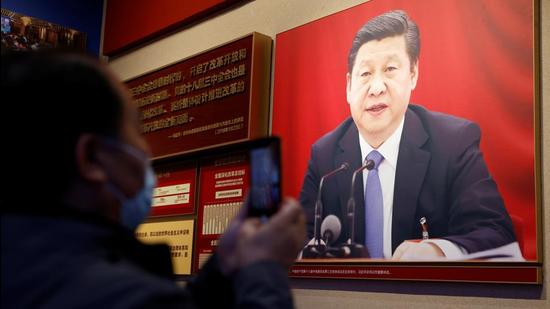
A 12-page communique released at the end of the four-day CPC plenum on November 11 defined Xi’s role in China’s history and politics (REUTERS)
Meetings with the then visiting United States (US) secretary of state Hillary Clinton and the Singaporean prime minister, Lee Hsien Loong, were cancelled. Xi’s absence in the public space was followed by the censoring of any search of his name on Chinese social media platforms.
Speculation and conspiracy theories ricocheted: From the suspension-of-disbelief-inducing assassination attempt and palace intrigue — among the secretive CPC elite ahead of the coronation — to the mere mundane, a bout of the humbler backache.
Then, just like that, on September 15, Xi was back: Official news service Xinhua published a one-line captioned photo, showing Xi attending an event at the China Agricultural University in Beijing to mark the country’s National Science Popularisation Day.
Nine years later, forget disappearing from public space, Xi has stamped his seal of authority on China forever: He has elevated himself to the stature of Mao Zedong and Deng Xiaoping. As leading China scholar and historian, Geremie R Barme once noted, Xi is now “chairman of everything”.
“Xi Jinping revealed his sweeping bureaucratic ambitions early on leading me in late 2013 to dub him China’s ‘Chairman of Everything’,” Barme wrote recently. Xi has all but ensured that he will carry on as China’s leader for, at least, an additional five years when the generational, once-in-a-decade, CPC Congress takes place in the second half of 2022.
A 12-page communique released at the end of the four-day CPC plenum on November 11 defined Xi’s role in China’s history and politics.
“The Party has established Comrade Xi Jinping’s core position on the Party Central Committee and in the Party as a whole and defined the guiding role of Xi Jinping Thought on Socialism with Chinese Characteristics for a New Era,” the communiqué said.
What was the Plenum’s significance?
Simply put, the adoption of the landmark “resolution on the major achievements and historical experience of the CPC’s 100 years of endeavours” puts the focus on “Comrade Xi’s” contribution in resolving problems faced by China for a long time, and its role in global politics.
The CPC under Xi will now address the weakening of the Party’s leadership in some aspects that, experts told Chinese state-run media, had caused a series of problems including long-standing corruption, environmental pollution, increasingly unstable and insecure situations in some regions like the Xinjiang Uyghur Autonomous Region (XUAR) and the Hong Kong Special Administrative Region.
The plenum has added aura, stature and a sense of invincibility to Xi: He was directly called a “helmsman” by a party official in a post-plenum press conference. China’s propaganda machinery has already created a cult of personality around him.
“His (Xi’s) works have been published in luxurious volumes; every speech he makes is celebrated as ‘important’ – his every statement and quotation is hailed as golden formulations. His activities, history, and personality are limned in terms that suggest an approaching apotheosis,” Barme told the New York Times after the plenum.
The general secretary’s photos and daily political and diplomatic activities adorn China’s state control media, day in, day out; his thoughts are now enshrined in China’s constitutions and treasured in Chinese school textbooks; any bookshop worth its Communist party salt in China proudly display books on Xi’s thoughts; this week, local media was carrying his voice-overs for stories he wanted to share with the people of China.
Official People’s Liberation Army (PLA) portals keep reminding their readers about loyalty; every day, China’s armed forces are reminded that they should be guided by Xi’s leadership and his thoughts. The Chinese President has used strong rhetoric in speeches when the occasion required.
At the 100th anniversary of the CPC, he said: “The Chinese people will never allow foreign forces to bully, oppress or enslave us. Whoever nurses delusions of doing that will crack their heads and spill blood on a Great Wall of steel built from the flesh and blood of 1.4 billion Chinese.”
Nothing encapsulates the supine state media’s devotion to Xi more than a Xinhua article on him published a day ahead of the 19th CPC’s sixth Plenum. Xi is “a man of determination and action, a man of profound thoughts and feelings, a man who inherited a legacy and dares to innovate, and a man who has forward-looking vision and is committed to working tirelessly,” Xinhua said.
Xinhua’s profile, headlined “Xi Jinping, the man who leads CPC) on a new journey”, painted him a man with “little time for himself”, for whom “happiness is achieved through hard work.” Xi has essentially headlined China and its policies — both domestic and international — in the last nine years.
Starting from the anti-corruption campaign in 2013 followed by the Belt and Road Initiative to the recent common prosperity drive, just to name a few initiatives -- the general secretary is now the Helmsman. He has led a more globally assertive China involving aggressive posturing on Taiwan, maritime border disputes in the South China Sea and serious tension with India on the boundary dispute, leading to the deaths of soldiers for the first time in four decades.
The darker side of Xi’s reign has been glossed over inside China even if it involved the persecution of its own people but then China has a history of doing so.
Xi’s rule has been marked by worsening persecutions of ethnic minorities in Xinjiang, Inner Mongolia and Tibet, three autonomous regions, the targeting of whistleblowers and regime critics, the crackdown in Hong Kong, the evident lack of support for the #MeToo movement, and the initial mishandling — even cover-up — of the coronavirus pandemic in the central Chinese city of Wuhan.
“Since Xi Jinping came to power the repression has gotten worse and worse overall, in every aspect of Chinese society you can see how the party is becoming more intolerant of any kind of independent activity,” Yaqiu Wang from rights group, Human Rights Watch, wrote in a report earlier this year.
Meanwhile, no explanation has ever been given for the vice president’s absence from public space during those two weeks in 2012. No explanation has also been offered yet why President Xi hasn’t left China since his return from Myanmar on January 18, 2020. As if on cue, the country itself remains somewhat isolated with international travel severely restricted.
Of course, the “chairman of everything” surely knows the political perks of working from home.
Sutirtho Patranobis, HT’s experienced China hand, writes a weekly column from Beijing exclusively for HT Premium readers

 E-Paper