
 E-Paper



Hutong Cat | War games, white paper, and 'China's final warning' on Taiwan
An old Soviet-era political proverb, coined when Washington made a show of its close ties with Taiwan in the 1950s and 60s, is surprisingly relevant today.


An old Soviet-era political proverb, which means “China’s final warning” in Russian is making the rounds of the internet.
It is surprisingly relevant today.
The background is this: It was coined in the erstwhile Soviet Union between the 1950s and ‘60s when Beijing would snap at Washington if it made a show of its close ties with self-ruled Taiwan. Like it does and is doing now.
Unlike now, Washington then had official diplomatic ties with Taipei, not Beijing.
Every time an American fighter aircraft would patrol Taiwan and the waters around it, China would announce it was the “final warning” to the US, accompanied by an unsaid threat of military retaliation.
In Soviet homes, the warning would be broadcast in Russian on radio, often voiced by the famous announcer, Yuri Borisovich Levitan.
By the mid-1960s and some 900 such announcements later – and after China did not carry out any military retaliation – the warnings morphed into the proverb “China’s final warning” among wry Russians to whom it became the example of an empty threat.
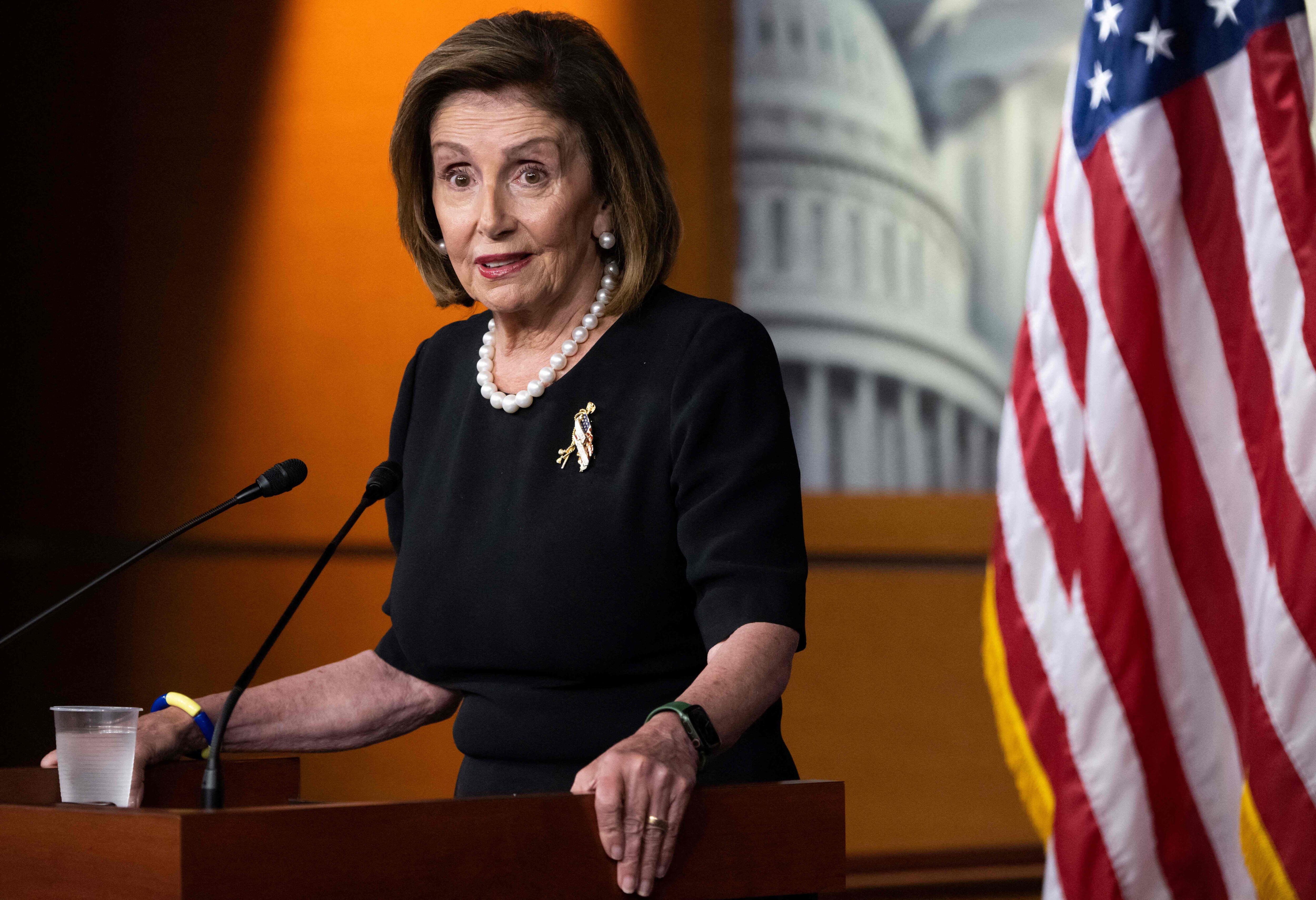
Six decades later, no one’s quite sure how real the threat of violence – a full-fledged invasion to merge Taiwan with the mainland – is behind Beijing’s show of belligerence against US House Speaker Nancy Pelosi's visit to Taiwan, the self-governed island of some 23 million people.
China, however, has shown the likely way it will go forward with the merger of the island, beginning with a blockade of the surrounding shipping and air lanes to soften it up first.
Since 1949, China has claimed Taiwan as part of its territory and has vowed to merge it with the mainland, by force if necessary.
Beijing put up a massive show out of its calibrated fury against Pelosi’s visit, mixing hard rhetoric and a live display of its military might; it also sanctioned her and cancelled bilateral mechanisms with the US including the critical climate talks.
China issued warning after warning to the US against Pelosi's visit, saying it would have severe consequences.
“Not sit idly by,” the Chinese foreign ministry said about what its military might do in case Pelosi visited – in a similar vein to what Beijing used to say some 60 years ago.
Then, after the American politician went to Taipei anyway, Beijing intensified its largest military drill around Taiwan.
The People’s Liberation Army (PLA) fired missiles, which flew over the island for the first time, deployed more than 100 fighter jets, many warships, and surrounded the island from six sides in what was a simulated island invasion exercise.
The drill was unprecedented in both scale and how close PLA ships, for one, got to the island.
It was evident from the scale of the multi-services exercise that the PLA’s eastern theatre command had long been ready with a blueprint of the simulated Taiwan invasion and blockade: Pelosi’s visit, which lasted less than 24 hours, allowed the PLA to test and show it to the world.
It was an indication that the threat of an invasion is real, even if it is not China's first choice.
The day the military drill was over – with the PLA promising regular patrols in and around the Taiwan Strait from now on – Beijing released a government policy paper on the island, reiterating its threat to use force to merge it with the mainland, saying the “one country, two systems” mechanism is best suited for it but adding that it wants a peaceful reunification.
The new white paper – The Taiwan Question and China’s Reunification in the New Era – is only the third such document to be released after 1993 and 2000, and the first since President Xi Jinping came to power a decade ago.
The Chinese government document revealed a complete disregard for the people of Taiwan, their lives, their aspirations, and the political system they have built over decades, transitioning from a military dictatorship to a functional democracy with individual rights.
The white paper mentions China’s preference for “peaceful reunification,” identified as the first choice of the ruling Communist Party of China (CPC).
Tellingly, however, the paper said China “…will not renounce the use of force, and we reserve the option of taking all necessary measures”.
Referring to the use of military force, it said: “This is to guard against external interference and all separatist activities. In no way does it target our fellow Chinese in Taiwan. Use of force would be the last resort taken under compelling circumstances,” it added.
"The future of Taiwan lies in China's reunification, and the wellbeing of the people of Taiwan hinges on the rejuvenation of the Chinese nation," the paper said.
Hong Kong “compatriots” would have found it interesting the repeated reference to how the “one country, two systems” mechanism is best suited for Taiwan.
When the time came – in fact, before it came – Beijing foisted its own vetted politicians to rule Hong Kong and is now gradually eroding all the freedoms the city’s residents enjoyed.
Given Hong Kong’s example, China possibly knows how hollow its own promises to maintain Taiwan’s social systems sound. The Taiwanese know it too.
“To realise peaceful reunification, we must acknowledge that the mainland and Taiwan have their own distinct social systems and ideologies. The 'one country, two systems' principle is the most inclusive solution to this problem,” the white paper said.
The CPC has no sense of irony: In the same white paper, it did away with a promise – made in the earlier two white papers -- not to send troops or administrators to Taiwan if it takes control of the island, possibly indicating less political autonomy for the island.
The response from Taiwan has been unequivocal.
Taiwan’s Mainland Affairs Council (MAC) described the white paper as “wishful thinking”.
“Taiwan insists that neither side of the Taiwan Strait has jurisdiction over the other and firmly rejects the ‘one country, two systems’ principle,” it said. “This is the status quo and the current reality in the Taiwan Strait,” the MAC added.
The white paper also pledged “to increase our compatriots’ knowledge of the mainland and reduce these misconceptions and misgivings, in order to help them resist the manipulation of separatists.”
If that’s a hint toward “re-education”, Lu Shaye, China’s ambassador to France, said it in as many words: “After reunification, we will do re-education.”
That's a chilling warning by any measure.
Sutirtho Patranobis, HT’s experienced China hand, writes a weekly column from Beijing, exclusively for HT Premium readers. He was previously posted in Colombo, Sri Lanka, where he covered the final phase of the civil war and its aftermath, and was based in Delhi for several years before that
The views expressed are personal


