In 2004, I was in the seventh grade when the first free presidential election took place in Afghanistan. For my country, that election was the second most important step after writing its new constitution in building a stabilised democratic society with the help of the international community.
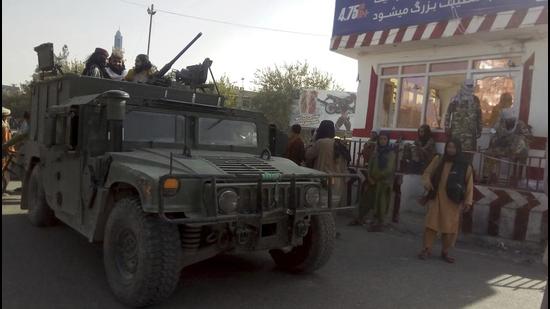
We stand vulnerable to the atrocities of the Taliban. Why? Because we dream of a democratic society (AP)
Since then, I could not wait to be old enough to vote for my country’s new president. Although I barely knew much about voting rights or participatory democracy, I still felt proud and powerful. I thought my opinion and my vote mattered.
Later, I studied at the journalism department of Kabul University, where I learnt about democracy, the right to vote, and freedom of speech. My studies helped me vote in the elections in 2014 and 2019, despite the high risk of being attacked by the Taliban. I voted in 2014 and 2019 amid the risk of being attacked by the Taliban. Back then, for me, as a media student, voting was not the only thing to do. I felt that it was my responsibility to openly talk about its importance with pride. Posting on social media was another way to express myself and convince others to participate in democracy for future generations.
In 2015, I went to India to pursue my Master’s degree in Journalism at AJK Mass Communication Research Center in Jamia Millia Islamia, New Delhi. In Jamia, I saw Muslims, Hindus, Sikhs, Buddhists, Christians, and many others belonging to different communities living together peacefully in the largest democracy in the world. Living and studying in the democratic, diverse, and stable India gave me a dream and a goal: Working for a democratic Afghanistan by preserving and polishing its cultural values, such as hospitality, music, clothing, and men and women working together. This made me return home after graduating, despite having a job at the Pashto department of the international division of the AIR: All India Radio.
Soon after returning home, I came back to the journalism department at Kabul University, where I became a teaching assistant and permanent faculty member. I was surprised when I met my students for the first time. Meeting and sharing thoughts with young minds made me happy. I found them much more aware and enthusiastic about democratic values than many from my generation.
At the time, I was full of hope, despite the fact that war was still raging in the countryside. I did not lose hope even when, every now and then, bomb blasts and suicide attacks killed people I knew in my own city, Kabul. After every lecture with these enthusiastic young men and women at Kabul University, it made me happy to see that my dream of a peaceful and democratic society was taking shape in front of me.
Even the deadly attack on Kabul University on November 2, 2020, which, according to official numbers, killed 32 people and wounded 50 others, including students and faculty members, could not stop us. Just two days after the violent attack, while everyone was still traumatised, we returned to our classes, most of us wearing black to express our grief. We were determined to build a new society.
Such acts of solidarity and defiance also made me realise that I was not the only one rooting for a democratic Afghanistan. Almost everyone my age has a similar story. The new generation of Afghanistan, those who went to schools and universities after 2001, and took part in elections in the last 17 years, always dreamed of a democratic society, where humanity was of the most considerable value.
Meanwhile, we knew about the corruption and rivalries among the different warlords sharing power, but we considered that as a passing stage and as a bridging point to the future we dreamed of. We were somewhat indulged, because we knew our country was yet to recover fully from the disastrous four decades of war, including the USSR invasion, the civil war among Mujaheddin, and the darkest era of the Taliban.
In fact, we thought we could grow up to the point of becoming a democratic example for our neighbours, like Iran, where the regime exercises tight control, for Pakistan suffering under the control of the military, and the Central Asian nation with their fixed elections. To reach our dream, we were confident and counting on our partners in the international community: Europeans, Americans, Indians, Arab nations, and others who came to our country in the aftermath of 9/11.
Do not get me wrong. We were not expecting sympathy. Our confidence was pragmatic and based on a common interest. Afghans have been fighting a war on behalf of the world — the war on terrorism. The world had no choice but to stand by our side. This is what we hoped for. The international community did take some initiatives but ultimately we were left to fend for ourselves.
Afghans were horrified when Zalmay Khalilzad, the United States (US) Special Representative for Afghanistan Reconciliation, signed the Doha agreement with the Taliban in February 2020. The US kept the elected government of Afghanistan out of this deal. It also treated the Taliban as a parallel government. Soon, the Taliban appeared as “honourable guests” in Moscow, Tehran, and Beijing. Our biggest disappointment is not the departure of the North Atlantic Treaty Organization (NATO) forces from Afghanistan; it is the treatment of the Taliban by the international community as a legitimate force, equating it with Afghanistan’s elected government.
While the Taliban is gaining more territory inside the country and gaining political leverage abroad, many of us live in the fear of being executed. We stand vulnerable to the atrocities of the Taliban. Why? Because we dream of a democratic society. Because we refuse to live under a regime of terror.

 E-Paper