India has the opportunity to become the envy of the world, if we plan and execute a five-year journey to convert Anganwadis into a high-quality early learning system, both in their capacity and in the national perception.
As part of Azadi ka Amrit Mahotsav, India is celebrating past achievements, taking stock of the present, and identifying potential and priorities for the future. During this global showcase, it is important to highlight the Integrated Child Development Services (ICDS) initiative — a rarely acknowledged project that has ensured service delivery of health and nutrition interventions for young parents and 0-6-year-old children, but has not yet realised its potential as a free, universal, high-quality preschool system. In the past 50 years, India has put the basics in place to allow us to create a foundation for children for a different India @ 100. This is ICDS’s Anganwadi system, a network of 1.4 million community centres in India, “womanned” by female “sevikas” with the mandate to provide free nutrition, daycare, and early childhood care and education (ECCE) to nearly 30 million preschool children and 80 million 0-6 children.
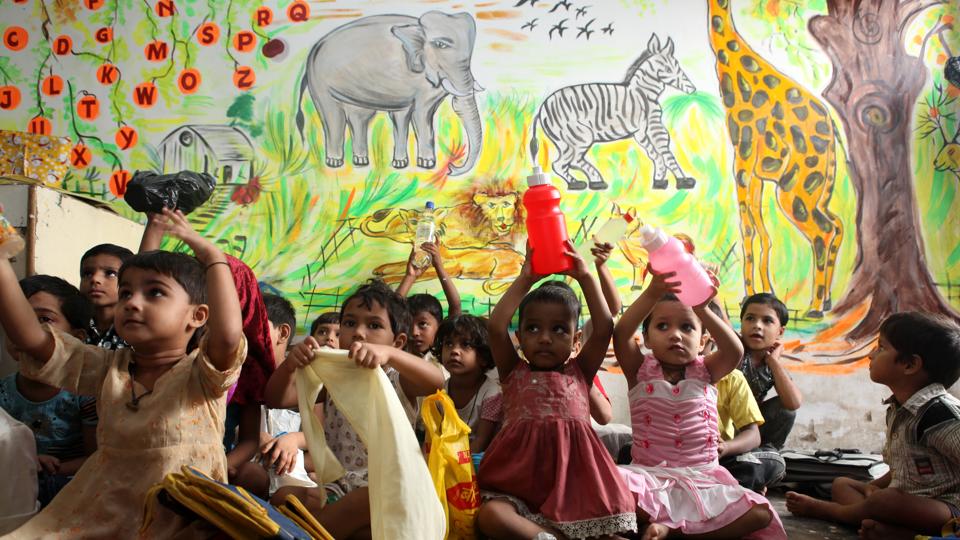
India already has the world’s largest early learning system — let’s make it a high-quality one. (HT Photo)
In recent years, ECCE and preschool have become a singular policy focus in the developed world, thanks to advances in neuroscience demonstrating that 90% of brain development happens in the first six years of life and that building or rupturing of neural connections at this stage impacts advancement throughout life. Add the powerful impact on parental (especially women’s) workforce participation, and it is no surprise that experts refer to ECCE as having among the highest “social” returns on investment of any development intervention. Budgets remain a challenge though, even with this new-found focus — in the United States (US), President Joe Biden tried and failed to pass legislation mandating free, universal pre-K even in 2022. India has the opportunity to become the envy of the world, if we plan and execute a five-year journey to convert Anganwadis into a high-quality early learning system, both in their capacity and in the national perception.
What makes this setup uniquely poised for delivery of high-quality ECCE to ensure that all children are school ready and able to read and do basic maths by grade 2, rather than only the 50% today?
First, the hard work of institutionalising a network and infrastructure has already been done by women and child development departments at the Centre and state — nearly every child can access an Anganwadi within a short walking distance.
Second, rather than trying to fix an existing education model as is the case with our schools, we have a clean slate and the opportunity to create an effective model from scratch, with the added benefit of learning from our past failures in schools.
Third, the Anganwadi sevika’s natural motivation and outlook — she is from the community and vested and accountable for its success, she is less “qualified” and, therefore, hungrier for certification and more open to learning — is important, given the public sector’s lack of financial incentives and constrained governance mechanisms. Macro factors are supportive — digital support through phones is accessible to nearly all sevikas (compared to 20% four years ago), ECCE concepts are more fundamental and accessible as compared to higher grades, and new sevikas are recruited with much better education backgrounds.
Finally, ECCE is a policy focus across India and governments at national and state levels are working aggressively to find solutions.
What more is required? The ICDS needs a massive perception overhaul to be considered an education system, in addition to its traditional functioning of nutritional and health support, in the eyes of both its clients (parents and communities) and its own (from sevika to the political and bureaucratic leadership). As part of this, the Anganwadi centre’s branding must change from currently “daliya centres” to centres of quality nutrition and education delivery. This mindset change will need to be accompanied by quality inputs in the form of more staffing, upgraded buildings and teaching learning materials. Currently, per-child budgets are much lower than in schools — finance departments need to loosen their purse strings, and politicians across the board need to realise that a mission-mode approach to improving ECCE will be a big vote winner. India already has the world’s largest early learning system — let’s make it a high-quality one.
Siddhant Sachdeva and Azeez Gupta serve on early childhood education task forces at the state and national level respectively, and are co-founders of Rocket Learning, a non-profit supporting a million children with universal high-quality early learningThe views expressed are personal

 E-Paper