Just Like That | Notes on biting political humour and morality in an immoral age
Of one of my first postings to a dictatorship, where people mocked leaders in private, and complied with the regime in public; and the release of a new book on the dilemma of doing the right thing even in very difficult circumstances.
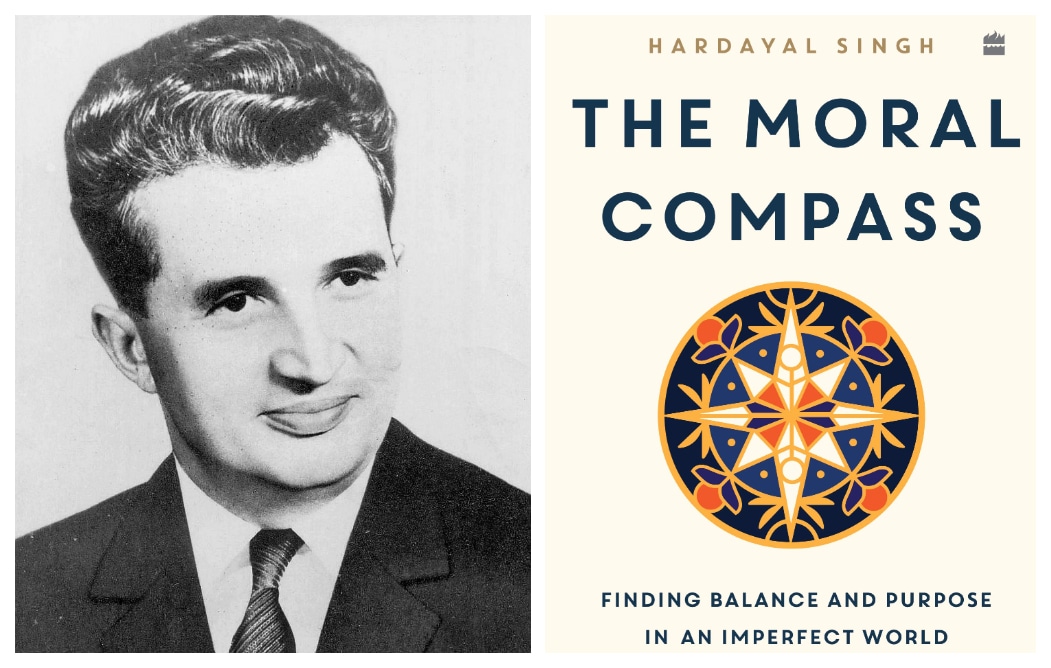
Nicolae Ceausescu, the general secretary of the Romanian Communist Party (1965-1989) and Hardayal Singh's The Moral Compass. (Wikimedia Commons (L)/Amazon.in)
My first postings in the Indian Foreign Service were in east Europe: Bulgaria, Romania, and later Moscow. This was in the era before the Berlin Wall came down, and when the Cold War was in full swing. East Europe, and the then Union of Soviet Socialist Republics (USSR), were communist dictatorships, with no freedom of expression or dissent.
Romania, undoubtedly, was perhaps the worst. Nicolae Ceausescu, the general secretary of the Romanian Communist Party for almost 25 years (1965-1989), was a ruthless dictator, who snuffed out even a whiff of dissent. He was "elected" every time unanimously, and ruled over this beautiful country with a brutal hand, as though it was his personal fiefdom.
Ordinary Romanians had no means to express their anguish or anger. It was in these circumstances that humour became their only instrument of protest. Not publicly, of course, because retribution would be swift and harsh, but in private. These jokes were woundingly satirical, the only way a repressed people could express their resentment. If a joke was cracked in the morning, by evening it would be on almost everybody’s lips, by the power of sheer word of mouth, since there was no internet or social media. People mocked in private, and complied with the regime in public.
One joke that was very popular was this one: Ceausescu falls in love madly with French actress, Bridgette Bardot. She resists his advances, but he is persistent. Finally, she says, "Ok, Nicu, I will marry you but on one condition. You must allow for free emigration from Romania." Hearing this, Ceausescu blushes deeply. With a shy look on his face he says, "Oh darling, you are so clever. You want to live all alone with me in Romania!"
Another one was even more biting, hitting squarely at the authoritarian regime. This joke surfaced just after the communist regime had raised prices yet again on essential commodities. It goes like this: Two policemen are patrolling at night. One of them asks the other, "Brother, what do you think of this price hike?" The other one replies, "What can I say, brother? The same as you," at which the first policeman says, "In that case, brother, you are under arrest!"
Ceausescu died a violent death. In December 1989, he ordered the army to fire at Romanians protesting economic deprivation. Many either died or were injured. Riots broke out across the country. The capital Bucharest was besieged. Ceausescu and his wife tried to flee in a helicopter, but were arrested by the army, which had joined the people. They were summarily tried for economic sabotage and genocide, and executed by firing squad on December 25, 1989.
There is a lesson in this for all dictators. The wheels of history may move slowly, but finally, deliver justice. Tyranny, however seemingly invincible, is never permanent. The will of the people ultimately prevails.
The Moral Compass
This was the title of a book that was released in New Delhi last week. Its author, Hardayal Singh, was a member of the Indian Revenue Service, who retired as chief commissioner of income tax in New Delhi. He had a reputation for being scrupulously honest, even in a department that otherwise enjoys certain notoriety.
The Moral Compass is about the dilemma of doing the right thing even in very difficult circumstances. The book is a collection of 17 short stories, about people who have to decide what to do when acting ethically could very well have adverse consequences. Dharma in the Hindu worldview is a very sophisticated concept. It lays down a normative framework for correct behaviour, but judges the final choice in terms of the context of the situation. Unlike Christianity, there are no 10 commandments in Hinduism, and hence, no absolutisms in pronouncing a verdict of innocent or guilty. For instance, if a starving man on the verge of losing his life, takes an apple from an overhanging branch of a rich man’s orchard, is he committing theft, or only acting to save his life? An individual must act according to his or her conscience, viveka, in any given situation, and face the consequences of that action.
I spoke at the launch along with Shyam Saran, former foreign secretary, and Gurcharan Das, noted author and economist. I raised the question of whether Indians are predisposed to act ethically, or do so only under compulsion or fear. Do they follow Mahatma Gandhi’s dictum of the means being as important as the end, or are only concerned about the end — be it status, wealth or power? It was an engrossing discussion, with spirited audience participation. I think that, in these times, when all principles and morality seem to have evaporated, this book should be read by as many people as possible.
Pavan K Varma is author, diplomat, and former Member of Parliament (Rajya Sabha).
Just Like That is a weekly column where Varma shares nuggets from the world of history, culture, literature, and personal reminiscences with HT Premium readers

 E-Paper