Just Like That | Notes on nostalgia, a must-read book and important translations
Remembering a serendipitous evening in my house with a very talented ghazal singer; necessary reading on the forced displacement caused by Partition; and young colleague's work in translating his grandfather's work.
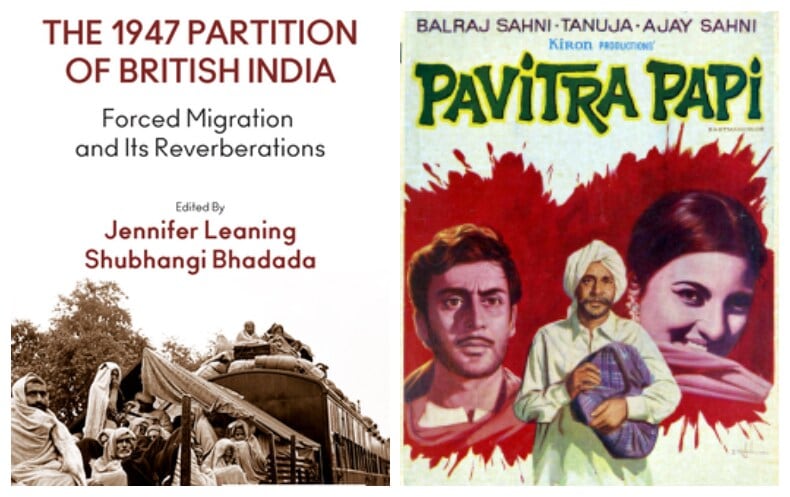
The 1946 Partition of British India (L). Pavitra Papi.
Many years ago, the renowned Kathak maestro Uma Sharma told me that she had learnt of a lady who used to run her own kotha in Old Delhi, and now lived in shabby anonymity in Jangpura, a residential area in south Delhi. This lady, whose name was Mushtari Bai, had a huge repertoire of ghazals and thumris, and at one time, commanded owners of Bentleys and Rolls Royces at her establishment in the walled city. Uma said that we should organise one evening, where she would sing again.
That memorable evening was arranged at my home. Mushtari Bai, now pushing her 60s, arrived with her tabla and sarangi vadak. I had invited some close friends. The mehfil was set. To begin with, Mushtari was a little reticent, as anyone would be who has not performed for a long time. But the audience was appreciative, and gradually, she got into form. Her voice was seductive and trained, and the numbers she sang came down from the hallowed traditions of the best of the past. We saw then what Mushtari must have been like in her heyday. Her eyes flashed, her nose pin — probably artificial — sparkled, her eyebrows heaved, her eyes darted enticingly, as did her smiles and sidelong glances. If we closed our eyes, this could have been the dazzling young Mushtari Bai singing to the rich and powerful in her exclusive kotha in the walled city some decades ago.
I don’t think Delhi has had an evening quite like this. By a strange serendipity, as Mushtari was singing, the internationally acclaimed photographer, Raghu Rai, was taking pictures, one of India’s leading artists, Jatin Das, was sketching, the legendary singer, Naina Devi, was playing the harmonium, and Uma Sharma was doing bhava sitting next to the performer.
The recreation of the past brings its own sense of nostalgia and wistfulness, especially since we know that it is irrevocably gone. The patrons are no more, the artists of yore languish in penury if they are still alive, the Urdu tehzibyat has long evaporated, and the ambience of the intimate baithak is seriously endangered. We live in a time of SMSes and instant communication, where emotions have rarely the luxury of relaxed, melodious elaboration.
Priya Paul's and Sethu's dinner
This week, I received an invitation for dinner from Priya Paul, the chairperson of the The Park chain of hotels. Priya and her husband, Sethu Vaidyanathan, are old friends. They have a beautiful home, and are charming and welcoming hosts. This evening was especially organised to meet Professor Jennifer Leaning of the Public Health department of Harvard, and Hitesh Hathi, of the Lakshmi Mittal and Family South Asia Institute, also at Harvard University.
After several years of research by Professor Leaning, the Mittal Institute’s project on the 1947 Partition of India has culminated in a book, The 1947 Partition of India: Forced Migration and its Reverberations. It was fascinating to hear both the scholars talk about the meticulous research they had done on Partition, a subject that has not received the scholarship it deserves. Professor Leaning said that according to her demographic research, backed both by data and human testimony, some 18 million were displaced in this man-made tragedy, and around three million were killed. These figures, revealed for the first time, make the Partition the biggest displacement of human beings in recorded history.
It is a book that needs to be read.
Ambassador Navdeep Suri and Nanak Singh
Navdeep Suri is a younger and very capable colleague of mine in the Indian Foreign Service. Navdeep has done a great service by giving new life to the iconic writings of his grandfather, Nanak Singh (1897-1971), poet, song-writer and best-selling novelist from Punjab. Nanak Singh witnessed British rule, and the trauma of Partition, and chronicled them with a pathos and lyricism that will stand the test of time. One of his novels, Pavitra Papi (The Watchmaker) was made into a well-received film, starring the great thespian, Balraj Sahni.
Navdeep has translated into English Pavitra Papi, and other works, including Adh Khidiya Phul (An Incomplete Life) and Nanak’s long lost and powerful poem, Khooni Baisakhi (Bloody Spring), that recalls the horrors of the British massacre of innocent Indians at Jallianwala Bagh in 1919.
I enjoyed the discussion on Navdeep’s translations and the Partition at Kunzum, a popular literary salon run by Ajay Jain. Sanjoy Roy, leading event impresario and director of the Jaipur Literary Festival, was in conversation with Navdeep, the noted singer Sonam Kalra (whose both grandparents came to India after Partition), Suvir Saran, Michelin star chef and writer, and oral historian Aanchal Malhotra.
Pavan K Varma is author, diplomat, and former Member of Parliament (Rajya Sabha).
Just Like That is a weekly column where Varma shares nuggets from the world of history, culture, literature, and personal reminiscences with HT Premium readers

 E-Paper